1. Introduction: The Architecture of “Ancestral Satiety”
In the vast, hyper-processed taxonomy of modern breakfast, the Old-Fashioned Pancake stands as a landmark study in “Fundamental Starch-Hydration.” While contemporary “Box-Mixes” rely on industrial stabilizers and artificial emulsifiers to achieve a uniform texture, the “Old-Fashioned” variety is an exercise in “Manual Leavening and Lipid-Bound Moisture.”
This document serves as the “Structural Manifesto” for the dish. We move beyond the rudimentary “just-add-liquid” logic and enter the realm of “Gluten-Relaxation Physics.” By utilizing a specific “Resting Window” and a “Low-Friction Mixing” technique, we create a result that is “Diner-Dense” yet “Pillow-Soft.” For the high-performance host, the weekend ritualist, or the culinary minimalist, this is the “Platinum Standard” of comfort utility: it delivers a “High-Resolution” flavor profile that evokes the nostalgic “Malt-and-Butter” baseline of the early 20th-century American kitchen.
2. The Science of “Lump-Integrity” and Expansion
To master the Old-Fashioned Pancake, one must understand the behavior of Gluten Development under Minimal Agitation.
- The Gluten-Trap: When flour meets liquid, glutenin and gliadin proteins begin to form a network. In bread, this is desired for chew. In pancakes, excessive gluten creates a “Rubbery-Matrix.”
- The “Lump” Philosophy: Paradoxically, a perfect pancake batter must contain small lumps of dry flour. These “Flour-Pockets” prevent the gluten from forming a continuous chain, ensuring a “Short-Crumb” (tender) texture.
- The Binary Leavening: We utilize Baking Powder to drive vertical lift. The chemical reaction releases carbon dioxide gas upon hydration and again upon thermal exposure. This “Double-Action” ensures the pancake “Inflates” the moment it contacts the radiant heat of the griddle.
3. The Blueprint Overview: Technical Specifications
- Cuisine Type: Classic Americana / Heritage Breakfast
- Difficulty Level: Easy (Focus on “Mixing Restraint”)
- Total Preparation Time: 10 Minutes
- Batter-Resting Phase: 10 Minutes (Mandatory for “Starch-Settling”)
- Total Cooking Time: 15 Minutes
- Total Time: 35 Minutes
- Dietary Classifications: High-Carbohydrate Comfort.
- Yield: 10–12 Large Pancakes
4. Equipment and Tools: The Essentials of “Thermal Distribution”
- Heavy-Gauge Cast Iron Griddle: The Gold Standard. Cast iron provides a “Thermal Reservoir” that prevents temperature drops when cold batter is applied.
- Whisk and Large Silicone Spatula: For the “Low-Agitation” fold.
- 1/4 Cup Measure: To ensure “Volumetric Symmetry” for even stacking.
- Wide Stainless-Steel Spatula: For the “Single-Motion” flip.
5. Ingredients Section: Sourcing for “Buttery-Base” Resolution
In a dish defined by its simplicity, the “Fat-Quality” and “Flour-Protein Content” dictate the final “Sensory Resolution.”
The “Dry-Scaffold”
- All-Purpose Flour: 1.5 cups. (Avoid Bread Flour; the protein content is too high for a tender pancake).
- Baking Powder: 3.5 tsp. (A generous amount is required for the “Old-Fashioned” lift).
- Granulated Sugar: 1 tbsp. (Not for sweetness, but to aid the browning process for a golden crust).
- Salt: 1 tsp. (To provide the “Savory-Counterpoint” to the syrup).
The “Liquid-Emulsion”
- Whole Milk: 1.25 cups. (The “Lipid-Carrier”).
- Egg: 1 large. (The “Protein-Binder” and “Color-Driver”).
- Unsalted Butter: 3 tbsp, melted. (For “Nutty-Depth”).
- Vanilla Extract: 1 tsp. (The “Aromatic-Anchor”).
6. The “Low-Agitation” Protocol: Mastering the Crumb
The primary failure point of an old-fashioned pancake is “Over-Mixing.” To achieve a “Master-Tier” result, you must utilize the “Sequential-Well Technique.”
- The Dry-Synthesis: Whisk all dry ingredients until “homogeneously aerated.”
- The Central-Well: Create a deep crater in the center of the flour.
- The Rapid-Fold: Pour the liquid emulsion into the well. Use a spatula to fold the dry into the wet using no more than 12–15 strokes. 4. The Stop-Point: Stop while you still see “Streaks of Flour.” This is the “Safety-Zone” for gluten management.
7. The “Hydration-Window”: Why Resting Matters
One of the most overlooked steps in pancake engineering is the 10-minute rest.
- The Science: During this phase, the starch granules in the flour fully “Hydrate,” absorbing the milk.
- The Result: This thickens the batter naturally and allows the baking powder to begin its “First-Action” bubbles. If you cook the batter immediately, the pancakes will be thin and “leaky.” If you rest the batter, they will be “Architecturally Tall.”
8. Step-by-Step Instructions: The Master Execution
Step 1: The “Melt-and-Cool” Cycle
Melt your butter and let it cool slightly. If you add “Scald-Hot” butter to your cold milk and egg, it will “Crystallize” into small fat-beads, resulting in an uneven “Lipid-Distribution.”
Step 2: The “Well-Synthesis”
Follow the Low-Agitation Protocol (Section 6). Remember: Lumps are a sign of “Structural Success.”
Step 3: The “Hydration-Rest”
Set the batter aside for 10 minutes. Use this time to preheat your griddle.
Step 4: The “Thermal-Calibration”
Heat the griddle to Medium-High (190°C / 375°F).
- The “Water-Bead” Test: Flick a drop of water onto the surface. If it “Dances” and evaporates instantly, the thermal mass is ready for deployment.
Step 5: The “Deployment”
Lightly grease the griddle with a “Lipid-Film” (butter or oil). Pour 1/4 cup of batter. Do not spread it; let “Gravity-Dynamics” define the circle.
Step 6: The “Bubble-Threshold” Flip
Cook until bubbles form on the surface and pop, leaving small “Craters” that do not immediately fill back in. This is the “Internal-Set” signal. Flip once.
Step 7: The “Golden-Amber” Finish
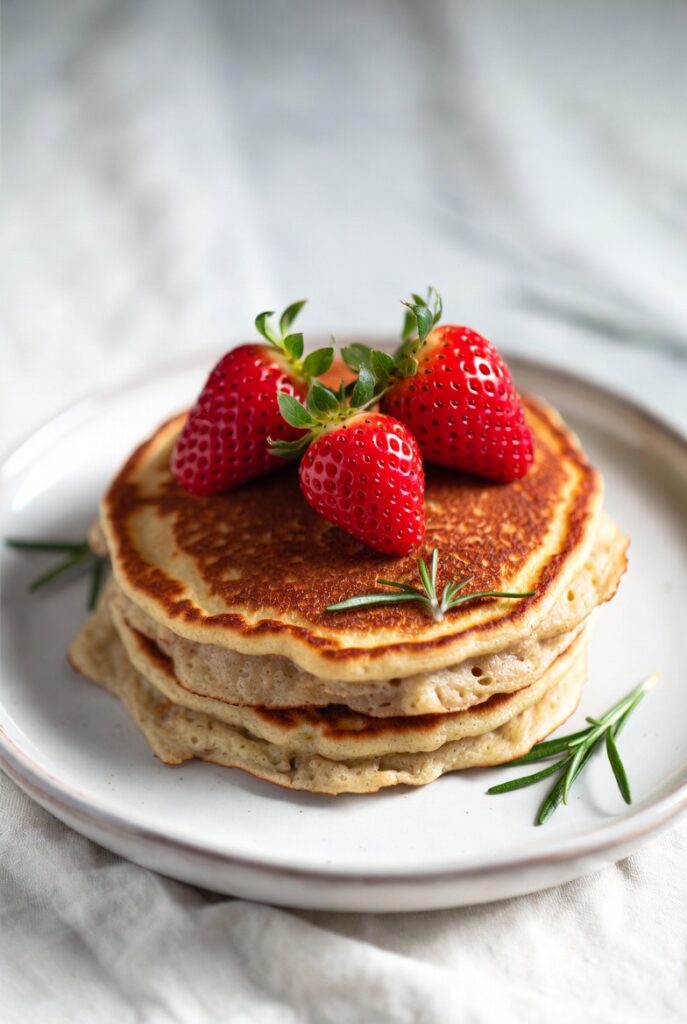
Cook the second side for only 60–90 seconds. The second side will never be as perfectly uniform as the first; this is the “Authentic-Asymmetry” of a handmade pancake.
9. Satiety and the “Glucose-Lipid” Equilibrium
Old-Fashioned Pancakes provide a “High-Resolution Satiety” profile:
- The Immediate Carb-Reward: The soft starch provides an immediate “Sensory Comfort.”
- The Fat-Buffer: The whole milk and butter provide the “Satiety-Lipids” that prevent the “Glucose-Spike” from being too rapid.
- The Protein-Anchor: The egg provides the “Amino-Binding” necessary for a long-lasting fullness.
10. Modular Customization: The “Flavor Pivots”
- The “Blueberry-Inclusion” Draft: Drop fresh berries onto the batter after pouring it on the griddle. This prevents the “Berry-Bleed” from turning the batter purple.
- The “Buttermilk-Shift”: Replace milk with buttermilk and reduce baking powder to 2 tsp while adding 1/2 tsp baking soda. This creates a “Tangy-Lactic” resolution.
- The “Cinnamon-Swirl” Standard: Add 1 tsp of cinnamon to the dry-scaffold for a “Warm-Aromatic” finish.
11. Storage and “Thermal Recovery”
- Refrigeration: Store in an airtight container for up to 3 days.
- The Recovery Method: Avoid the microwave for the best experience. To restore the “Lace-Crisp” edges, reheat in a toaster oven or a dry pan over low heat.
- Freezing: These are “Batch-Stable.” Freeze with parchment paper between layers for up to 2 months.
12. Frequently Asked Questions (FAQ)
Q: Why is my first pancake always “Sub-Standard”?
A: This is the “Surface-Seasoning” phenomenon. The first pancake absorbs the excess surface oil and “Calibrates” the griddle temperature. Consider it a “Sacrificial Calibration.”
Q: Can I use Whole Wheat flour?
A: Affirmative. However, you must increase the milk by 2 tbsp, as whole wheat is more “Hydroscopic” and will absorb more moisture.
Q: My pancakes are flat. What happened?
A: Your baking powder is likely “Chemically-Inactive.” Test it by dropping a teaspoon into hot water; if it doesn’t “Violently-Fizz,” it’s time to replace your leavening agent.
13. Nutritional Information
(Per serving – 3 Large Pancakes)
| Nutrient | Amount |
| Calories | 420 kcal |
| Protein | 10g |
| Total Fat | 16g |
| Net Carbs | 58g |
| Calcium | 15% DV |
14. The “Visual Gravity” of Presentation
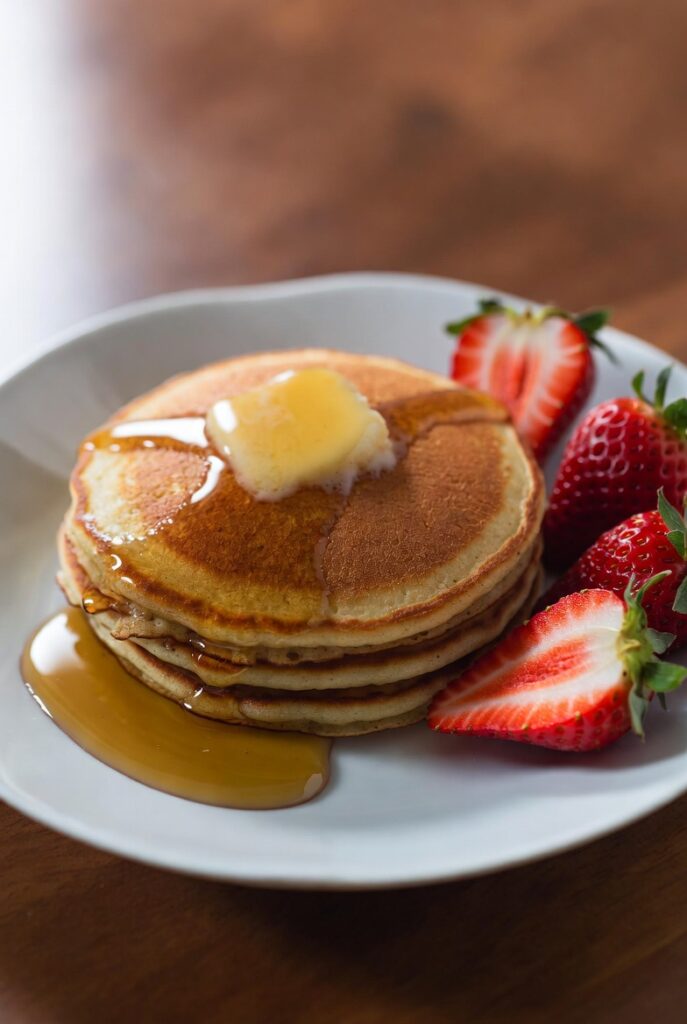
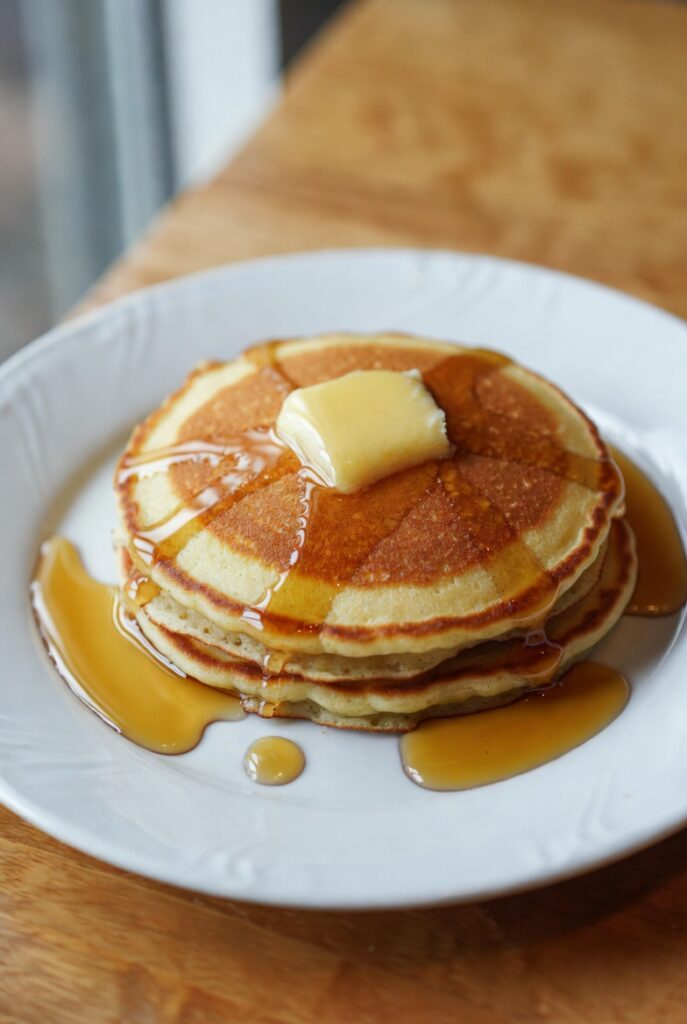
- The Stack: Arrange in a “Vertical-Column” of three.
- The “Butter-Crown”: Place a single “Cold-Pat” of butter on the top; the residual heat will create a “Lava-Flow” of lipids down the sides.
- The Syrup-Resolution: Use Grade A Amber Maple Syrup. Pour in a “Concentric-Circle” to ensure even “Syrup-Saturation.”
15. Conclusion: The Master Draft of Heritage Utility
The Golden-Ratio Protocol is more than a recipe; it is a “Vessel for Intentional Synergy.” It proves that “Gourmet Results” can be achieved through the mastery of “Gluten-Relaxation” and “Thermal Distribution.” By respecting the “Hydration-Rest” and the “Low-Agitation Protocol,” you are delivering a breakfast that is visually “Amber-and-Gold,” nutritionally dense, and sensorially perfect.
It is the ultimate “Morning Anchor”—a “Sweet-and-Savory” testament to the power of simple ingredients, thoughtfully aligned.