1. Introduction: The Architecture of “Cylindrical Comfort”
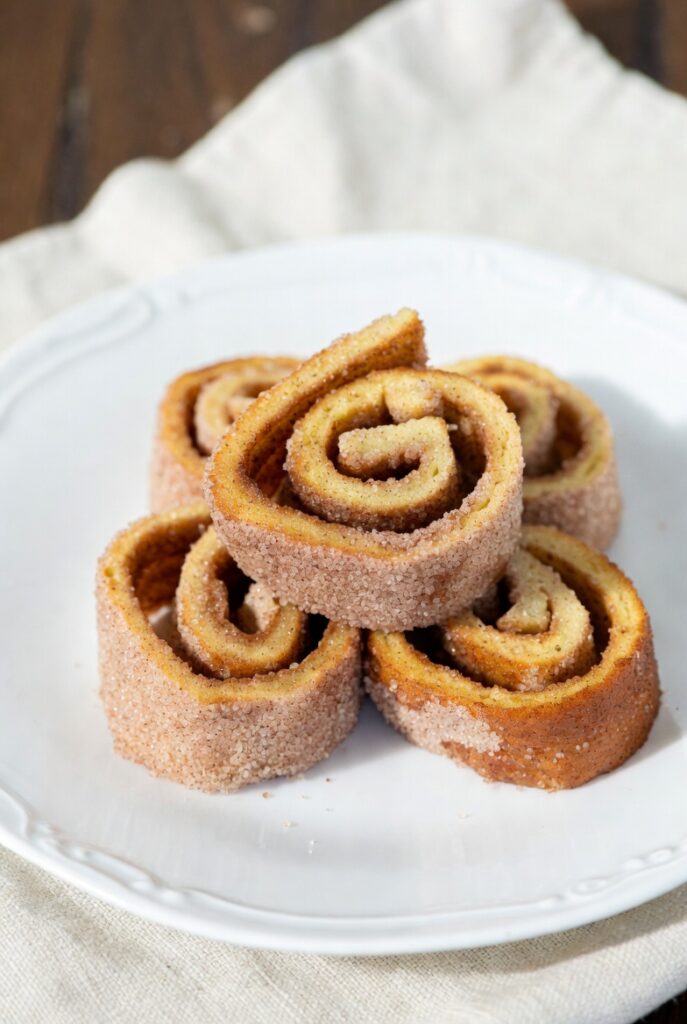
In the evolving taxonomy of brunch-tier gastronomy, the Cinnamon Sugar French Toast Roll-Up represents a landmark study in “Structural Starch Re-Engineering.” While traditional French toast relies on the “Planar Absorption” of a flat slice of bread, the Roll-Up utilizes a “Toroidal Configuration.” This geometric shift allows for a 360-degree surface area exposure to the griddle, ensuring a higher ratio of “Maillard-Crisp” crust to “Custard-Soft” interior.
This document serves as the “Structural Manifesto” for the dish. We move beyond the rudimentary “bread-and-egg” logic and examine the mechanics of “The Compression Bond.” By utilizing the tensile strength of white bread and a specific “Seam-Seal” technique, we create a result that is “Sugar-Laced” and “Zero-Friction.” For the high-performance host, the parent seeking “Toddler-Utility,” or the culinary strategist, this is the “Platinum Standard” of handheld breakfast engineering.
2. The Science of “Capillary Saturation” and Tension
To master the French Toast Roll-Up, one must understand the behavior of Starch-Fiber Compression.
- The Flattening Phase: By rolling the bread flat with a pin, we collapse the “Air-Pockets” (the crumb). This creates a high-density “Starch-Sheet” that acts as a structural scaffold. Without this step, the bread would absorb too much egg wash and lose its “Tensile Integrity,” resulting in a structural failure (tearing) during the roll.
- Capillary Action: Once the bread is rolled around a filling, it creates a “Cylinder.” When dipped into the custard, the liquid enters the outer layers via capillary action but is blocked from reaching the core by the compressed density of the roll. This ensures the center remains hot and “Gooey” while the exterior becomes “Fried-Gold.”
- The Adhesion-Gap: The cinnamon-sugar coating isn’t merely a flavoring; it acts as a “Textural Friction-Layer.” When applied post-cook, it creates a “Micro-Crunch” that contrasts with the “Elastic-Tender” bread fibers.
3. The Blueprint Overview: Technical Specifications
- Cuisine Type: Modern American / Handheld Brunch
- Difficulty Level: Easy (Focus on “Rolling Tension”)
- Total Preparation Time: 15 Minutes
- Total Cooking Time: 10 Minutes
- Total Time: 25 Minutes
- Dietary Classifications: High-Carbohydrate, Kid-Friendly.
- Yield: 10–12 Roll-Ups
4. Equipment and Tools: The Essentials of “Cylindrical Precision”
- Rolling Pin or Smooth Bottle: To achieve the “Starch-Collapse” required for a flexible roll.
- Non-Stick Griddle or Large Skillet: To ensure a “Zero-Friction” rotation during the cooking phase.
- Shallow Wide Bowl: For the “Custard-Drip” phase. The width of the bowl must exceed the length of the roll.
- Kitchen Tongs: Essential for the “Rotational-Sear” technique.
5. Ingredients Section: Sourcing for “High-Contrast” Resolution
The “Elasticity” of your bread dictates the final “Structural Integrity” of the cylinder.
The “Starch Scaffold”
- Soft White Sandwich Bread: 12 slices. (Brioche or standard white bread works best due to high “Pliability”).
- Cream Cheese: 4 oz, softened. (The “Adhesive Core”).
- Fruit Inclusion (Optional): Finely diced strawberries or blueberries.
The “Custard-Emulsion”
- Large Eggs: 2 units. (The “Protein-Binder”).
- Whole Milk: 1/4 cup. (The “Liquid-Carrier”).
- Vanilla Extract: 1 tsp.
- Cinnamon: 1/2 tsp.
The “Friction-Coating”
- Granulated Sugar: 1/2 cup.
- Cinnamon: 1 tbsp.
- Salted Butter: 3 tbsp (for the griddle).
6. The “Compression-Roll” Protocol: Mastering the Seal
The primary failure point of a French toast roll-up is “Unravelling” on the griddle.
- The Perimeter Clear-Zone: Spread your filling (cream cheese/fruit) across the bread, but leave a 0.5-inch margin at the top edge.
- The “Tension-Tuck”: Start rolling from the bottom as tightly as possible. You want to feel “Lateral Resistance.”
- The “Egg-Glue”: Dab a tiny amount of the egg custard onto the final 0.5-inch margin. This acts as a “Pressure-Activated Sealant” that locks the roll together before it ever hits the pan.
7. Deep Dive: Thermal Management and “Rotational Searing”
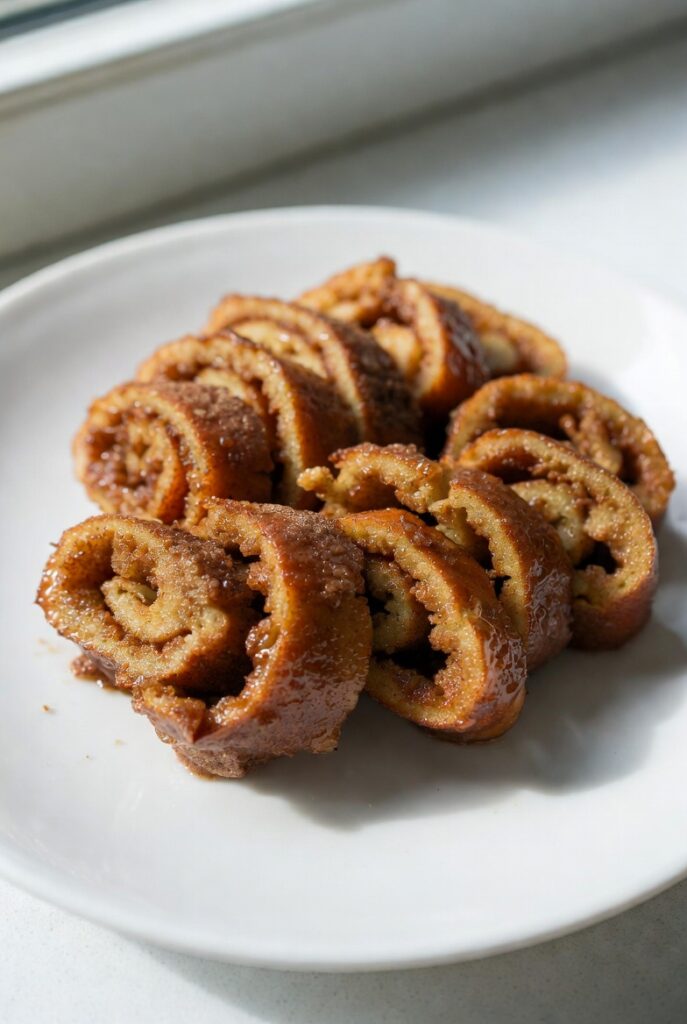
Unlike standard French toast, which is cooked on two sides, the Roll-Up is a cylinder that requires a “Four-Quadrant Sear.”
- The Medium-Heat Threshold: Operate at 175°C (350°F). Because the bread is compressed, high heat will char the sugar before the internal cream cheese reaches its “Melting-Point.”
- The “Seam-First” Deployment: Always place the roll onto the griddle with the seam-side down. The heat will immediately “Cauterize” the egg-seal, locking the roll into its permanent toroidal shape.
8. Step-by-Step Instructions: The Master Execution
Step 1: The “Crust-Removal” and “Flattening”
Trim the crusts from all 12 slices of bread. Use your rolling pin to flatten the bread into thin, dense squares.
- The Logic: Crusts lack “Flex-Elasticity” and will cause the roll to crack during the “Tension-Tuck.”
Step 2: The “Adhesive-Load”
Spread a thin layer of cream cheese on the bottom third of the bread. Add your fruit or a sprinkle of cinnamon-sugar.
Step 3: The “Tension-Tuck” Execution
Follow the Compression-Roll Protocol (Section 6). Ensure each roll is a tight, uniform cylinder.
Step 4: The “Custard-Submersion”
Whisk the egg, milk, vanilla, and cinnamon.
- The Submersion Rule: Do not “Soak” the rolls. A quick 3-second roll through the custard is sufficient. Over-saturation will cause the compressed starch to expand and fall apart.
Step 5: The “Rotational-Sear”
Melt butter on the griddle. Place rolls seam-side down. Use tongs to rotate the rolls 90 degrees every 60 seconds until all sides are “Glistening-Gold.”
Step 6: The “Sugar-Encapsulation”
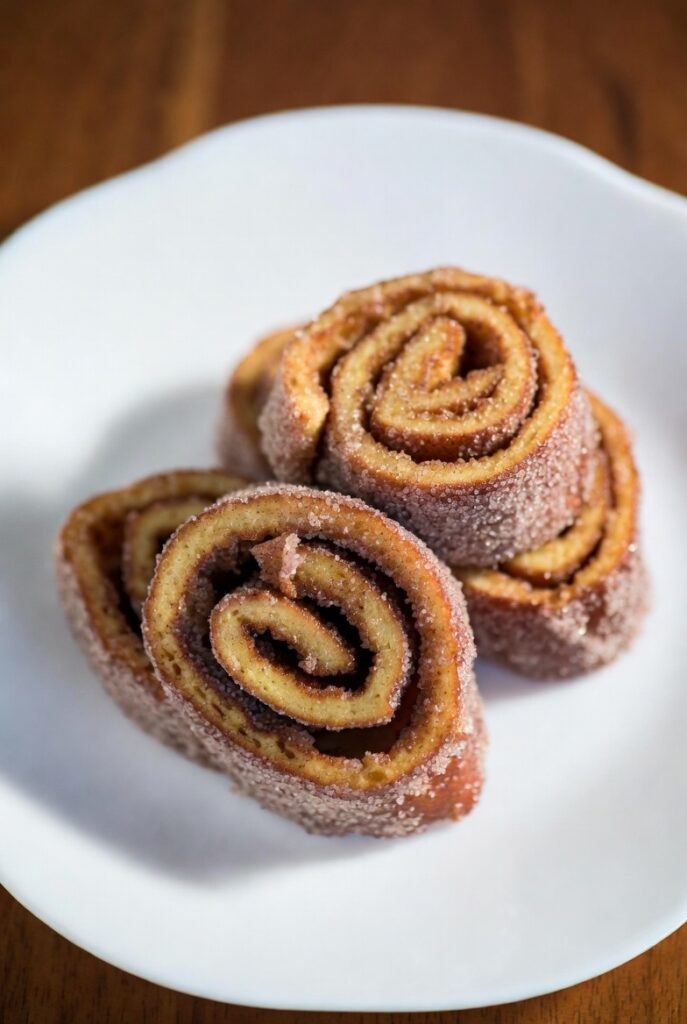
Immediately upon removal from the heat, toss the rolls in the cinnamon-sugar mixture.
- The Thermal-Stick Logic: The residual heat from the butter will melt the sugar slightly, creating a “Crystalline-Shell” that adheres to the bread.
9. Satiety and the “Glucose-Lipid” Arc
French Toast Roll-Ups provide a “High-Resolution Satiety” profile:
- The Handheld Reward: The “Bite-Sized” nature encourages “Mindful Consumption.”
- The Lipid Anchor: The cream cheese core provides “Long-Form” fats that slow the absorption of the bread’s simple starches.
- The Sensory Multiplier: The combination of the “Crunch” (sugar), the “Elastic” (bread), and the “Goo” (filling) hits multiple “Texture-Nodes” in the brain, leading to faster “Sensory Satiety.”
10. Modular Customization: The “Flavor Pivots”
- The “Nutella-Draft”: Replace cream cheese with hazelnut cocoa spread for a “Deep-Umami” sweetness.
- The “Apple-Pie” Shift: Use sautéed cinnamon apples in the core for a “Fruit-Fiber” boost.
- The “Savory-Platinum” Utility: Omit the sugar coating and fill with ham and swiss cheese for a “Monte Cristo” variation.
11. Storage and “Thermal Recovery”
- Refrigeration: Store in an airtight container for up to 3 days.
- The Recovery Method: The Air Fryer is Mandatory. To restore the “Crystalline-Shell,” reheat at 180°C (350°F) for 3 minutes. A microwave will make the sugar “Syrupy” and the bread “Soggy.”
12. Frequently Asked Questions (FAQ)
Q: Why did my roll-up unspool in the pan?
A: You likely skipped the “Egg-Glue” step or didn’t place it seam-side down first. The initial heat is what “Welds” the bread together.
Q: Can I leave the crusts on?
A: Negative. Crusts are the “Structural Enemy” of the roll-up. They are too dry to bend and will cause the roll to “shatter” during assembly.
Q: Is there a way to make these “Low-Sugar”?
A: Affirmative. Replace the sugar coating with a dusting of monk fruit sweetener or simply serve with a side of high-protein Greek yogurt for dipping.
13. Nutritional Information
(Per serving of 3 Roll-Ups)
| Nutrient | Amount |
| Calories | 340 kcal |
| Protein | 9g |
| Total Fat | 14g |
| Net Carbs | 42g |
| Sodium | 290mg |
14. The “Visual Gravity” of Presentation
- The “Radial-Mandala”: Arrange the roll-ups in a circle on a dark plate, points facing inward.
- The “Dipping-Centroid”: Place a small bowl of maple syrup or yogurt in the center of the plate.
- The “Dusting-High-Note”: A final sprinkle of powdered sugar through a sieve provides a “Snow-Capped” contrast to the amber cinnamon.
15. Conclusion: The Master Draft of Handheld Utility
The Toroidal Tension Protocol is more than a recipe; it is a “Vessel for Intentional Synergy.” It proves that “Gourmet Results” can be achieved through the mastery of “Starch-Compression” and “Rotational Searing.” By respecting the “Seam-Seal” and the “Four-Quadrant Sear,” you are delivering a breakfast that is visually “Golden-and-Bold,” nutritionally dense, and sensorially perfect.