1. Introduction: The Architecture of “Lipid-Fiber Synergy”
In the sophisticated taxonomy of breakfast gastronomy, the Mediterranean Veggie Scramble stands as a landmark study in “Volumetric Satiety.” Unlike the standard American scramble, which often over-indexes on high-fat proteins (bacon/sausage), this protocol utilizes a “Polychromatic Vegetable Matrix” to provide bulk, micronutrients, and a “High-Resolution” flavor profile without excessive caloric density.
This document serves as the “Constitutional Blueprint” for the dish. We move beyond the rudimentary “eggs-in-a-pan” logic and examine the mechanics of “The Moisture-Sequestration Technique.” By managing the high water content of Mediterranean vegetables, we prevent the “Weeping Egg” phenomenon, ensuring a “Custard-Soft” finish. For the high-performance athlete, the health-conscious gourmet, or the “Zero-Friction” meal prepper, this is the “Platinum Standard” of morning utility.
2. The Science of “Phytochemical Integration”
To master the Mediterranean Scramble, one must understand the behavior of Vegetable-to-Egg Moisture Ratios.
- The Water-Release Problem: Vegetables like spinach, tomatoes, and mushrooms are over 90% water. If added directly to raw eggs, they release steam during the coagulation phase, breaking the egg’s protein bonds and resulting in a “Soggy-Plate” failure.
- The Pre-Sauté Phase: By subjecting the vegetables to a high-heat “Dry-Sauté” before adding the eggs, we induce the Maillard Reaction and evaporate excess moisture. This concentrates the vegetable sugars, creating a “Savory-Base” for the eggs to cradle.
- The Coagulation Curve: Eggs denature at roughly 63°C (145°F). By integrating pre-cooked vegetables, we ensure the eggs cook quickly and evenly without the vegetables remaining raw or the eggs becoming rubbery.
3. The Blueprint Overview: Technical Specifications
- Cuisine Type: Mediterranean Fusion / Functional Breakfast
- Difficulty Level: Easy (Focus on “Moisture Management”)
- Total Preparation Time: 10 Minutes
- Total Cooking Time: 10 Minutes
- Total Time: 20 Minutes
- Dietary Classifications: Gluten-Free, Low-Carb, High-Fiber, Keto-Friendly.
- Yield: 2 Servings
4. Equipment and Tools: The Essentials of “Thermal Sensitivity”
- 8-Inch Non-Stick Skillet: To ensure a “Zero-Friction” release of the delicate egg proteins.
- Heat-Resistant Silicone Spatula: For the “Constant-Fold” technique required for soft curds.
- Stainless Steel Whisk: To achieve “Nano-Aerate” integration of the yolks and whites.
- Standard Colander: For the triple-rinse of spinach and tomatoes.
5. Ingredients Section: Sourcing for “Chromatographic” Brilliance
In a dish defined by “Visual Density,” the ripeness of the tomatoes and the “Snap” of the peppers dictate the final “Sensory Resolution.”
The “Protein Base”
- Large Eggs: 4 units. (Pasture-raised for a “Vibrant-Gold” yolk).
- Feta Cheese: 2 oz, crumbled. (The “Brine-Driver”).
The “Vegetable Matrix”
- Baby Spinach: 1 cup. (The “Iron-Engine”).
- Cherry Tomatoes: 1/2 cup, halved. (The “Acidic-High-Note”).
- Red Bell Pepper: 1/4 cup, finely diced. (For “Capsaicin-Free” crunch).
- Kalamata Olives: 1 tbsp, sliced. (The “Salty-Lipid” anchor).
- Red Onion: 2 tbsp, minced. (The “Sulfur-Aromatic”).
The “Lipid-Herb” Finish
- Extra Virgin Olive Oil (EVOO): 1 tbsp.
- Fresh Oregano or Parsley: 1 tsp, minced.
- Red Pepper Flakes: A pinch (Optional).
6. The “Constant-Fold” Protocol: Mastering the Curd
The primary failure point of scrambled eggs is “Over-Coagulation” (rubberiness).
- The Low-and-Slow Deployment: Never cook eggs on high heat. You want a “Gentle-Sizzle,” not a “Thermal-Shock.”
- The Spatula-Sweep: Use the spatula to push the cooked eggs from the perimeter toward the center in a “Clockwise-Sweep.” This allows the raw egg “Slurry” to contact the pan surface, creating “Ribboned-Curds.”
- Residual-Heat Logic: Turn off the heat when the eggs are still 85% set. The internal thermal mass will complete the cooking process on the plate, ensuring a “Creamy-Resolution.”
7. Step-by-Step Instructions: The Master Execution
Step 1: The “Vegetable-Reduction” Phase
Heat EVOO in the skillet over medium heat. Add the onions and peppers. Sauté for 3 minutes until softened. Add the tomatoes and cook for 2 minutes until they begin to “Blister” and release their juices.
Step 2: The “Spinach-Collapse”
Add the spinach to the hot pan. Toss until it reaches “Total-Wilt.”
- The Master Hack: If the pan looks dry, add 1 tsp of water. The steam will collapse the spinach in seconds without burning the other vegetables.
Step 3: The “Egg-Aerate” Synthesis
While the vegetables rest on low heat, whisk the eggs with a pinch of salt and pepper. Whisk for at least 30 seconds until the mixture is uniform and slightly foamy.
Step 4: The “Thermal-Integration”
Pour the eggs into the pan over the vegetables. Increase heat slightly to medium-low. Follow the Constant-Fold Protocol (Section 6).
Step 5: The “Feta-Inclusion”
When the eggs are almost set, sprinkle the feta and olives across the top. Fold once to integrate.
Step 6: The “Aromatic-Resolution”
Remove from heat immediately. Garnish with fresh herbs and a final drizzle of raw EVOO to preserve the “Floral-Polyphenols” of the oil.
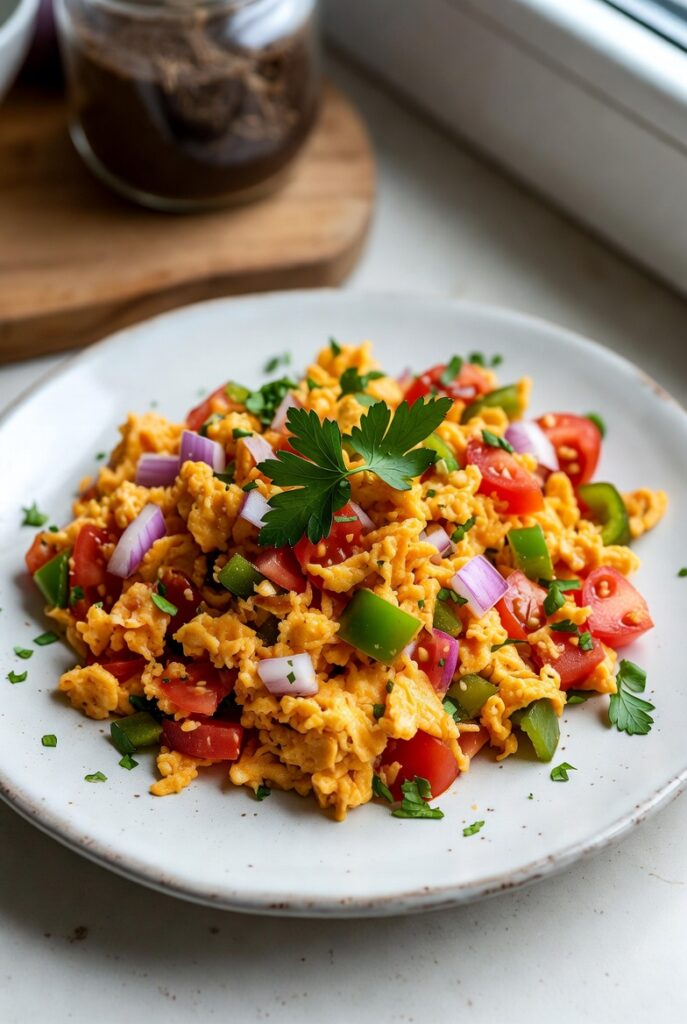
8. Satiety and the “Phytonutrient” Arc
Mediterranean Veggie Scrambled Eggs provide a “High-Resolution Satiety” profile:
- The Fiber-Protein Synergy: The combination of vegetable fiber and egg protein slows gastric emptying, providing a 4–6 hour “Energy-Plateau.”
- The Micronutrient-Density: You are receiving a massive dose of Vitamin K, Vitamin C, and Lycopene before 9:00 AM.
- The “Visual-Fullness” Factor: Because the vegetables add significant volume, your plate looks “Abundant,” tricking the brain into a state of “Early-Satiety.”
9. Modular Customization: The “Flavor Pivots”
- The “Aegean” Draft: Add 1 tsp of capers and replace red onion with shallots for a “Sharper-Acid” profile.
- The “Anatolian” Shift: Add a dollop of Greek Yogurt to the raw egg mixture for an “Ultra-Creamy” resolution.
- The “Harvest” Standard: Add diced zucchini or artichoke hearts to the “Vegetable-Reduction” phase for extra “Fibre-Density.”
10. Storage and “Thermal Recovery”
- Refrigeration: While best fresh, you can store this for 24 hours in a sealed container.
- The Recovery Method: Avoid the microwave. Reheat in a skillet over low heat with 1 tsp of water to “Re-Steam” the eggs and vegetables without making them rubbery.
11. Frequently Asked Questions (FAQ)
Q: Why do my eggs turn “Gray”? A: This is usually due to “Cast-Iron Oxidation” or overcooking. Use a non-stick pan and remove from heat while “Glistening.”
Q: Can I use egg whites only? A: Affirmative. However, you will lose the Lecithin and Vitamin D found in the yolk. Increase the feta slightly to compensate for the lost “Lipid-Richness.”
Q: Should I add milk or water to the eggs? A: Negative. For this specific Mediterranean style, the moisture from the tomatoes and spinach provides enough “Steam-Lift.” Adding extra liquid can lead to a “Watery-Plate.”
12. Nutritional Information
(Per serving)
| Nutrient | Amount |
| Calories | 280 kcal |
| Protein | 18g |
| Total Fat | 19g |
| Net Carbs | 6g |
| Fiber | 2g |
13. The “Visual Gravity” of Presentation
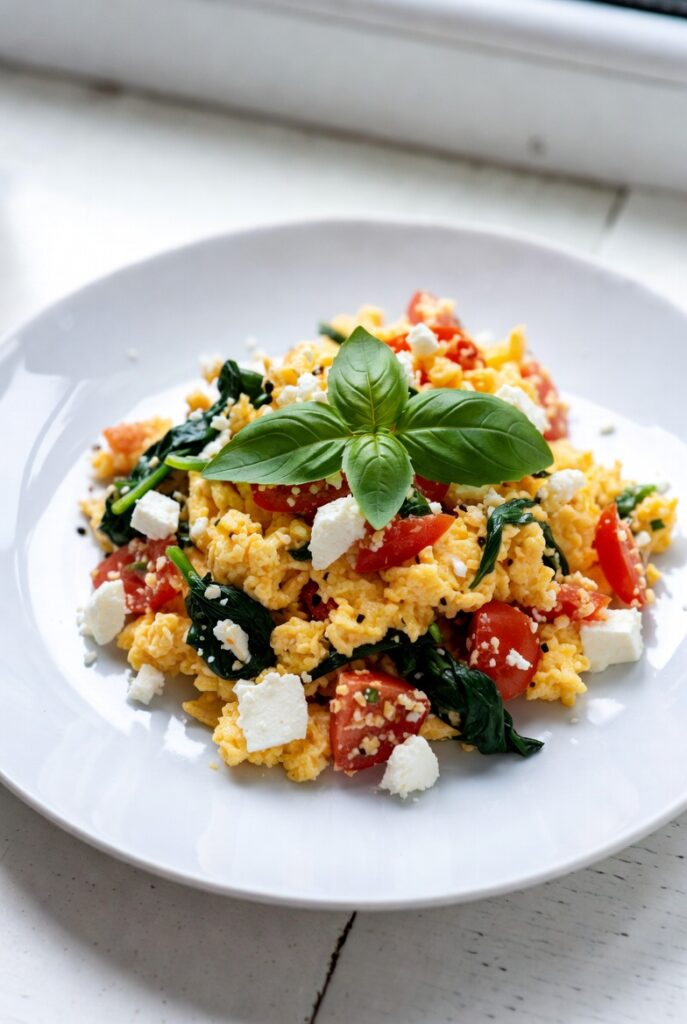
- The Color-Contrast: Serve on a plain white or slate-gray plate to allow the “Ruby” tomatoes and “Jade” spinach to pop.
- The Vertical-Stack: Use a ring mold or simply mound the eggs in the center of the plate to provide “Vertical-Gravity.”
- The Herb-Dusting: Sprinkle the fresh herbs from a height of 10 inches for even distribution.
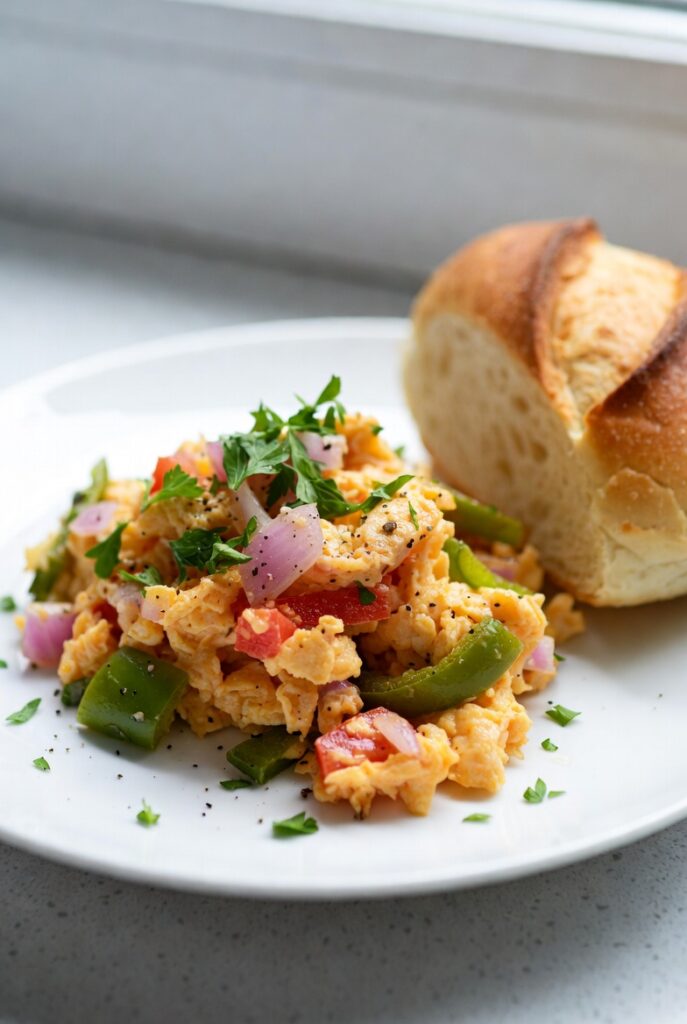
14. Conclusion: The Master Draft of Morning Utility
The Polychromatic Protein Protocol is more than a recipe; it is a “Vessel for Intentional Synergy.” It proves that “Gourmet Results” can be achieved through the mastery of “Moisture-Sequestration” and “Constant-Folding.” By respecting the “Pre-Sauté Phase” and the “Residual-Heat Logic,” you are delivering a breakfast that is visually “Vibrant-and-Bold,” nutritionally dense, and sensorially perfect.