1. Introduction: The Taxonomy of “Superfruit Structuralism”
In the sophisticated landscape of functional gastronomy, the Acai Bowl is frequently misunderstood as a mere “fruit salad in a blender.” In reality, it represents a complex exercise in “Rheological Engineering.” The objective is to transform the frozen pulp of the Euterpe oleracea—a palm fruit native to the Amazonian floodplains—into a stable, “Spoonable-Solid” matrix.
This document serves as the “Acai Manifesto.” We move beyond the rudimentary “smoothie-in-a-dish” logic and examine the mechanics of “The Cryogenic-Density Threshold.” By balancing the unique lipid profile of acai with specific fiber-anchors, we achieve a texture that is “Soft-Serve Resilient” and thermally stable. For the high-performance athlete, the micronutrient strategist, or the culinary aestheticist, this is the “Platinum Standard” of morning utility.
2. The Science of the “Amazonian Lipid-Matrix”
To master the Perfect Acai Bowl, one must understand the unique biological composition of the fruit and how it interacts with thermal energy.
2.1 The Unsaturated Fat Variable
Unlike strawberries or blueberries, which are primarily water and sugar, the acai berry is roughly 50% fat (on a dry-weight basis). These are primarily healthy monounsaturated fats, similar to those found in olive oil. When blended at sub-zero temperatures, these lipids act as “Structural Emulsifiers.” They create a creamy, buttery mouthfeel that water-based fruits cannot replicate. This is why a “True Acai” bowl has a “Velvet-Finish” rather than an “Icy-Grit.”
2.2 The Anthocyanin Payload
The deep purple hue of the acai is a visual indicator of high Anthocyanin concentrations. These are powerful antioxidants that are highly sensitive to thermal degradation. To preserve the “Chromatographic-Brilliance” and the nutrient density, the blending process must be fast and cold. If the friction of the blender blades heats the mixture above 4°C (40°F), the antioxidants begin to oxidize, turning the vibrant purple into a dull, brownish hue.
2.3 The “Non-Newtonian” Behavior
A high-quality acai base behaves as a “Bingham Plastic.” It remains rigid and holds its shape (the “Spoon-Test”) until a specific amount of force is applied. To achieve this, we must minimize the “Lubricant-to-Solid” ratio, forcing the blender to work against the internal friction of the frozen fruit.
3. The Blueprint Overview: Technical Specifications
- Cuisine Type: Amazonian-Functional / Modern Wellness
- Difficulty Level: Medium (Requires “Tamper-Agitation” mastery)
- Total Preparation Time: 10 Minutes
- Total Assembly Time: 5 Minutes
- Total Time: 15 Minutes
- Dietary Classifications: Vegan, Gluten-Free, High-ORAC (Oxygen Radical Absorbance Capacity).
- Yield: 1 Large “Performance-Tier” Bowl
4. Equipment and Tools: The Essentials of “Centrifugal Force”
- High-Output Blender (1200+ Watts): The Non-Negotiable Tool. A standard kitchen blender lacks the torque to process frozen acai pulp without excessive liquid, which results in a “Smoothie Soup.”
- Blender Tamper: The “Active-Interface” tool. It allows you to break up “Air-Pockets” and push the frozen mass into the blades without adding water.
- Insulated Stainless Steel Bowl: To prevent “Thermal-Bleed.” A cold bowl keeps the acai at its “Viscosity-Peak” for the duration of the meal.
- Offset Spatula: For creating the “Assembly-Platform” on top of the base.
5. Ingredients Section: Sourcing for “Chromatographic” Brilliance
The “Fiber-to-Lipid” ratio dictates the final “Structural Integrity.”
5.1 The “Frozen Core” (The Structural Scaffold)
- Pure Unsweetened Acai Puree: 2 packets (200g). (Look for “Grade A” or “Special” for highest fat content).
- Frozen Half-Bananas: 1.5 units. (Must be frozen at the “Leopard-Spot” ripeness for maximum sugar-to-starch conversion).
- Frozen Blueberries: 1/2 cup. (Acts as a “Color-Booster” and provides pectin for thickness).
5.2 The “Liquid Catalyst” (The Minimum Lubricant)
- Unsweetened Almond or Macadamia Milk: 1/4 cup. (Lipid-rich milks enhance the acai’s creaminess).
- Cold-Brew Hibiscus Tea: (An alternative for “Acidic-Brightness”).
5.3 The “Density-Anchors”
- Frozen Zucchini or Cauliflower: 1/2 cup. (Provides “Inert-Volume” and fiber without altering the flavor or adding sugar).
- Nut Butter: 1 tbsp. (Provides the “Lipid-Weight” to keep the base stable).
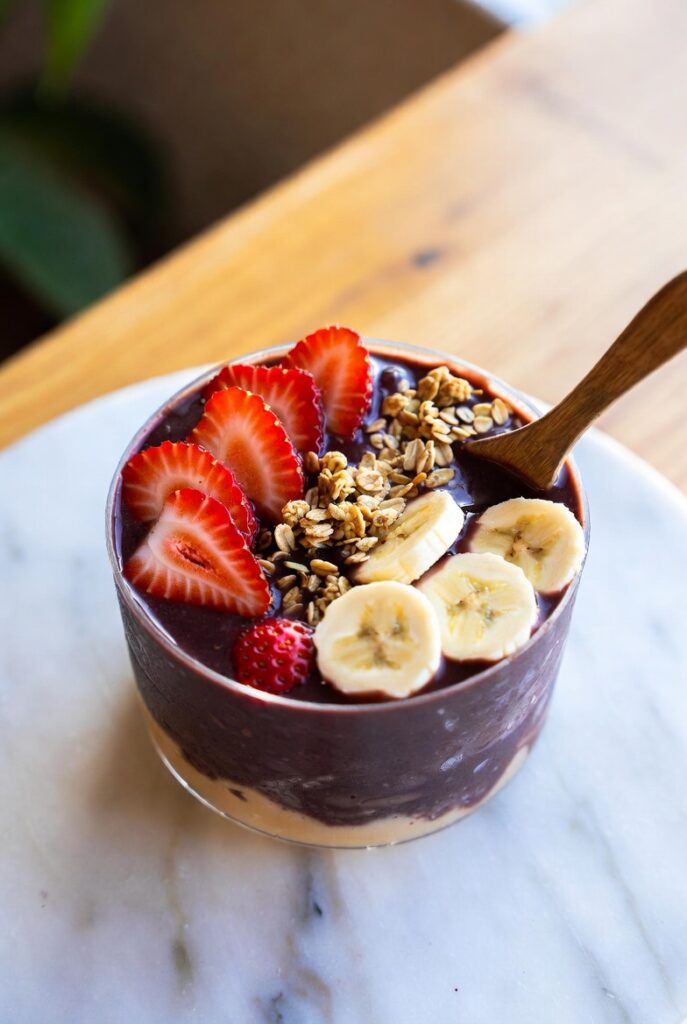
6. The “Minimum-Liquid” Protocol: Mastering the Blend
The primary failure point of an acai bowl is “Vortex-Cavitation”—where the blades spin in an air pocket because the mixture is too thick. To solve this without adding liquid, you must use the “Incremental-Hydration Technique.”
Phase 1: The Layered Deployment
Place the liquid at the bottom. Follow with the nut butter and any powders. Place the frozen acai packets (broken into chunks) and frozen fruit at the very top. This ensures the blades “Catch” the liquid first before engaging the heavy solids.
Phase 2: The “High-Torque” Start
Start on the lowest setting. Immediately use the tamper to drive the frozen chunks into the blades. As the fruit breaks down, it will release its own internal moisture, creating a “Thick-Vortex.”
Phase 3: The “Four-Leaf Clover”
Once the mixture begins to move, increase to medium-high speed. You are looking for a “Four-Leaf Clover” shape to form on the surface. This indicates that the entire mass is circulating and emulsifying properly. If the clover disappears, the base is melting; stop immediately.
7. Step-by-Step Instructions: The Master Execution
Step 1: The “Cryogenic-Prep” Ritual
Place your serving bowl and your blender jar in the freezer for 10 minutes. A “Warm-Jar” failure is a common cause of “Edge-Melting.”
Step 2: The “Acai-Synthesis”
Execute the Minimum-Liquid Protocol (Section 6). Blend until the mixture looks like “Deep-Purple Soft-Serve.” You should be able to turn the blender jar upside down without the mixture falling out (The “Dairy-Queen” Test).
Step 3: The “Platform-Leveling”
Transfer the base into the chilled bowl. Use an offset spatula to level the surface. This creates a flat “Structural-Plane” that prevents your toppings from sinking into the center.
Step 4: The “Architecture of Toppings” (Section 8)
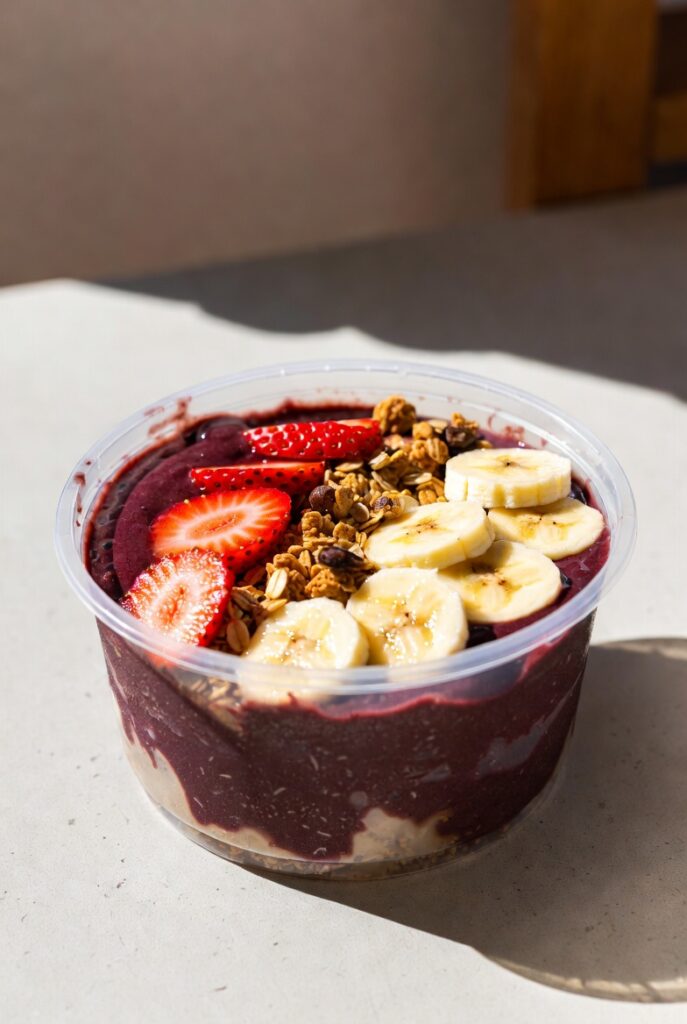
Apply toppings in organized rows. This isn’t just for aesthetics; it allows you to control the “Textural-Experience” of every spoonful.
8. The “Textural-Contrast” Matrix: Topping Selection
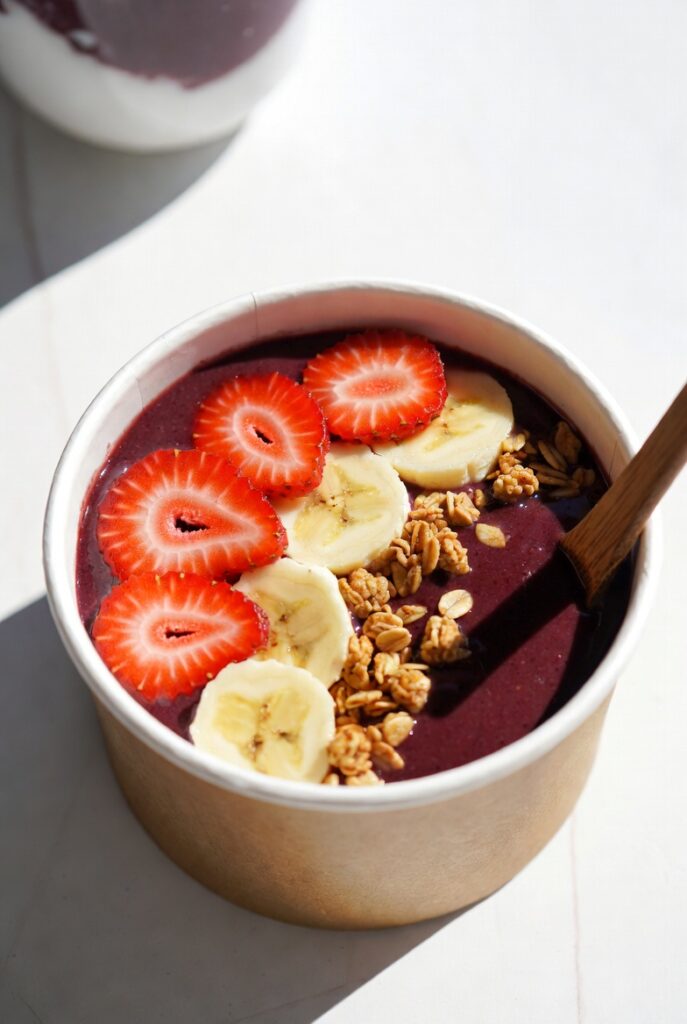
A master-tier acai bowl relies on “The Rule of Three”: A Crunch, a Fresh, and a Lipid.
| Category | Item | Function |
| The Crunch | Hemp Hearts / Sprouted Granola | Provides “Mechanical-Resistance” and triggers satiety. |
| The Fresh | Sliced Kiwi / Sliced Strawberries | Provides “Acidic-Brightness” to cut through the fatty acai. |
| The Lipid | Cacao Nibs / Cashew Butter | Provides “Flavor-Extension” and a glossy finish. |
| The Aromatic | Bees Pollen / Shredded Coconut | Provides “Floral-Levity” and olfactory complexity. |
9. Satiety and the “Anthocyanin-Fiber” Arc
The Acai Bowl provides a “High-Resolution Satiety” profile:
- Chewing Activation: By using organized toppings, you are forced to chew. This starts the digestive process in the mouth, sending “Fullness-Signals” to the brain much faster than a liquid smoothie.
- Stable Glycemic Curve: Because acai is low in sugar and high in fat/fiber, it moderates the sugar spike from the banana and toppings. This ensures a 4-hour “Energy-Plateau.”
- Antioxidant Protection: The high ORAC value helps combat oxidative stress from morning exercise, making it the ultimate “Recovery-Anchor.”
10. Modular Customization: The “Functional Pivots”
- The “Iron-Shield” Draft: Add 1 tsp of spirulina and top with pumpkin seeds (pepitas) for a “High-Mineral” resolution.
- The “Neuro-Focus” Shift: Add 1 tsp of Lion’s Mane mushroom powder and top with walnuts.
- The “Protein-Platinum” Utility: Add 1 scoop of pea protein. Note: You must increase liquid by 2 tbsp to compensate for the “Protein-Absorption” of the powder.
11. Frequently Asked Questions (FAQ)
Q: My acai bowl is “Grainy” and “Icy.” What happened?
A: This is an “Emulsification-Failure.” You likely used ice cubes or didn’t use a lipid-anchor (like banana or nut butter). To fix this, ensure your fruit is “Flash-Frozen” and your blender is high-speed.
Q: Can I use acai powder instead of frozen pulp?
A: Technically affirmative, but you will lose the “Lattice-Strength” of the pulp fibers. If using powder, you must increase the frozen banana volume by 50% to maintain the “Soft-Serve” texture.
Q: How do I stop the “Melting-Edge”?
A: Ensure the bowl is pre-frozen. If the edges melt instantly, the friction from your blender was too high. Reduce blending time by using a more powerful motor or colder fruit.
12. Nutritional Information
(Per “Performance-Tier” Bowl)
| Nutrient | Amount |
| Calories | 440 kcal |
| Protein | 10g |
| Total Fat | 18g |
| Fiber | 14g |
| Vitamin A | 25% DV |
| Iron | 15% DV |
13. The “Visual Gravity” of Presentation
- The “Spiral-Drizzle”: Warm your almond butter for 10 seconds. Drizzle from 12 inches above the bowl in a tight spiral to create “Nano-Thin” lines.
- The “Color-Block”: Group green (kiwi), red (strawberry), and yellow (bee pollen) in distinct sectors to create “Visual-Pop.”
- The “Seed-Dusting”: Finish with a pinch of chia seeds or hemp hearts. This provides a “Professional-Matte” finish to the glossy fruit.
14. Conclusion: The Master Draft of Functional Utility
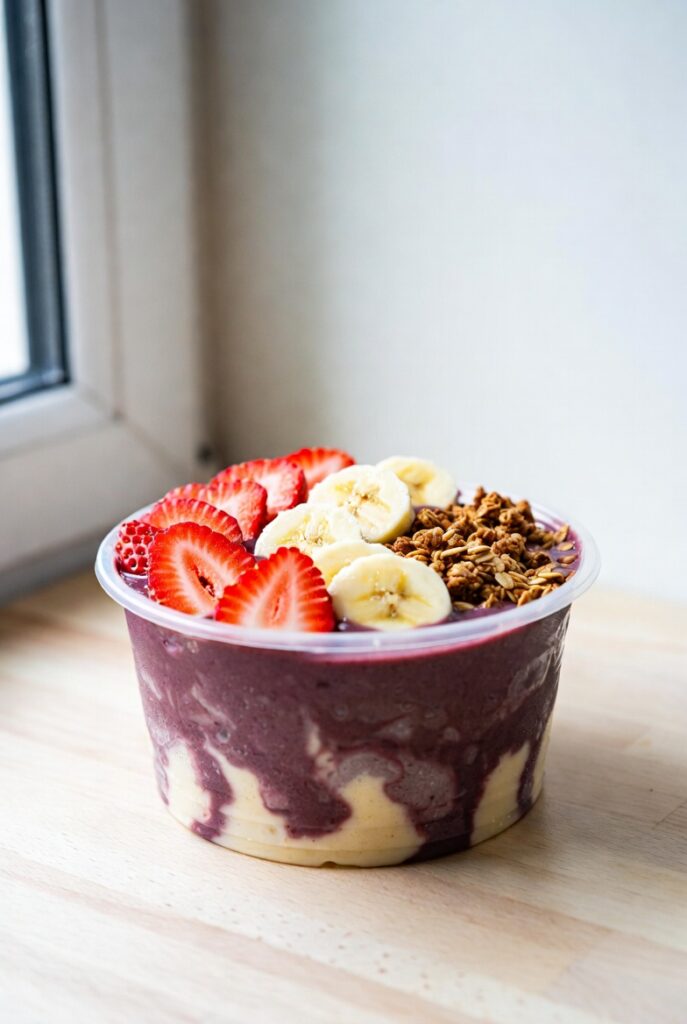
The Deep-Purple Bio-Architect Protocol proves that an acai bowl is not merely a “Trend,” but a “Vessel for Intentional Nutrition.” By mastering the “Minimum-Liquid Protocol” and respecting the “Cryogenic-Density Threshold,” you are delivering a breakfast that is visually “Radiant,” nutritionally complete, and sensorially perfect.
It is the ultimate “Functional-Anchor”—a “Cold-and-Dense” testament to the power of Amazonian biology and modern culinary engineering.