1. Introduction: The Architecture of “Spoonable Nutrition”
In the sophisticated taxonomy of functional breakfast engineering, the Smoothie Bowl represents a landmark achievement in “Volumetric Satiety.” Unlike a traditional liquid smoothie, which is often consumed with a high “Glycemic Velocity,” the smoothie bowl is designed for a “Slow-Release Nutrient Delivery.” By transitioning from a drinkable liquid to a “Spoonable Solid,” we engage the mechanical process of mastication, which triggers the release of satiety hormones like cholecystokinin (CCK) and peptide YY (PYY) far more effectively than a beverage.
This document serves as the “Structural Manifesto” for the dish. We move beyond the rudimentary “blended-fruit” logic and examine the mechanics of “The Viscosity-Threshold Phase.” By managing the ratio of frozen solids to liquid lubricants, we achieve a “Soft-Serve” texture that can support the gravitational weight of diverse toppings. For the high-performance athlete, the health-conscious gourmet, or the “Aesthetic-First” content creator, this is the “Platinum Standard” of morning utility.
2. The Science of “Cryogenic Blending” and Rheology
To master the Smoothie Bowl, one must understand the behavior of Fluid Dynamics and Thermal Mass.
2.1 The Viscosity-Threshold
The primary failure point of a smoothie bowl is “Structural Collapse” (becoming too liquid). A true smoothie bowl must achieve a high yield stress—the ability to resist flow under its own weight. This is achieved through the use of Frozen Micro-Crystals. When fruit is frozen, its cellular structure breaks down; when blended with minimal liquid, these ice crystals and fruit fibers create a dense, “Thixotropic” paste that holds its shape.
2.2 The Emulsification Factor
To achieve the “Creamy-Resolution” associated with high-end smoothie boutiques, you must introduce Lipid-Based Emulsifiers. Ingredients like avocado, nut butters, or Greek yogurt act as surfactants. They coat the ice crystals and fruit fibers, reducing friction during the blending process and creating a mouthfeel that is “Silk-Tender” rather than “Icy-Grit.”
2.3 The “Slow-Freeze” Logic
Using “Flash-Frozen” fruit is superior to using ice cubes. Ice cubes dilute the nutrient density and flavor profile. By utilizing the fruit itself as the “Cryogenic-Engine,” you maintain a 100% concentration of flavor and micronutrients.
3. The Blueprint Overview: Technical Specifications
- Cuisine Type: Functional Gastronomy / Modern Wellness
- Difficulty Level: Medium (Focus on “Blender-Motor Management”)
- Total Preparation Time: 10 Minutes
- Total Assembly Time: 5 Minutes
- Total Time: 15 Minutes
- Dietary Classifications: Vegan-Friendly, Gluten-Free, High-Antioxidant.
- Yield: 1 Large “Performance-Tier” Bowl
4. Equipment and Tools: The Essentials of “Centrifugal Force”
- High-Output Blender (1200+ Watts): The Non-Negotiable Tool. Low-wattage blenders cannot process frozen solids without excessive liquid, which results in a “Smoothie Soup.”
- The Tamper Tool: Essential for pushing the “Frozen-Ledge” down into the blades without adding extra liquid.
- Insulated Ceramic Bowl: To prevent “Thermal-Bleed.” A cold bowl keeps the smoothie at its “Viscosity-Peak” for the duration of the meal.
- Silicone Spatula: For a “Zero-Waste” transfer from the blender jar.
5. Ingredients Section: Sourcing for “Chromatographic” Brilliance
The “Fiber-to-Liquid” ratio dictates the final “Structural Integrity.”
5.1 The “Frozen Base” (The Structural Scaffold)
- Frozen Bananas: 1.5 units, sliced before freezing. (The “Creaminess-Anchor”).
- Frozen Mixed Berries: 1 cup. (The “Antioxidant-Payload”).
- Frozen Cauliflower Rice: 1/2 cup. (The “Secret-Volume” agent; provides bulk without sugar or flavor interference).
5.2 The “Liquid Lubricant” (The Catalyst)
- Unsweetened Almond or Oat Milk: 1/4 to 1/2 cup. (Start with the minimum amount).
- Coconut Water: (An alternative for “Electrolyte-Density”).
5.3 The “Emulsifiers & Boosters”
- Almond Butter: 1 tbsp. (The “Lipid-Stabilizer”).
- Chia Seeds: 1 tbsp. (The “Hydrophillic-Binder”; they absorb 10x their weight in water, thickening the base).
- Protein Powder: 1 scoop. (Vanilla or Berry flavored).
6. The “Minimum-Liquid” Protocol: Mastering the Blend
The primary mistake in smoothie bowl construction is adding too much liquid at the start. To achieve a “Master-Tier” result, you must utilize the “Incremental-Hydration Technique.”
Phase 1: The Dry-Solid Deployment
Place the hardest frozen items at the bottom of the blender (closest to the blades). Add your powders and seeds next.
Phase 2: The Lubrication Phase
Pour in exactly 1/4 cup of liquid. This will seem insufficient. This is intentional.
Phase 3: The Tamper-Agitation
Start the blender on the lowest speed. Use the tamper to aggressively push the frozen fruit into the blades. As the fruit breaks down, it will release its own internal moisture, creating a “Thick-Vortex.” Only add more liquid 1 tablespoon at a time if the motor “Cavitates” (spins without moving the food).
7. Step-by-Step Instructions: The Master Execution
Step 1: The “Thermal-Prep” Ritual
Place your serving bowl in the freezer for 5 minutes. A “Warm-Bowl” failure is the most common cause of “Edge-Melting.”
Step 2: The “Base-Synthesis”
Execute the Minimum-Liquid Protocol (Section 6). Blend until the mixture looks like soft-serve ice cream. You are looking for a “Four-Leaf Clover” shape to form in the vortex.
Step 3: The “Fold-In” Integration
Stop the blender. Add the chia seeds and nut butter. Pulse 3–5 times. This ensures the fibers are integrated without being completely pulverized, preserving some “Textural-Interest.”
Step 4: The “Gravitational-Pour”
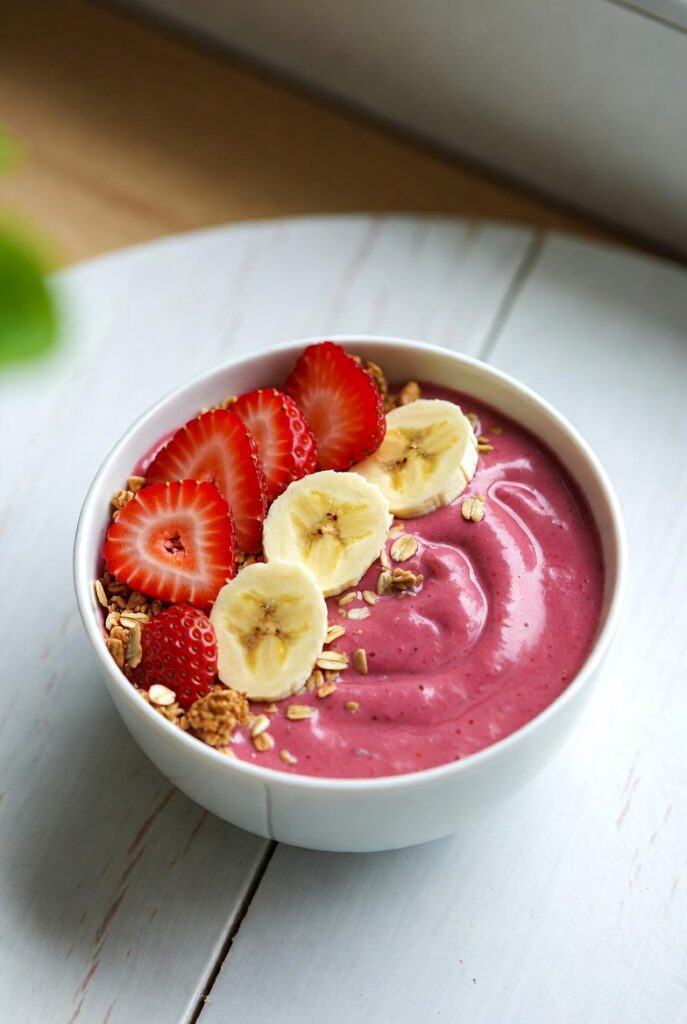
Using your silicone spatula, transfer the base into the chilled bowl. Smooth the top with the back of a spoon to create a flat “Assembly-Platform” for your toppings.
Step 5: The “Architecture of Toppings” (Section 8)
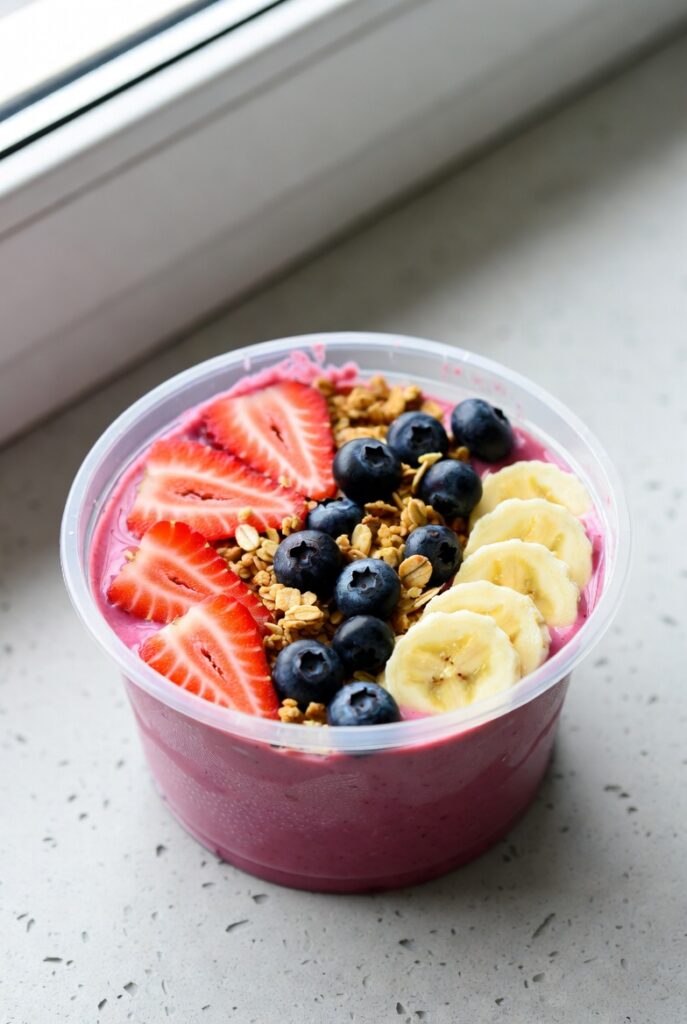
Apply toppings in organized rows or “Color-Blocks” to maximize the visual resolution and ensure every spoonful has a balanced “Crunch-to-Cream” ratio.
8. The “Textural-Contrast” Matrix: Topping Selection
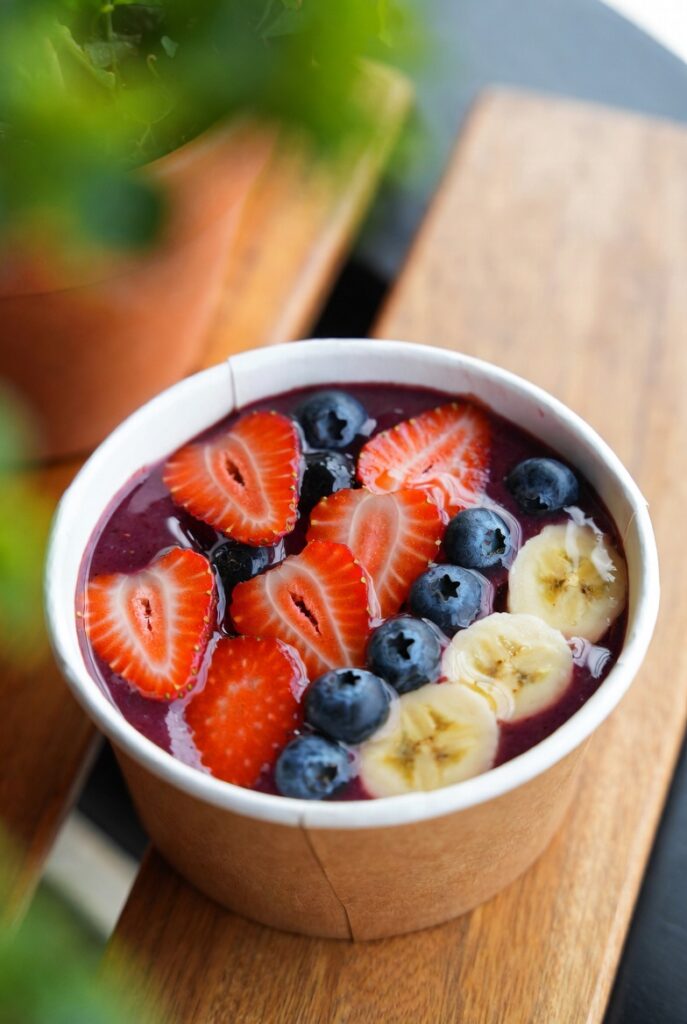
A smoothie bowl without toppings is merely a thick smoothie. To achieve “Gourmet-Tier” status, you must apply the “Rule of Three”: A Crunch, a Fresh, and a Superfood.
| Category | Item | Function |
| The Crunch | Grain-Free Granola / Cacao Nibs | Provides “Mechanical-Resistance” and satiety. |
| The Fresh | Sliced Strawberries / Dragonfruit | Provides “Acidic-Brightness” to cut through the base. |
| The Superfood | Hemp Hearts / Goji Berries | Provides “Micro-Nutrient Density” and visual pop. |
| The Lipid-Drizzle | Peanut Butter / Raw Honey | Provides “Flavor-Extension” and a glossy finish. |
9. Satiety and the “Chew-to-Digest” Arc
The Smoothie Bowl provides a “High-Resolution Satiety” profile:
- Cephalic Phase Response: The act of seeing the organized toppings and using a spoon signals to the brain that a “Full Meal” is being consumed, rather than a “Quick Snack.”
- Fiber-Density: By utilizing whole frozen fruits and cauliflower rice, you are consuming 10–15g of fiber. This slows gastric emptying and prevents the “Insulin-Spike” associated with fruit juices.
- Hydrophillic Expansion: The chia seeds continue to expand in the stomach, providing a “Long-Form” fullness that can last until the mid-afternoon.
10. Modular Customization: The “Flavor Pivots”
- The “Green-Energy” Draft: Add 1 cup of frozen spinach and 1/2 an avocado. The avocado provides the “Lipid-Silkiness” that compensates for the lack of banana sweetness.
- The “Cacao-Recovery” Shift: Add 2 tbsp of raw cacao powder and use chocolate protein. This creates a “Healthy-Frosty” profile ideal for post-workout inflammation reduction.
- The “Tropical-Resolution”: Use frozen mango and pineapple as the base. Top with toasted coconut flakes and macadamia nuts for a “High-Lipid” island profile.
11. Frequently Asked Questions (FAQ)
Q: Why is my smoothie bowl “Melting” before I finish it?
A: You likely added too much liquid during the blending phase or failed to “Pre-Chill” your bowl. Ensure your base is 80% frozen solids by volume.
Q: Can I use fresh fruit and just add ice?
A: Technically affirmative, but discouraged. Ice results in a “Watered-Down” flavor and a “Grainy” texture. For “Platinum Standard” results, the fruit itself must be the ice.
Q: How do I get those “Perfect Rows” of toppings?
A: Use a small pair of culinary tweezers for seeds and berries. Place the largest items (like granola) first, then fill the gaps with smaller items (like hemp hearts).
12. Nutritional Information
(Per “Performance-Tier” Bowl)
| Nutrient | Amount |
| Calories | 420 kcal |
| Protein | 25g |
| Total Fat | 14g |
| Fiber | 12g |
| Net Carbs | 38g |
13. The “Visual Gravity” of Presentation
- The “Swoosh” Technique: Use the back of a spoon to create a “Crescent-Indent” in the base before placing toppings.
- Color-Theory: Use high-contrast fruits. For a purple acai base, use yellow mango or bright green kiwi to create “Visual-Pop.”
- The “Drizzle-Height”: Warm your nut butter for 10 seconds. Drizzle from 12 inches above the bowl to create “Nano-Thin” lines that look professional and organized.
14. Conclusion: The Master Draft of Functional Utility
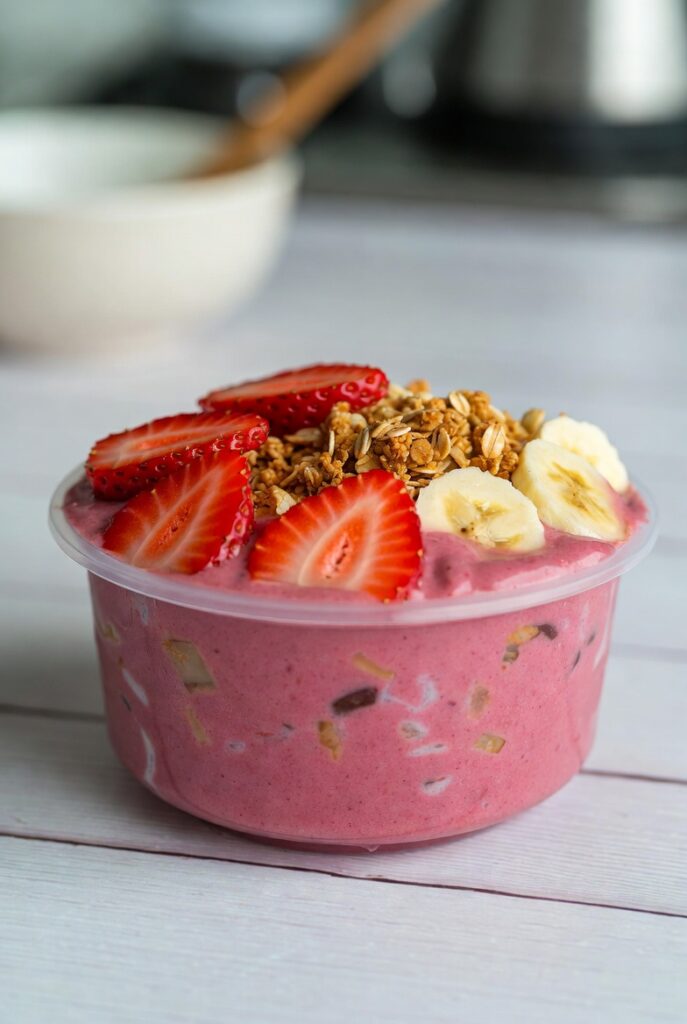
The Viscosity-Density Protocol proves that a smoothie bowl is not merely a “Trend,” but a “Vessel for Intentional Nutrition.” By mastering the “Minimum-Liquid Protocol” and respecting the “Thermal-Prep Ritual,” you are delivering a breakfast that is visually “Vibrant,” nutritionally complete, and sensorially perfect.
It is the ultimate “Macro-Anchor”—a “Cold-and-Dense” testament to the power of high-output blending and thoughtful assembly.