1. Introduction: The Intersection of Elegance and Efficiency
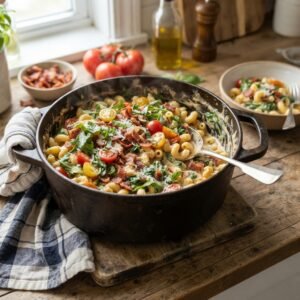
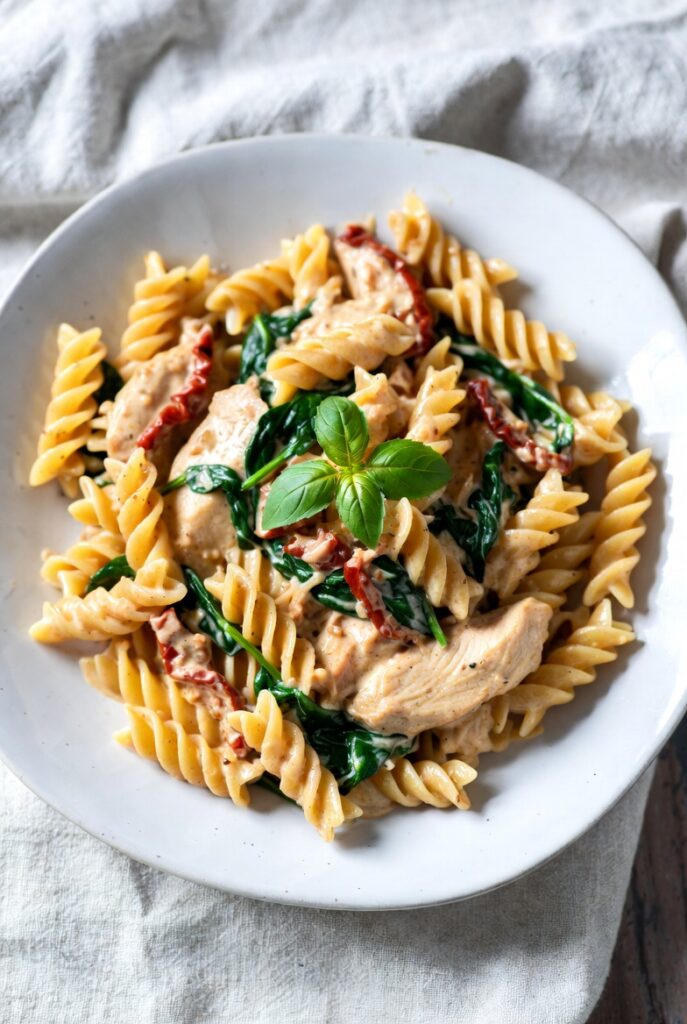
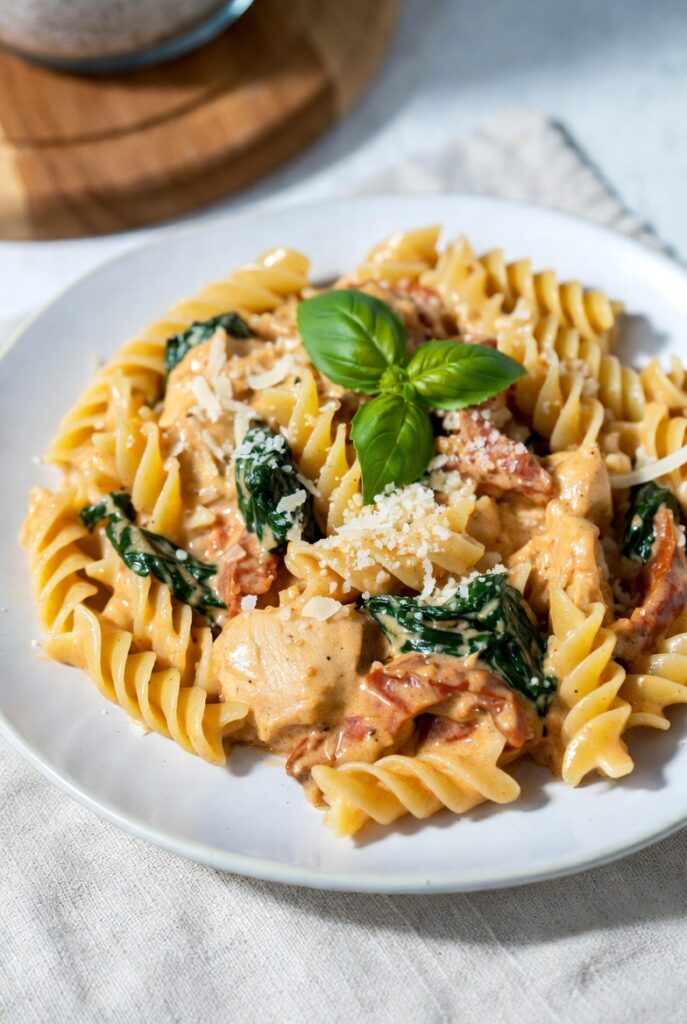
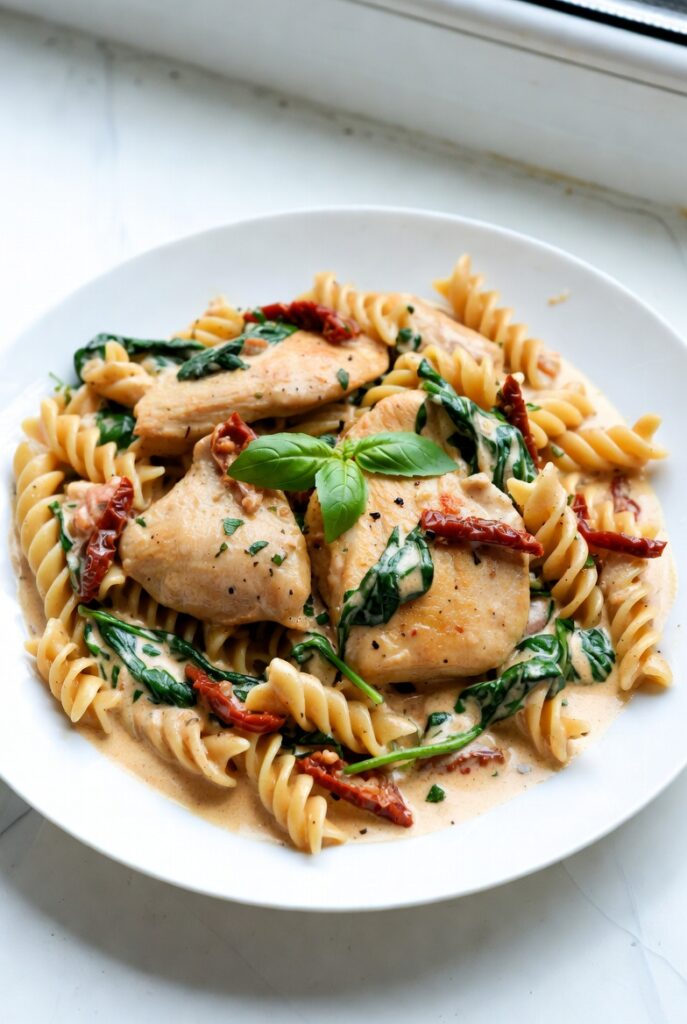
In the realm of high-performance culinary drafts, the One-Pot Creamy Tuscan Chicken Pasta represents a peak achievement in flavor density. This dish is a strategic “Signature Assembly” that manages to bridge the gap between “comfort food” and “gourmet dining.” By utilizing the “Tuscan Trinity”—sun-dried tomatoes, spinach, and garlic—this meal provides a complex micronutrient profile while adhering to the strict principles of “Single-Vessel Engineering.”
The brilliance of One-Pot Creamy Tuscan Chicken Pasta lies in its sophisticated moisture management. Unlike traditional pasta dishes where the starch is discarded in the boiling water, this one-pot method captures the $amylopectin$ released by the pasta, using it to emulsify the cream and chicken stock into a velvet-like sauce. For the modern professional, this represents the ultimate tactical victory: a restaurant-quality meal that requires minimal active labor and produces a “Zero-Friction” cleanup process. It is a dish that respects your time without compromising the sensory luxury of a home-cooked dinner.
2. The Science of “Starch Emulsification”
To master One-Pot Creamy Tuscan Chicken Pasta, one must understand the molecular physics of the “One-Pot” liquid ratio. In a standard boiling environment, pasta is a passive participant. However, in this assembly, the pasta serves as a thickening agent. As the pasta hydrates, it sheds starch into the cooking liquid. When combined with the lipids from the heavy cream and the fats from the seared chicken, this starch creates a stable emulsion that clings to the noodles.
The secret to a professional-grade One-Pot Creamy Tuscan Chicken Pasta is the “Reduction Phase.” Because the liquid is not drained, the initial volume of chicken broth must be precisely calibrated. Furthermore, the inclusion of sun-dried tomatoes provides a concentrated source of $glutamate$ (the molecule responsible for savory “umami”), which deepens the flavor profile without the need for artificial additives. When you execute this dish, you are performing a controlled reduction—transforming a thin broth into a rich, golden sauce through the power of evaporation and starch suspension.
3. Recipe Overview: The Master Blueprint
- Cuisine Type: Modern Italian-American / Fusion
- Difficulty Level: Intermediate (Requires focus on liquid reduction)
- Total Preparation Time: 15 Minutes
- Total Cooking Time: 25 Minutes
- Total Time: 40 Minutes
- Dietary Classifications: High-Protein, High-Satiety, Nutrient-Dense.
- Yield: Serves 4 to 6
4. Equipment and Tools: The Essentials of Heat Retention
The structural success of your One-Pot Creamy Tuscan Chicken Pasta depends on a pan that can facilitate both a high-heat sear and a consistent simmer.
- 12-inch Deep Skillet or 5-Quart Dutch Oven: A standard frying pan is too shallow. You need high walls to manage the pasta and liquid volume.
- Wooden Flat-Edge Spatula: For “Deglazing”—scraping the chicken fond (browned bits) from the bottom, which is the soul of the sauce.
- Tongs: For precisely handling the chicken during the initial searing phase.
- Microplane: For grating fresh Parmesan cheese to ensure it melts smoothly into the emulsion.
5. Ingredients Section: Sourcing for Depth
The integrity of One-Pot Creamy Tuscan Chicken Pasta is built upon the contrast between the rich dairy and the acidic aromatics.
The Protein Anchor
- Boneless, Skinless Chicken Breasts or Thighs: Sliced into bite-sized pieces. Thighs offer a more succulent texture, while breasts provide a leaner profile.
The Tuscan Trinity
- Sun-Dried Tomatoes: Specifically those packed in oil. The oil itself is a “Flavor Concentrate” that should be used for the initial sauté.
- Fresh Baby Spinach: Provides a massive dose of Vitamin K and iron, wilting into the sauce at the final stage.
- Fresh Garlic: 4 to 6 cloves. In One-Pot Creamy Tuscan Chicken Pasta, garlic is a primary flavor pillar, not a background note.
The Fluid Matrix
- Short Pasta (Penne or Bowtie): Short shapes are superior for one-pot methods as they are easier to submerge and stir.
- Low-Sodium Chicken Broth & Heavy Cream: The combination that creates the “Liquid Gold” sauce.
- Parmesan Cheese: For the “Salty Finish” and additional structural thickening.
6. The “Golden Sear” Technique
The most common failure in One-Pot Creamy Tuscan Chicken Pasta is “Boiled Chicken Syndrome.” If the chicken is added directly to the liquid, it will have a soft, unappealing texture.
To achieve a “Master Draft” finish, you must perform the “Golden Sear.” Sauté the chicken in the sun-dried tomato oil over medium-high heat until a deep golden crust forms. You are not trying to cook the chicken through at this stage; you are simply creating a flavor barrier. Once seared, remove the chicken. The “residue” left in the pan—the fond—is concentrated protein and sugar that will dissolve into the broth, giving your One-Pot Creamy Tuscan Chicken Pasta its signature amber hue and deep, roasted flavor.
7. Deep Dive: Lycopene and Fat Soluability
Why is the combination of sun-dried tomatoes and cream so nutritionally effective? Sun-dried tomatoes are a dense source of $lycopene$, a powerful antioxidant. However, $lycopene$ is “fat-soluble,” meaning the human body struggles to absorb it in the absence of lipids.
By pairing these tomatoes with the fats found in the heavy cream and chicken in your One-Pot Creamy Tuscan Chicken Pasta, you are maximizing the bio-availability of these antioxidants. This dish is a prime example of “Functional Synergy”—where the culinary components work together to ensure that the nutrients are not just present, but actually utilized by your system for cardiovascular and cellular health.
8. Step-by-Step Instructions: The Master Blueprint
Step 1: The Flavor Infusion
Heat 2 tablespoons of oil from the sun-dried tomato jar in your skillet. Add the chicken pieces and sear until golden. Remove the chicken and set aside; it will finish cooking later in the sauce.
Step 2: The Aromatic Build
In the same pan, add the diced onions and sun-dried tomatoes. Sauté for 3 minutes, then add the garlic and red pepper flakes. Cook for 60 seconds until the aroma is “peak.”
Step 3: The Liquid Submersion
Pour in 3 cups of chicken broth and 1 cup of heavy cream. Scrape the bottom of the pan to release the fond. Add 12 oz of dry pasta. Ensure the pasta is mostly submerged.
Step 4: The Controlled Simmer
Bring to a boil, then immediately reduce to a simmer. Cover the pan. Cook for 10–12 minutes, or until the pasta is al dente.
The Pro Move: Stir every 3 minutes. As the liquid reduces, the starch will make the pasta in your One-Pot Creamy Tuscan Chicken Pasta prone to sticking.
Step 5: The Final Assembly
Stir the seared chicken back into the pan. Add 2 large handfuls of fresh spinach. The heat from the sauce will wilt the spinach in approximately 60 seconds.
Step 6: The Emulsion Finish
Turn off the heat. Stir in 1/2 cup of freshly grated Parmesan cheese. This will “tighten” the sauce, turning it into a silky glaze that perfectly coats every noodle.
9. Expert Tips and Variations
- The “Acid Brightener”: If the sauce feels too heavy, add a squeeze of fresh lemon juice at the very end. The acidity will “lift” the fats and brighten the sun-dried tomatoes.
- The “Mushrooms” Upgrade: Sauté sliced baby bella mushrooms with the onions for an earthier, more “forest-like” One-Pot Creamy Tuscan Chicken Pasta.
- Variations: * The “Shrimp” Pivot: Use jumbo shrimp instead of chicken. Sear them for only 60 seconds per side, then add them back only in the final minute to prevent overcooking.
- The “Low-Carb” Shift: This specific sauce is excellent over zoodles (zucchini noodles), but you must reduce the chicken broth by 75% as zoodles do not absorb liquid.
10. Storage and “The Cream Stability”
One-Pot Creamy Tuscan Chicken Pasta is a robust meal-prep option, but it requires specific reheating logic.
- Refrigeration: Store in an airtight container for up to 3 days.
- The Reheat: Cream-based sauces tend to “break” or become oily in the microwave. To restore the original emulsion, add a teaspoon of water or milk before reheating. Heat in 30-second increments, stirring in between to redistribute the fats.
- Note: The pasta will continue to absorb the sauce as it sits. If your leftovers seem “dry,” it’s simply because the starch has done its job—just add a splash of liquid to bring it back to life.
11. Frequently Asked Questions (FAQ)
Q: Can I use milk instead of heavy cream?
A: You can, but the sauce will be thinner. To maintain the “Creamy” standard of One-Pot Creamy Tuscan Chicken Pasta, you may need to whisk a teaspoon of cornstarch into the milk before adding it to the pan.
Q: Why is my chicken dry?
A: You likely overcooked it during the initial searing phase. Remember: the chicken only needs a “crust” at the start; it does its actual cooking during the 10-minute pasta simmer.
Q: Do I have to use sun-dried tomatoes?
A: They are the soul of the “Tuscan” profile. If you substitute fresh tomatoes, the flavor will be much milder and the sauce will be more watery.
12. Nutritional Information
(Per serving – approx. 1/4 of the pan)
| Nutrient | Amount |
| Calories | 520 kcal |
| Protein | 36g |
| Total Fat | 24g |
| Net Carbs | 38g |
| Fiber | 4g |
| Iron | 20% DV |