1. Introduction: The Strategic Integration of Omega-3s
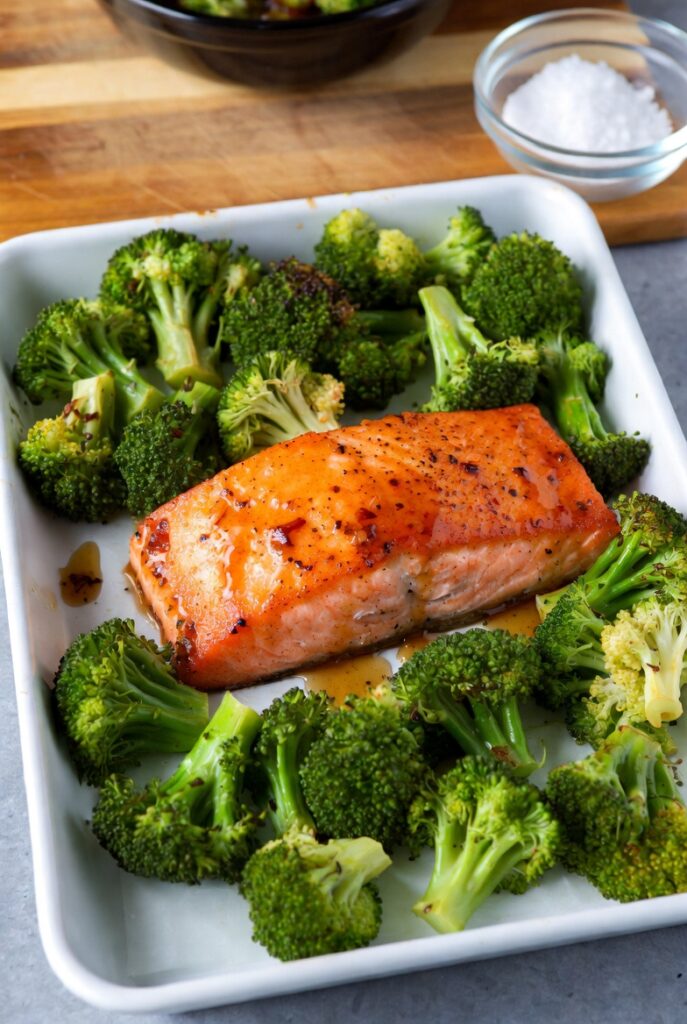
In the high-stakes environment of modern meal planning, where cognitive bandwidth is a finite resource and physical health is a non-negotiable priority, the Sheet Pan Honey Garlic Salmon and Broccoli represents the ultimate “Zero-Friction” solution. This is not merely a recipe; it is a tactical intervention designed to bridge the gap between “high-performance nutrition” and “logistical simplicity.” By utilizing the principles of “Single-Surface Engineering,” this dish delivers a comprehensive profile of healthy fats, lean proteins, and vital micronutrients without the cognitive load or cleanup requirements of multi-pot cooking.
The brilliance of Sheet Pan Honey Garlic Salmon and Broccoli lies in its “Thermal Symmetry.” In traditional cooking, the chef must manage the divergent heat requirements of a delicate fish and a fibrous vegetable across different pans, timers, and heat sources. The sheet pan method synchronizes these variables into a singular roasting window. We harness the oven’s convective air to glaze the salmon into a succulent, umami-rich centerpiece while simultaneously achieving a nutty, caramelized “char” on the broccoli florets. For the busy professional, the athlete, or the health-conscious parent, this meal is the gold standard for metabolic recovery.
Beyond its physical benefits, the Sheet Pan Honey Garlic Salmon and Broccoli serves as a psychological anchor. There is a specific “Zen of the Sheet Pan”—the realization that a gourmet-level, restaurant-quality dinner can be achieved through ten minutes of mechanical preparation and fifteen minutes of passive roasting. It is a meal that respects your time, your energy, and your biology, providing a repeatable framework for consistent dietary excellence.
2. The Science of the “Glaze Barrier” and Sulforaphane
To master the execution of Sheet Pan Honey Garlic Salmon and Broccoli, one must understand the chemical interactions occurring on the pan’s surface. Salmon is a highly sensitive protein composed of delicate myofibrils. When exposed to dry heat, these fibers contract, and the moisture within—along with the white protein known as albumin—tends to leak out.
The secret to a professional-grade result is the “Glaze Barrier.” The honey in our emulsion acts as a viscous seal. As the temperature rises, the honey undergoes “sucrose dehydration,” creating a protective, caramelized layer that locks the $omega-3$ fatty acids inside the fillet. This prevents the salmon from drying out and ensures a “melt-in-your-mouth” texture. Simultaneously, the soy sauce provides the $glutamates$ necessary for “umami,” while the garlic releases sulfuric compounds that deepen the flavor profile.
On the vegetable side of the pan, the broccoli is undergoing its own transformation. Broccoli is a powerhouse of Glucoraphanin, which, when chopped and heated, converts into Sulforaphane. This compound is one of the most potent natural activators of the Nrf2 pathway, which triggers the body’s internal antioxidant defense system. By roasting the broccoli in the presence of the salmon’s healthy fats, we enhance the bio-availability of the broccoli’s fat-soluble vitamins, such as Vitamin $K$ and Vitamin $A$. This is not just a meal; it is “Functional Synergy” in its most palatable form.+1
3. Recipe Overview: The Master Blueprint
- Cuisine Type: Modern Fusion / High-Performance Clean Eating
- Difficulty Level: Very Easy (Requires only basic knife skills and thermal monitoring)
- Total Preparation Time: 15 Minutes
- Total Cooking Time: 15 Minutes
- Total Time: 30 Minutes
- Dietary Classifications: High-Protein, Heart-Healthy, Gluten-Free (with Tamari), Paleo-friendly.
- Yield: Serves 2 to 4 (Scalable based on pan size)
4. Equipment and Tools: The Essentials of Heat Transfer
The success of your Sheet Pan Honey Garlic Salmon and Broccoli depends on the precision of your tools.
- Heavy-Duty Half-Sheet Pan (18×13 inch): This is the foundation of the dish. Avoid thin, “non-stick” supermarket pans which warp under high temperatures. A professional-grade, heavy-gauge aluminum pan provides the “Thermal Mass” necessary to maintain a constant temperature, ensuring the broccoli sears rather than steams.
- Parchment Paper or Silicone Mat: This is a critical friction-reduction tool. The high sugar content of the honey will “fuse” to the metal pan at $400^\circ F$, creating a cleaning nightmare. Parchment paper ensures a “slide-off” finish.
- Silicon Pastry Brush: For the even distribution of the glaze. This ensures that every millimeter of the salmon surface is protected by the “Glaze Barrier.”
- Instant-Read Meat Thermometer: While visual cues are helpful, the thermometer is the only way to guarantee a perfect $145^\circ F$ (63°C) internal temperature, preventing the tragedy of overcooked salmon.
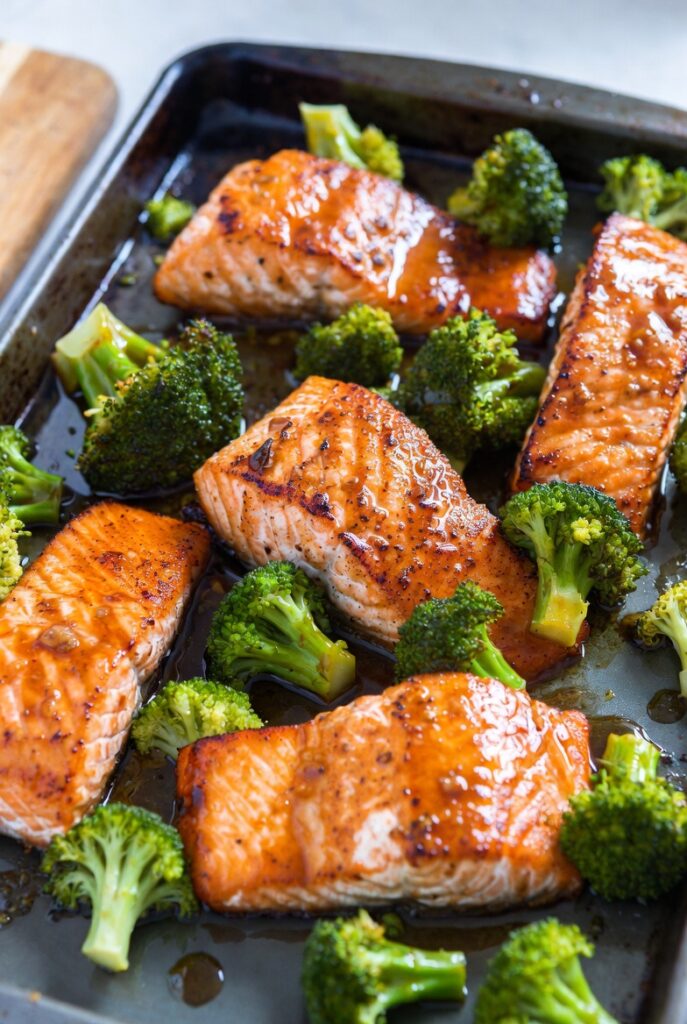
5. Ingredients Section: Sourcing for Metabolic Density
In a two-component dish like Sheet Pan Honey Garlic Salmon and Broccoli, the quality of the raw materials is the primary driver of the final flavor.
The Protein Anchor
- Wild-Caught or High-Quality Sourced Salmon Fillets: Look for “Center-Cut” pieces. They have a uniform thickness which ensures even cooking. Avoid “tail-cuts” for this recipe, as they thin out and will overcook before the broccoli is ready.
The Green Matrix
- Fresh Broccoli Florets: 2 large heads. The key here is “Uniform Micronization”—cutting the florets into small, equal-sized pieces to maximize the surface area for roasting.
- Optional Color Pop: Thinly sliced red bell peppers or carrots can be added to the matrix to increase the spectrum of $carotenoids$.
The Honey Garlic Emulsion
- Raw, Unfiltered Honey: 3 tablespoons. Provides the base for the “Glaze Barrier.”
- Minced Garlic: 4 cloves. Fresh garlic is mandatory; jarred garlic lacks the pungent $allicin$ required for this flavor profile.
- Low-Sodium Soy Sauce or Tamari: 2 tablespoons. For the essential salty contrast.
- Toasted Sesame Oil: 1 teaspoon. This provides a “High-Note” aromatic finish that makes the dish feel gourmet.
- Fresh Ginger: 1 tablespoon, grated. Ginger serves as a natural digestive aid and provides a refreshing heat.
6. The “Single-Layer” Rule: Achieving the Char
The most common failure in Sheet Pan Honey Garlic Salmon and Broccoli is “Vegetable Overcrowding.” This is a fundamental error in thermodynamics. When vegetables are piled on top of each other, the moisture they release becomes trapped between the layers. Instead of the water evaporating into the oven’s dry air, it stays trapped, effectively “steaming” the broccoli. This results in a soft, yellowish texture rather than the desired crisp, bright green “char.”
To achieve a “Master Draft” finish, you must respect the “Surface Area Rule.” Spread the broccoli florets across the pan so that they are not touching. This allows the convective heat to hit the florets from all angles, facilitating the “Crispy Tip” effect. The salmon should occupy the center “Thermal Zone”—the area of the pan that remains the most temperature-stable—while the broccoli occupies the “Perimeter Zone,” where the heat is often more aggressive due to the pan’s edges.
7. Deep Dive: The Role of Selenium and Brain Function
Why is the Sheet Pan Honey Garlic Salmon and Broccoli specifically recommended for cognitive high-performers? It centers on Selenium. Salmon is one of the richest sources of this essential mineral, which acts as a powerful antioxidant in the brain. Selenium is vital for the function of $selenoproteins$, which protect against oxidative stress and support healthy neurotransmitter function.
When you pair the Selenium in the salmon with the high levels of Vitamin $C$ and fiber in the broccoli, you are essentially providing your brain with a “Neuro-Protective Shield.” This combination supports stable energy levels, reduces systemic inflammation, and enhances mental clarity. For anyone working in a high-stress environment, this meal is a biological investment in long-term cognitive resilience.
8. Step-by-Step Instructions: The Master Blueprint
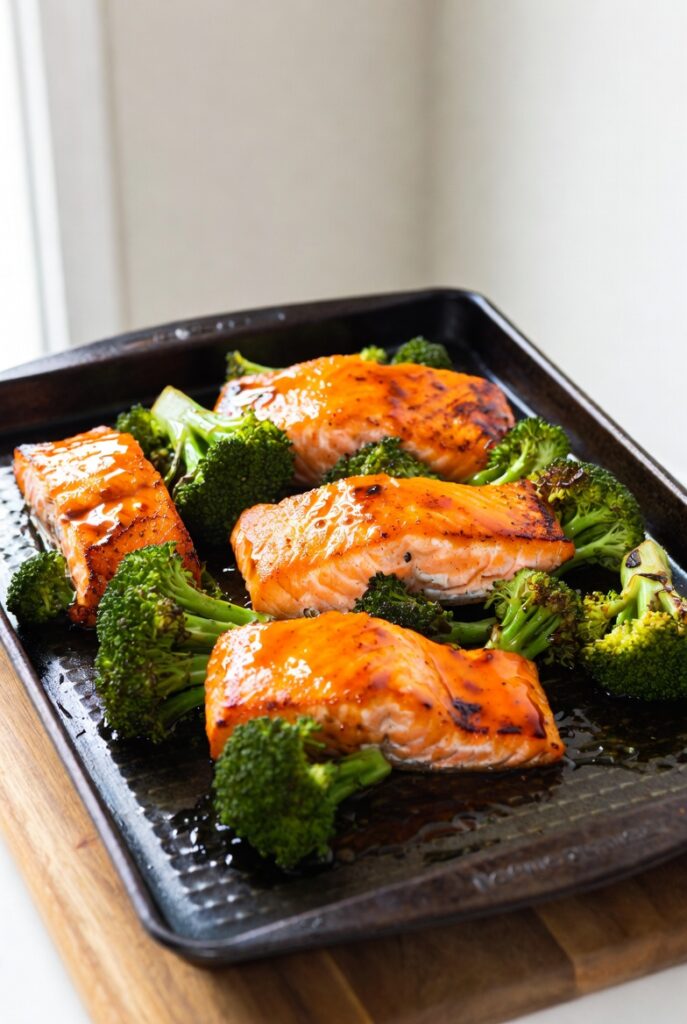
Step 1: The Thermal Calibration
Preheat your oven to $400^\circ F$ (200°C). This high temperature is necessary to activate the honey’s caramelization and the broccoli’s crisping simultaneously. Line your pan with parchment paper.
Step 2: The Glaze Emulsion
In a small bowl, whisk together the honey, soy sauce, minced garlic, grated ginger, and sesame oil. If the honey is too thick, microwave it for 10 seconds to ensure a smooth, paintable consistency.
Step 3: The Vegetable Preparation
Toss the broccoli florets in a large mixing bowl with 1 tablespoon of olive oil and a pinch of salt. Do not use the honey glaze on the broccoli yet; the high sugar content would cause the broccoli to burn before it softens.
Step 4: The Pan Logistics
Spread the broccoli onto the sheet pan, leaving a clear “avenue” in the center. Place the salmon fillets in the center avenue.
Step 5: The Glaze Application
Using your pastry brush, coat the salmon fillets with 75% of the Honey Garlic Glaze. Ensure the sides of the fillets are covered. Reserve the remaining 25% for the post-roast finish.
Step 6: The High-Heat Roast
Slide the pan into the oven. Roast for 12–15 minutes depending on the thickness of your fillets.
The Pro Move: At the 10-minute mark, check the salmon. If you want a more aggressive “char” on the broccoli and a deeper color on the glaze, switch the oven to “Broil” for the final 2 minutes. Watch the pan like a hawk—sugar burns rapidly under the broiler.
Step 7: The Signature Finish
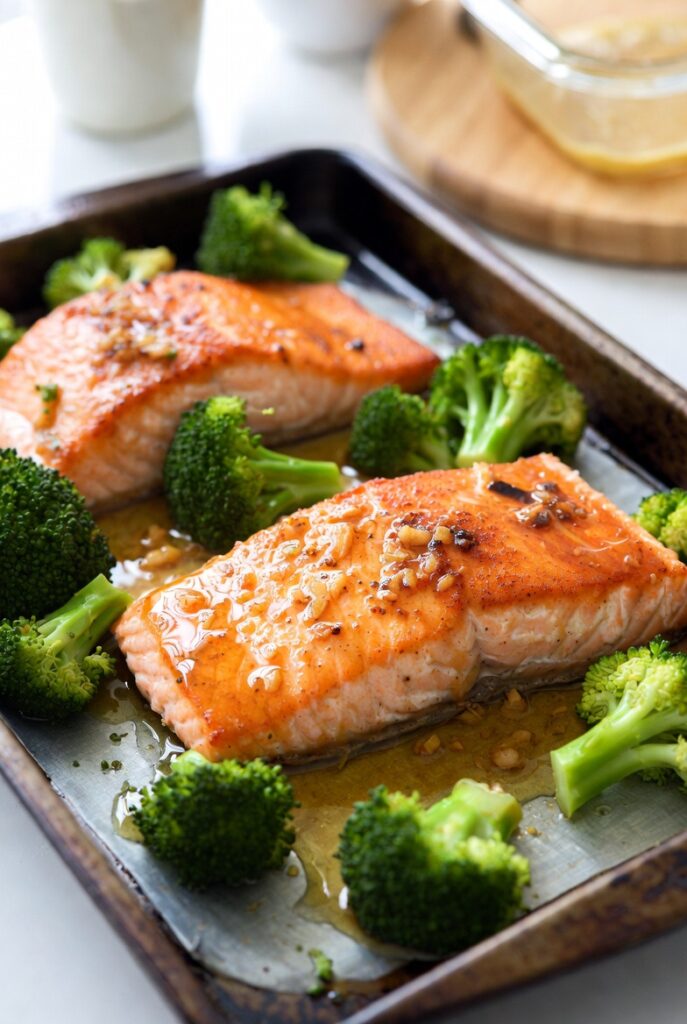
Remove from the oven. Drizzle the remaining 25% of the glaze over the salmon and the broccoli. The residual heat will “set” the fresh glaze. Garnish with toasted sesame seeds and thinly sliced green onions for a restaurant-quality aesthetic.
9. Modular Variations: Customizing the Standard
The Sheet Pan Honey Garlic Salmon and Broccoli is a versatile framework. You can adapt it to fit various dietary needs or flavor preferences:
- The “Spicy” Shift: Add 1 teaspoon of Sriracha or red pepper flakes to the glaze for a “Sweet-Heat” profile.
- The “Keto” Conversion: Replace the honey with a sugar-free maple syrup substitute or a liquid monk-fruit sweetener. Increase the oil content to support healthy ketosis.
- The “Grain” Integration: While designed as a low-carb meal, this dish is exceptional when served over a base of quinoa or cauliflower rice, which will absorb the excess honey-garlic juices from the pan.
10. Satiety and the “Glucose-Fat” Balance
One of the reasons the Sheet Pan Honey Garlic Salmon and Broccoli is so effective for weight management is its “Satiety Profile.” Satiety—the feeling of being full—is governed by several hormones, including $leptin$ and $ghrelin$. By providing a significant dose of protein (from the salmon) and a massive volume of fiber (from the broccoli), this meal triggers the body’s fullness signals through two different pathways.
The protein triggers the release of $peptide YY$, while the fiber physically stretches the stomach lining, signaling to the brain that the meal is complete. The small amount of natural sugar in the honey provides a psychological “sweet fix,” preventing the post-dinner cravings that often sabotage healthy eating habits. This balance makes the dish a powerful tool for anyone looking to maintain a healthy body composition without feeling deprived.
11. Storage and Reheating: Preserving the Integrity
Salmon is notoriously difficult to reheat without turning it into a “fish-flavored eraser.” However, because of our “Glaze Barrier,” this dish is more resilient than most.
- Refrigeration: Store in an airtight glass container for up to 2 days.
- The “Gentle” Reheat: Avoid the microwave if possible. Instead, use an air fryer at $350^\circ F$ (175°C) for 3–4 minutes. This will re-crisp the broccoli and warm the salmon through without over-cooking the center.
- The “Cold” Hack: This meal is actually excellent when served cold. Flake the salmon over a bed of spinach and use the residual honey-garlic juices as a natural vinaigrette for a high-performance lunch.
12. Frequently Asked Questions (FAQ)
Q: Can I use frozen broccoli?
A: You can, but it will not achieve the same “char” as fresh broccoli. Frozen vegetables contain more internal water, which will inevitably lead to some steaming. If using frozen, increase the oven temperature to $425^\circ F$ and roast for an extra 5 minutes.
Q: My salmon has white stuff on it. Is it safe?
A: Yes. That is albumin, a harmless protein that is pushed out of the muscle fibers as they contract. Our “Glaze Barrier” minimizes this, but it is entirely natural and safe to eat.
Q: Can I substitute the salmon for another fish?
A: Yes, trout or arctic char are excellent substitutes as they have a similar fat content. Leaner fish like cod will work, but you may need to reduce the cooking time to 10 minutes to prevent dryness.
13. Nutritional Information
(Per serving – based on 6oz salmon and 2 cups broccoli)
| Nutrient | Amount |
| Calories | 410 kcal |
| Protein | 36g |
| Total Fat | 19g |
| Net Carbs | 18g |
| Fiber | 6g |
| Vitamin C | 150% DV |
| Omega-3s | 2,500mg |