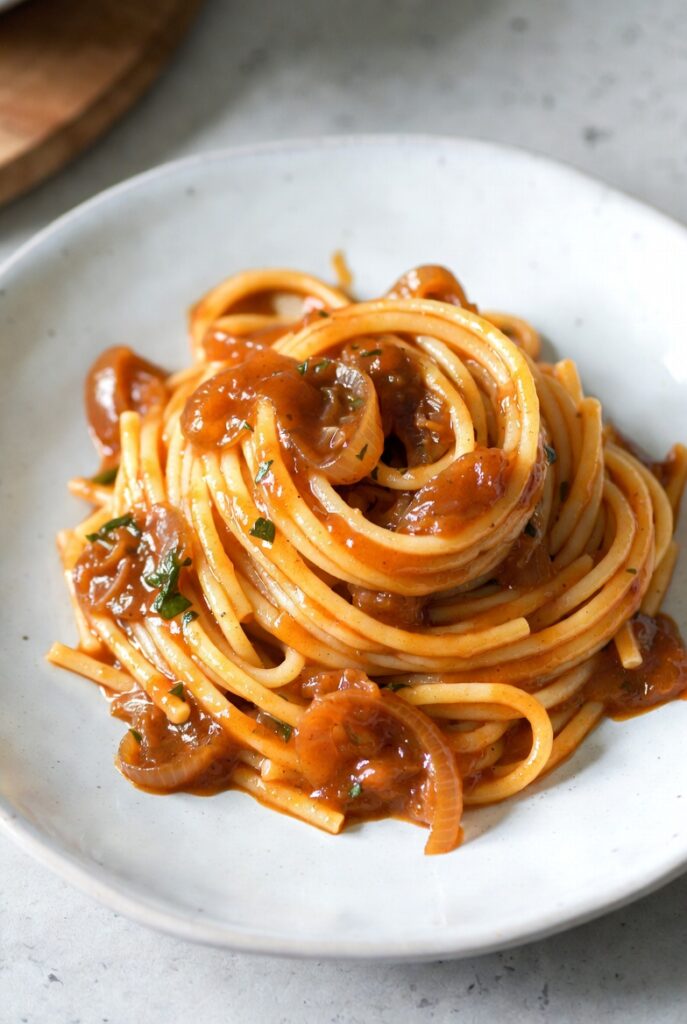
1. Introduction: The Luxury of Slow-Motion Caramelization
In the modern culinary landscape, the One-Pot French Onion Pasta represents a peak achievement in “Flavor Upcycling.” It takes the sophisticated, deeply savory profile of traditional Soupe à l’Oignon—a dish that usually requires hours of simmering and separate bread-toasting—and re-engineers it into a streamlined, high-performance pasta assembly. This is a “Signature Draft” that proves that “One-Pot” does not mean “Basic.” By utilizing the “Concentration Method,” we transform the humble yellow onion into a jammy, umami-dense foundation that seasons the pasta from the inside out.
The brilliance of One-Pot French Onion Pasta lies in its “Starch Integration.” In this method, the pasta is not boiled in a separate vat of water and drained; instead, it is simmered directly in a fortified beef broth alongside the caramelized onions. This captures the $amylose$ starch released by the noodles, which emulsifies with the residual sugars of the onions and a splash of heavy cream to create a silk-like glaze. For the epicurean professional, this is the ultimate tactical meal: a dish that tastes like a four-hour French bistro classic but is executed in a single vessel in under an hour.
Beyond the immediate sensory appeal, this dish is a masterpiece of “Pantry Efficiency.” It relies on low-cost, high-shelf-life staples—onions, dry pasta, and broth—to create a meal of remarkable depth. It is a defining example of how precision in the “Sauté Phase” can elevate simple ingredients into a gourmet experience that supports long-term satiety and metabolic warmth.
2. The Science of the “Pyrolytic Onions” and Deglazing
To master One-Pot French Onion Pasta, one must understand the chemical transition of the onion. Onions are rich in $allyl$ sulfides and natural sugars. When subjected to medium heat over a sustained period, they undergo two distinct processes: Sweating (releasing moisture) and Caramelization (the pyrolysis of sugars). This is not to be confused with browning or searing; true caramelization requires patience to break down the cellular walls of the onion until it reaches a deep, mahogany hue.
The secret to a professional-grade One-Pot French Onion Pasta is the “Deglaze Cycle.” As the onions cook, they leave a layer of concentrated sugars on the bottom of the pot. By introducing an acidic solvent—such as dry white wine or a splash of balsamic vinegar—you release these sugars back into the fat. This creates a “Flavor Compound” that serves as the base for the entire sauce.
Furthermore, the “Absorption Cooking” of the pasta ensures a superior mouthfeel. Traditional pasta is seasoned on the surface; one-pot pasta is seasoned throughout the matrix of the noodle. As the beef broth reduces, the salt and umami molecules are pulled into the pasta’s pores, resulting in a dish where every bite is a concentrated explosion of the French Onion profile.
3. Recipe Overview: The Master Blueprint
- Cuisine Type: French-American Fusion / Comfort Gourmet
- Difficulty Level: Intermediate (Requires patience during onion prep)
- Total Preparation Time: 10 Minutes
- Total Cooking Time: 45 Minutes
- Total Time: 55 Minutes
- Dietary Classifications: High-Satiety, Vegetarian-Adaptable (with Mushroom Broth).
- Yield: Serves 4 to 6
4. Equipment and Tools: The Essentials of Thermal Mass
The structural success of your One-Pot French Onion Pasta depends on a pot that can maintain a low, steady heat for caramelization without “hot spots.”
- 5-Quart Enameled Cast Iron Dutch Oven: The “Heavyweight Champion.” The cast iron provides the thermal inertia needed for slow onion browning, while the enamel surface prevents the acid in the wine from reacting with the metal.
- Wooden Flat-Edge Spatula: Essential for the “Scrape and Stir.” You need to keep the onions moving to prevent localized burning.
- Mandoline Slicer: For “Uniform Micronization.” To ensure the onions caramelize at the same rate, they must be sliced to the exact same thickness (approx. 3mm).
- Microplane: For the “Alpine Finish” of Gruyère or Parmesan cheese.
5. Ingredients Section: Sourcing for Umami Depth
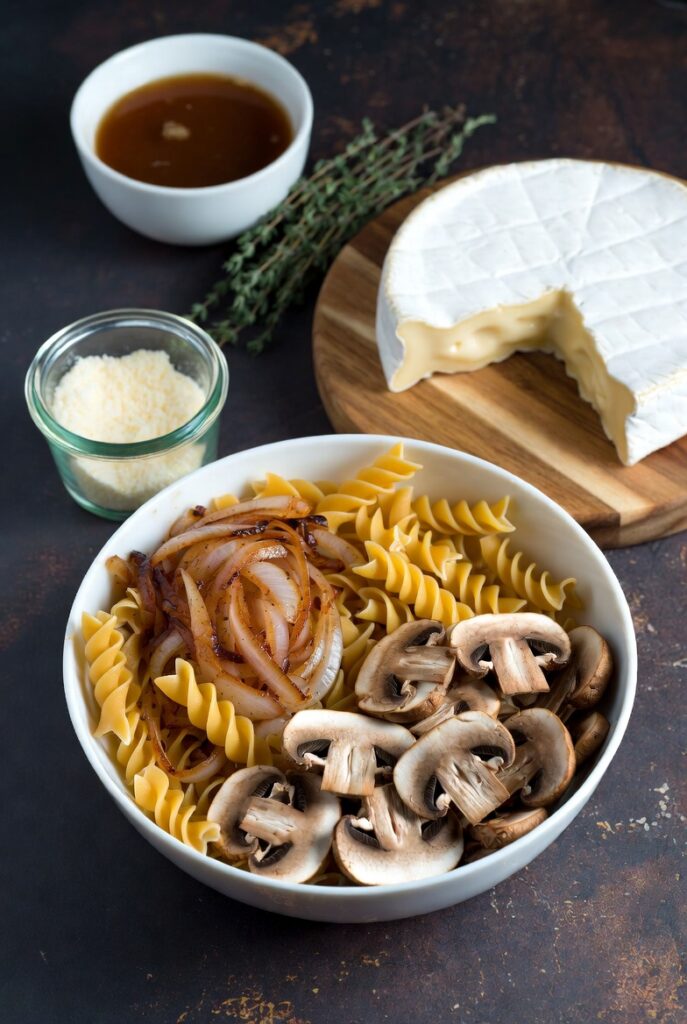
In a dish with such a focused flavor profile, the “Molecular Quality” of the aromatics is paramount.
The Aromatic Foundation
- Yellow Onions: 3 to 4 large onions. Yellow onions have the highest sugar content and the most robust structure for long caramelization.
- Unsalted Butter: 4 tablespoons. The lipids provide the medium for heat transfer and contribute to the “Velvet Mouthfeel.”
The Liquid Matrix
- Dry White Wine (Sauvignon Blanc or Sherry): 1/2 cup. The “Acid Catalyst” used to deglaze the pot and cut through the richness of the beef fat.
- Low-Sodium Beef Broth: 4 to 5 cups. This provides the “Savory Solvent” for the pasta.
- Heavy Cream: 1/4 cup. Added at the end to create the “Emulsion Glaze.”
The Starch and Finish
- Short Pasta (Rigatoni or Shells): Short, ridged pasta is superior as it captures the jammy onions in its hollows.
- Gruyère Cheese: The “Alpine Standard.” Its high fat content and nutty profile are the traditional pairing for French Onion flavors.
- Fresh Thyme: For a “Woody Aromatic” lift.
6. The “Patience Phase”: Onion Engineering
The most common failure in One-Pot French Onion Pasta is “The Rush.” If you cook onions on high heat, they will brown on the outside but stay raw and pungent on the inside. This results in a bitter sauce rather than a sweet one.
To achieve a “Master Draft” finish, you must commit to the 25-minute sauté. Start with the butter and onions over medium-high heat for 5 minutes to soften, then drop the heat to medium-low. If the onions look dry, add a tablespoon of water—this is the “Hydraulic Assist” that prevents burning while allowing the sugars to continue breaking down. By the time you add the pasta, the onions should be reduced to about 25% of their original volume and have the consistency of marmalade. This is the “Flavor Core” of your One-Pot French Onion Pasta.
7. Deep Dive: Quercetin and Immune Resilience
Why is the massive volume of onions in One-Pot French Onion Pasta a functional health choice? Onions are one of the most concentrated dietary sources of Quercetin, a flavonoid with potent antioxidant and anti-inflammatory effects.
Quercetin has been studied for its ability to support cardiovascular health and boost the immune system’s response to oxidative stress. Because the onions are cooked in a “One-Pot” system, the quercetin is not lost to boiling water; it remains in the sauce, ready for absorption. When paired with the zinc found in the beef broth, this meal becomes a “Nutritional Shield,” helping to fortify the body during cold and flu seasons while providing the comfort of a warm pasta dish.
8. Step-by-Step Instructions: The Master Blueprint
Step 1: The Soften and Sweat
Melt the butter in your Dutch oven over medium heat. Add the sliced onions and a pinch of salt. Sauté for 10 minutes until they are soft and translucent.
Step 2: The Caramelization Arc
Reduce heat to medium-low. Continue cooking for another 20–25 minutes, stirring occasionally. The onions will turn from gold to a deep, dark brown. If they stick too much, add a “Splash Assist” of water to loosen the fond.
Step 3: The Acid Deglaze
Increase the heat to medium. Pour in the white wine or sherry. Use your wooden spatula to scrape up all the “Gold” from the bottom of the pot. Let the wine reduce by half.
Step 4: The Starch Submersion
Add the dry pasta, 4 cups of beef broth, and the fresh thyme. Ensure the pasta is submerged.
Step 5: The Absorption Simmer
Bring to a gentle boil, then reduce to a simmer. Cover and cook for 10–12 minutes.
The Pro Move: Stir every 4 minutes. The high sugar content of the onions makes the pasta in your One-Pot French Onion Pasta more likely to stick to the bottom than in a traditional water boil.
Step 6: The Velvet Finish
Once the pasta is al dente and the liquid has reduced to a thick sauce, stir in the heavy cream and half of the Gruyère cheese. The residual heat will melt the cheese into the “Starch Emulsion.”
Step 7: The Alpine Crust
If using an oven-safe pot, sprinkle the remaining cheese over the top and place under the broiler for 2 minutes until bubbly and brown. Garnish with fresh parsley.
9. Expert Tips and Variations
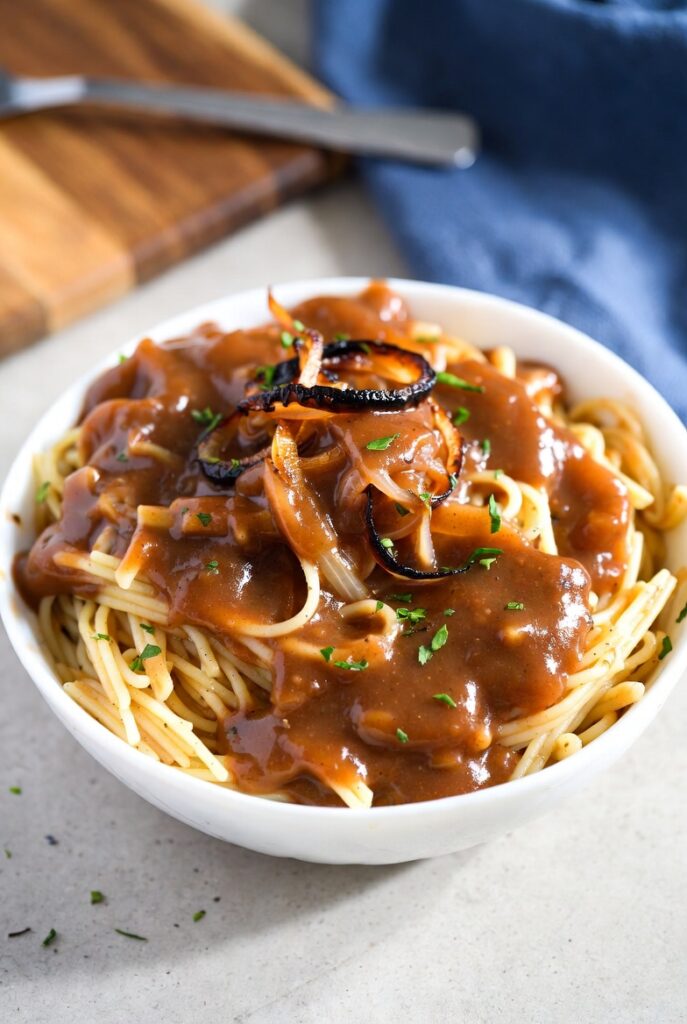
- The “Mushroom” Pivot: For a vegetarian version, replace the beef broth with a high-quality mushroom stock and add 8 oz of sautéed cremini mushrooms for an “Earthier Umami.”
- The “Balsamic” Twist: Add a teaspoon of balsamic glaze during the onion caramelization to intensify the sweetness and provide a more complex “Dark Note.”
- Variations: * The “Beefy” Standard: Stir in leftover shredded roast beef or sautéed steak bites at the end for a “Steakhouse Style” meal.
- The “French Dip” Style: Serve with a side of extra beef broth for “dipping,” mimicking the classic sandwich.
10. Satiety and the “Umami-Loop”
The One-Pot French Onion Pasta utilizes the “Umami-Loop” to trigger satiety. Umami—the fifth taste—is sensed by receptors that detect $glutamates$. These receptors signal to the brain that the body is receiving high-quality, protein-rich nutrition.
Because the onions and beef broth are so rich in natural glutamates, this dish satisfies “Sensory Hunger” much faster than a standard tomato-based pasta. This allows you to feel deeply satisfied with a smaller portion, making it a “High-Efficiency” meal for weight maintenance and psychological comfort.
11. Storage and Reheating: The Starch Matrix
French Onion Pasta is a resilient leftover, provided you manage the “Starch Rehydration.”
- Refrigeration: Store in airtight containers for up to 4 days.
- The Reheat: The pasta will absorb the sauce as it sits. When reheating, add 2 tablespoons of beef broth or water to “loosen” the emulsion.
- Note: This dish does not freeze well due to the dairy and the onion texture, so it is best enjoyed within the week of preparation.
12. Frequently Asked Questions (FAQ)
Q: Can I use red onions?
A: You can, but they have a slightly different sugar profile and may turn the pasta a purplish hue. Yellow or Vidalia onions are the standard for the best flavor balance.
Q: Why is my sauce too thin?
A: You likely added too much broth or didn’t simmer long enough. Remove the lid for the final 3 minutes of cooking to allow excess moisture to evaporate.
Q: Do I have to use wine?
A: No, but you need an acid. Substitute with 1 tablespoon of apple cider vinegar or balsamic vinegar to achieve the same deglazing effect.
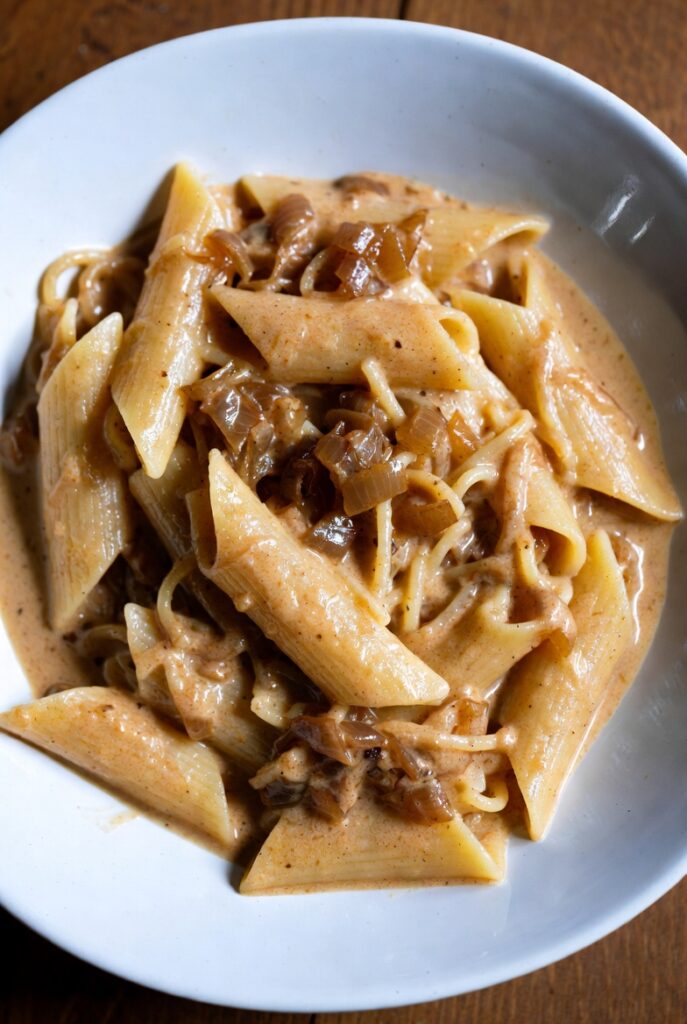
13. Nutritional Information
(Per serving – approx. 1.5 cups)
| Nutrient | Amount |
| Calories | 480 kcal |
| Protein | 18g |
| Total Fat | 22g |
| Net Carbs | 46g |
| Fiber | 4g |
| Quercetin | High |