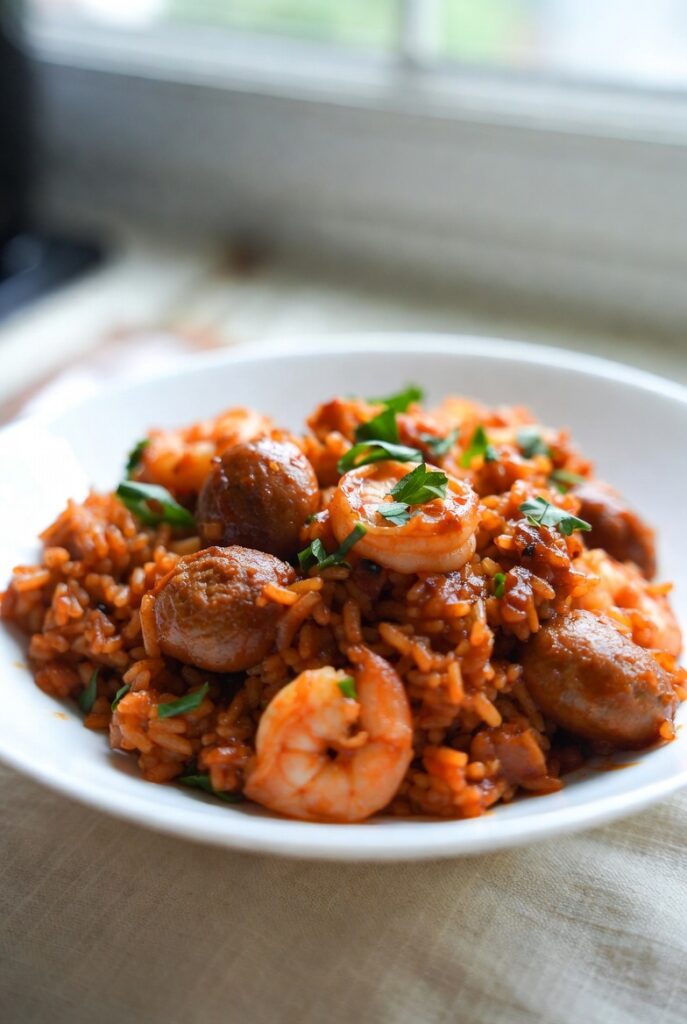
1. Introduction: The Industrial Soul of Creole Cooking
In the vast taxonomy of one-pan meals, the One-Pot Jambalaya with Sausage and Shrimp stands as a pinnacle of “Flavor Density.” Unlike its cousin, the Gumbo (which is a soup or stew served over rice), Jambalaya is a “Built-In” meal. It is a strategic “Signature Assembly” where the rice is cooked directly in the aromatic broth, absorbing the collective essence of the “Holy Trinity,” the smoked fats of the sausage, and the delicate juices of the shrimp. This dish is a tactical victory for anyone seeking a high-protein, nutrient-dense meal that provides a complex sensory experience without the logistical burden of multiple cooking vessels.
The brilliance of One-Pot Jambalaya with Sausage and Shrimp lies in its “Thermal Integration.” It is a dish that honors the historical roots of Louisiana—where Spanish, French, and African culinary traditions merged to create a system of “Single-Pot Survival.” For the modern high-achiever, this dish serves as the ultimate “Fuel Matrix.” It offers a balanced ratio of complex carbohydrates, lean and saturated fats, and high-quality protein, all infused with the anti-inflammatory properties of cayenne, garlic, and thyme. It is a meal that respects your time while providing a deep, lingering satiety that standard “quick meals” cannot match.
Beyond the nutrition, the One-Pot Jambalaya with Sausage and Shrimp represents the “Zen of Layered Flavors.” It proves that efficiency does not have to mean a loss of complexity. By following a specific sequence of “Searing,” “Sweating,” and “Simmering,” you transform a collection of humble staples into a unified, vibrant masterpiece. This is “High-Velocity Gourmet”—a repeatable standard for excellence in the home kitchen.
2. The Science of “Rice Hydration” and the Holy Trinity
To master One-Pot Jambalaya with Sausage and Shrimp, one must understand the chemical foundation of the “Holy Trinity”—onions, bell peppers, and celery. In French cooking, the mirepoix uses carrots; in the humid, swampy climate of Louisiana, carrots were replaced by bell peppers. This change is not just cultural, but functional. The bell pepper provides a higher water content and a specific $capsanthin$ antioxidant profile that, when sautéed, creates a savory-sweet base that carrots cannot replicate.
The secret to a professional-grade result is “Rice Management.” Because this is a “One-Pot” assembly, the rice is responsible for absorbing all the liquid in the pot. If the ratio of liquid to rice is off by even 10%, the dish will either be a “puddle” or a “crunchy mess.” We utilize long-grain white rice for its high amylose content, which ensures the grains remain distinct and fluffy rather than clumping together into a risotto-like texture.
Furthermore, the shrimp component introduces a “Delicate Window” of timing. Shrimp are composed of short muscle fibers that contract rapidly when exposed to heat. To prevent them from becoming “rubberized,” we utilize the residual steam of the rice. This is “Bio-Thermal Precision”—using the thermal mass of the finished rice to gently poach the shrimp in the final minutes of the process.
3. Recipe Overview: The Master Blueprint
- Cuisine Type: Creole / Cajun Fusion
- Difficulty Level: Intermediate (Requires focus on liquid-to-rice ratios)
- Total Preparation Time: 20 Minutes
- Total Cooking Time: 35 Minutes
- Total Time: 55 Minutes
- Dietary Classifications: High-Protein, Gluten-Free, Dairy-Free.
- Yield: Serves 6 to 8 (Superior for high-volume meal prep)
4. Equipment and Tools: The Essentials of Retention
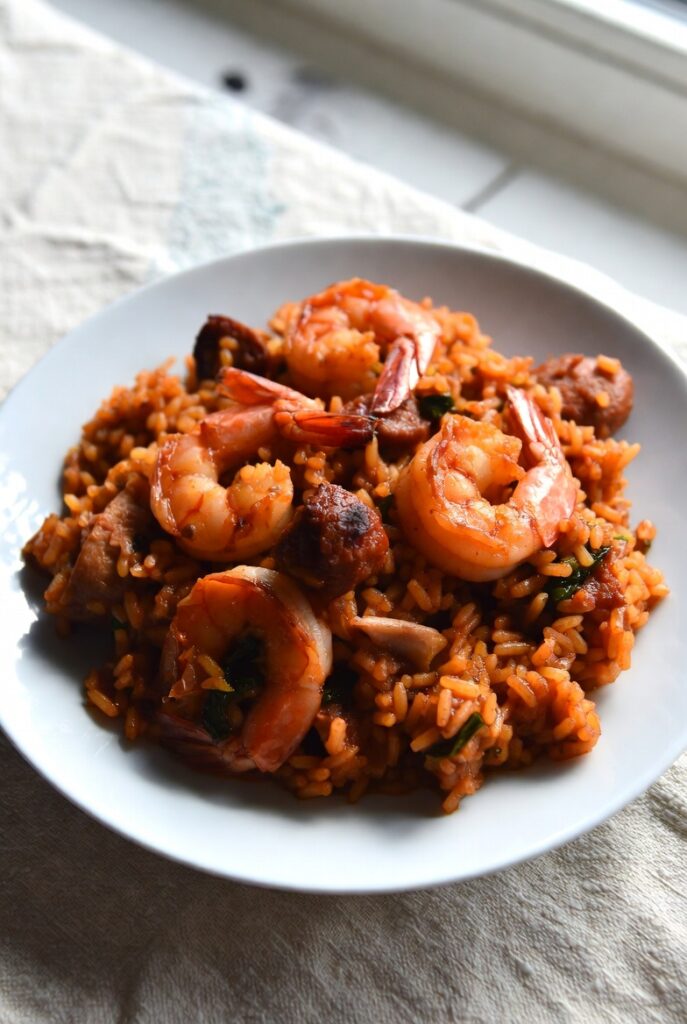
The structural integrity of your One-Pot Jambalaya with Sausage and Shrimp depends on a vessel that can manage high-heat searing and uniform simmering.
- 6-Quart Enameled Cast Iron Dutch Oven: This is the gold standard. The thick walls provide “Thermal Inertia,” preventing the bottom of the rice from scorching while the top layer is still steaming.
- Wooden Flat-Edge Spatula: Essential for “Deglazing.” You must be able to scrape the fond (browned bits) from the bottom of the pot, as this contains 40% of the dish’s final flavor profile.
- Large Measuring Pitcher: For precision liquid calibration.
- Chef’s Knife: For the “Uniform Dice.” To ensure the Holy Trinity softens at the same rate, every piece must be of equal size.
5. Ingredients Section: Sourcing for Umami
In a One-Pot Jambalaya with Sausage and Shrimp draft, the “Authenticity” of the flavor depends on the smoke and the spice.
The Protein Anchors
- Andouille Sausage: 1 lb. This is a double-smoked pork sausage that provides the “backbone” of the flavor. If unavailable, use a high-quality smoked kielbasa.
- Jumbo Shrimp: 1 lb, peeled and deveined. The “Tail-On” option is purely aesthetic; “Tail-Off” is superior for seamless consumption.
The Holy Trinity & Aromatics
- Yellow Onion, Green Bell Pepper, and Celery: The $1:1:1$ ratio that forms the aromatic base.
- Garlic: 4 cloves, minced.
- Canned Diced Tomatoes: 14.5 oz (specifically “Creole” style if possible). The acidity helps break down the fats in the sausage.
The Starch and Fluid
- Long-Grain White Rice: 2 cups. Do not use “Parboiled” or “Instant” rice; they lack the structural integrity for a 20-minute simmer.
- Chicken Broth: 3.5 to 4 cups. The “Variable” of the dish.
- Cajun/Creole Seasoning: A blend of cayenne, thyme, oregano, and garlic powder.
6. The “Fond-Deglaze” Sequence
The most common failure in One-Pot Jambalaya with Sausage and Shrimp is a “pale” flavor. This happens when the cook rushes the searing of the sausage.
To achieve a “Master Draft” finish, you must brown the sausage coins until they develop a dark, caramelized crust. As the fat renders out, it will leave a brown residue on the bottom of the Dutch oven. This is the fond. When you add the Holy Trinity, the moisture from the onions will act as a natural solvent. Use your spatula to scrape that fond into the vegetables. This process is called “Deglazing,” and it ensures that the “Smoky DNA” of the sausage is distributed through every single grain of rice. Without this step, your Jambalaya is merely a rice dish; with it, it is a culinary masterpiece.
7. Deep Dive: Capsaicin and Metabolic Throughput
Why is the One-Pot Jambalaya with Sausage and Shrimp considered a “Functional Fuel”? It centers on the use of Cayenne and Black Pepper. These spices contain $capsaicin$ and $piperine$, respectively. Both compounds are known to stimulate “Thermogenesis”—the process by which the body generates heat and burns calories.
When you consume a spicy Jambalaya, you are slightly increasing your metabolic rate. Furthermore, the high protein content from the shrimp and sausage has a high “Thermic Effect of Food” (TEF), meaning your body uses more energy to process these proteins than it does for simple fats or carbs. Paired with the complex carbohydrates of the rice, this meal provides a sustained, high-energy output that is perfect for post-workout recovery or a demanding workday.
8. Step-by-Step Instructions: The Master Blueprint
Step 1: The Maillard Sear
Place your Dutch oven over medium-high heat. Add 1 tablespoon of oil. Add the sliced sausage and sear for 5–7 minutes until deeply browned. Remove the sausage and set aside, leaving the rendered fat in the pot.
Step 2: The Trinity Sweating
Add the onion, bell pepper, and celery to the pot. Sauté for 8 minutes. The vegetables should become translucent and start to pick up the brown color from the sausage fat. Stir in the garlic and the Cajun seasoning for the final 60 seconds.
Step 3: The Tomato Matrix
Add the diced tomatoes (with juices) and use your spatula to thoroughly deglaze the bottom of the pot. Stir in the tomato paste if you prefer a “Red” (Creole) style Jambalaya.
Step 4: The Rice Submersion
Add the dry rice to the pot. Stir for 2 minutes. This “toasts” the rice and ensures the grains are coated in the aromatic oils, which prevents clumping.
Step 5: The Controlled Simmer
Pour in 3.5 cups of chicken broth. Add the browned sausage back into the pot. Bring to a boil, then immediately reduce the heat to the absolute lowest setting. Cover with a tight-fitting lid. Rule: Do not lift the lid for 20 minutes.
Step 6: The Poaching Finish
After 20 minutes, lift the lid. The rice should have absorbed the liquid. Quickly scatter the raw shrimp over the top of the rice. Replace the lid and turn off the heat. Let the pot sit for 5–7 minutes. The residual steam will poach the shrimp to a perfect, snappy pink.
Step 7: The Final Fluff
Remove the lid. Use a fork to gently fluff the rice, folding the shrimp and sausage together. Garnish with a massive handful of sliced green onions and a dash of hot sauce.
9. Satiety and Volume Management
The One-Pot Jambalaya with Sausage and Shrimp is a premier example of “Satiety Optimization.” Because the rice is cooked in a protein-rich broth with fibrous vegetables, it has a lower glycemic index than plain white rice. This means the energy is released into your bloodstream more slowly, preventing the “Sugar Crash” often associated with high-carb meals.
Furthermore, the “Volume” of the dish—provided by the Holy Trinity and the diced tomatoes—ensures that you feel physically full before you over-consume calories. It is a meal that respects the body’s natural hunger signals, making it an excellent choice for those looking to maintain a high-performance physique without feeling deprived of “Real Food.”
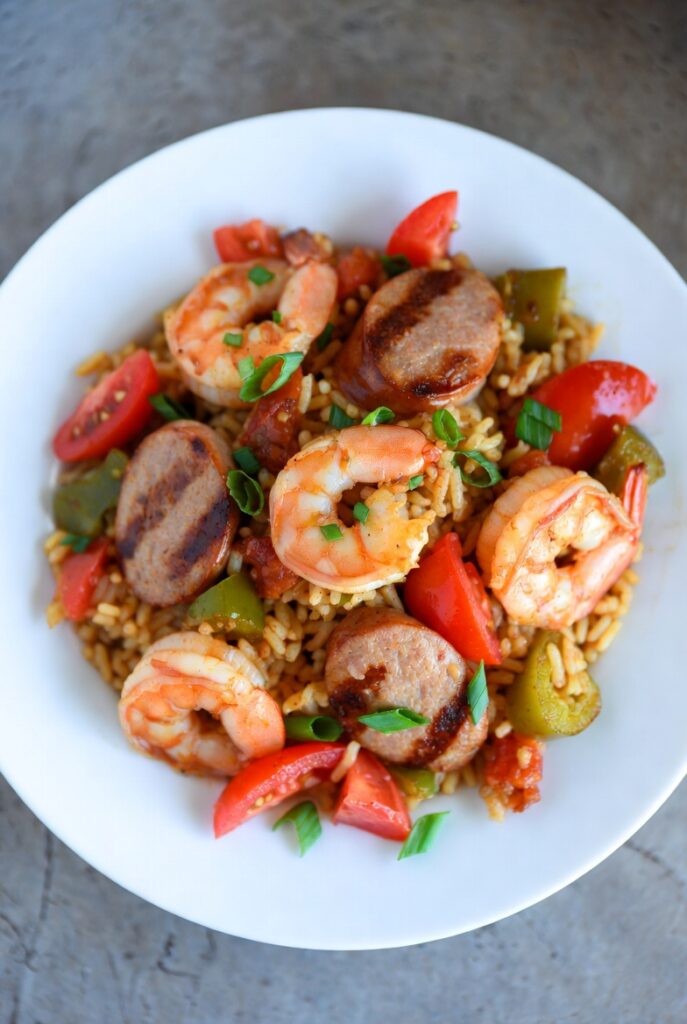
10. Storage and the “Second-Day” Evolution
Like many complex assemblies, the One-Pot Jambalaya with Sausage and Shrimp undergoes a “Flavor Evolution” after 24 hours in the refrigerator.
- Molecular Integration: As the dish cools, the starches in the rice continue to bond with the spices and fats. The heat of the cayenne mellows into a deep, rounded warmth.
- Reheating Logistics: When reheating, the rice may be drier. Add a splash of water or broth before microwaving or heating in a skillet. This creates a “Mini-Steam” effect that restores the original texture of the shrimp and rice.
- Meal Prep: This recipe makes a large volume. Portion it into glass containers for a “Zero-Friction” lunch that provides better nutrition than 95% of available takeout options.
11. Frequently Asked Questions (FAQ)
Q: Can I use brown rice?
A: Yes, but you must increase the liquid to 4.5 cups and the simmer time to 45 minutes. Do not add the shrimp until the very end, as they will not survive a 45-minute cook.
Q: Why is my Jambalaya “mushy”?
A: You likely stirred it too much or used too much liquid. Once the lid goes on, the rice must remain undisturbed to maintain its individual grain structure.
Q: Is this “Cajun” or “Creole”?
A: The addition of tomatoes technically makes this a “Creole” (city) Jambalaya. “Cajun” (country) Jambalaya typically omits the tomatoes and relies on the browning of the meat for color.
Q: Can I use frozen shrimp?
A: Yes. Just ensure they are fully thawed and patted dry before adding them to the pot, otherwise they will release excess water and throw off your liquid ratio.
12. Nutritional Information
(Per serving – approx. 1.5 cups)
| Nutrient | Amount |
| Calories | 450 kcal |
| Protein | 32g |
| Total Fat | 18g |
| Net Carbs | 38g |
| Fiber | 4g |
| Vitamin C | 40% DV |
| Iron | 20% DV |
13. Summary: The Master Draft of Efficiency
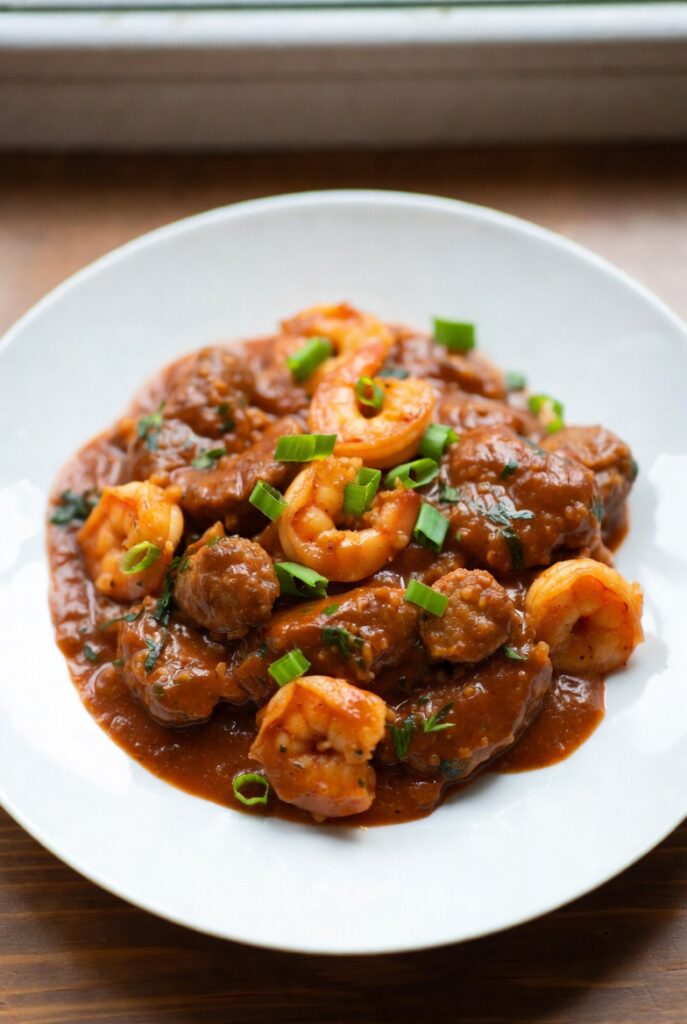
The One-Pot Jambalaya with Sausage and Shrimp is more than just a recipe; it is a system for high-quality living. It proves that you can have a meal that is deep, complex, and culturally rich without spending three hours in the kitchen or creating a mountain of dishes. By mastering the “Holy Trinity” and the “Poaching Finish,” you are adding a powerful tool to your culinary arsenal—one that delivers maximum biological and sensory ROI.