1. Introduction: The Industrial-Scale Solution to Deep Satiety
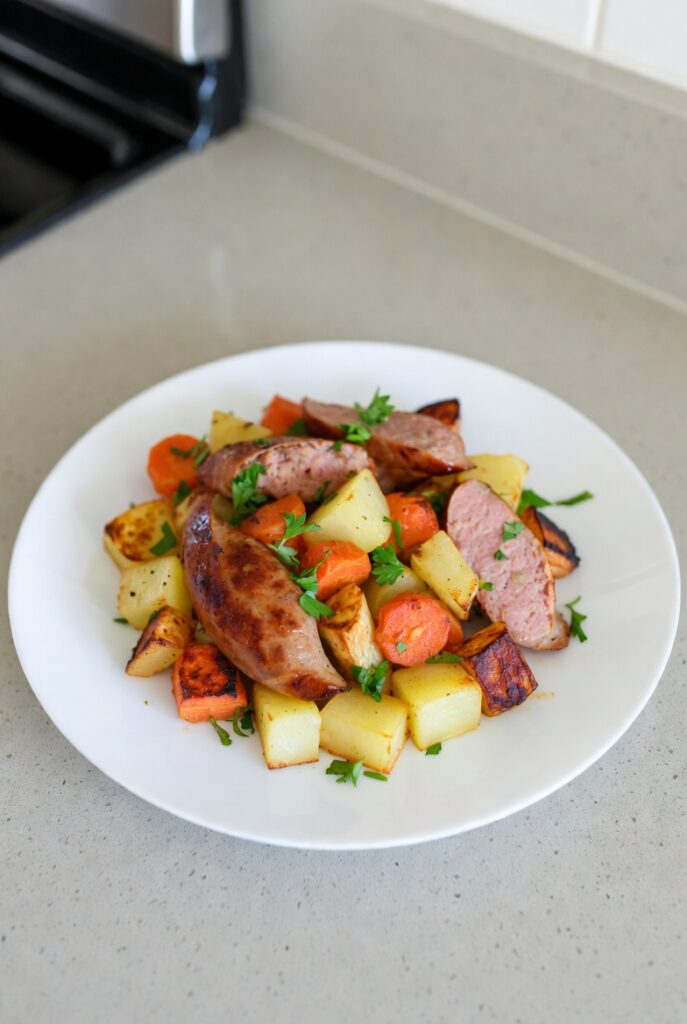
In the modern landscape of functional nutrition, the Sheet Pan Sausage and Root Vegetables assembly stands as a masterclass in “Time Arbitrage.” This dish is a tactical triumph over the “Decision Fatigue” that often plagues the evening hours. It represents a culinary philosophy where the oven’s convective power is harnessed to transform humble, earth-bound ingredients into a sophisticated, high-performance meal. By utilizing a single roasting plane, we synchronize the caramelization of complex carbohydrates with the rendering of high-quality proteins, creating a “Signature Assembly” that is as aesthetically pleasing as it is nutritionally dense.
The brilliance of Sheet Pan Sausage and Root Vegetables lies in its structural integrity. Unlike delicate leafy greens or soft-tissue proteins that require constant supervision, root vegetables are the “heavy lifters” of the produce aisle. They possess a dense cellular matrix that thrives under sustained heat, undergoing the Maillard reaction to unlock deep, nutty sweetness. For the high-achieving individual, this is the ultimate “Zero-Friction” dinner: fifteen minutes of mechanical preparation followed by thirty minutes of passive roasting, resulting in a meal that supports metabolic stability and provides a massive dose of fiber.
Beyond the immediate convenience, this dish represents the “Architecture of the Harvest.” It is a meal that respects the seasonality of the earth while providing the “Macros” required for physical recovery. Whether you are an athlete looking for glycogen replenishment or a professional seeking a low-stress meal prep solution, the Sheet Pan Sausage and Root Vegetables offers a reliable, repeatable standard of excellence. It is a dish that proves you do not need complex techniques to achieve gourmet-level results; you simply need the right thermal strategy.
2. The Science of “Cellular Caramelization”
To master Sheet Pan Sausage and Root Vegetables, one must understand the chemical transition of starches into sugars. Root vegetables—such as sweet potatoes, parsnips, and carrots—are essentially storage vessels for the plant’s energy. When subjected to the $400^\circ F$ (200°C) environment of a roasting pan, the starch molecules undergo pyrolysis. This is the process where heat breaks down the long-chain carbohydrates into simple sugars, which then brown on the surface to create a “crust.”
The secret to a professional-grade Sheet Pan Sausage and Root Vegetables is the “Surface-to-Mass Ratio.” If the vegetables are cut too large, the exterior will burn before the interior softens. If they are cut too small, they will lose their structural identity and turn into a paste. We aim for a “uniform micronization”—cutting everything into roughly 1-inch cubes. This ensures that every piece of vegetable reaches its peak sweetness simultaneously with the sausage reaching its safe internal temperature.
Furthermore, the sausage plays a critical role in the “Thermal Emulsion.” As the sausage roasts, its internal fats (lipids) render out onto the pan. This seasoned fat acts as a conductive medium, “frying” the bottom of the vegetables that are in contact with the metal. This is why a Sheet Pan Sausage and Root Vegetables dish tastes more cohesive than vegetables steamed separately; they are essentially being “confited” in the aromatic oils of the protein.
3. Recipe Overview: The Master Blueprint
- Cuisine Type: Modern Rustic / Functional Meal Prep
- Difficulty Level: Very Easy (Precision-based chopping)
- Total Preparation Time: 15 Minutes
- Total Cooking Time: 30–35 Minutes
- Total Time: 50 Minutes
- Dietary Classifications: Gluten-Free, Dairy-Free, High-Fiber, Paleo-friendly.
- Yield: Serves 4 to 6 (High-volume capacity)
4. Equipment and Tools: The Essentials of Conductive Heat
The success of your Sheet Pan Sausage and Root Vegetables depends on the gauge of your metal and the quality of your “Release Agent.”
- Heavy-Duty 18×13 inch Rimmed Sheet Pan: Avoid “thin” supermarket pans. A professional-grade, heavy-gauge aluminum pan will not warp under heat, ensuring even oil distribution.
- Large Stainless Steel Mixing Bowl: For the “Emulsion Toss.” You cannot achieve even seasoning by sprinkling spices over a flat pan; you must coat the ingredients in a bowl first.
- Parchment Paper (High-Heat Rated): This facilitates cleanup and prevents the “Starch-to-Metal Fusion” that often happens with roasted potatoes.
- Precision Chef’s Knife: A sharp blade is essential for the “Uniform Cube” technique, reducing the physical labor of processing dense roots like parsnips or rutabagas.
5. Ingredients Section: Sourcing for Texture and Aroma
In a Sheet Pan Sausage and Root Vegetables draft, the contrast between “Sweet,” “Savory,” and “Earthy” is what creates a balanced palate.
The Protein Anchor
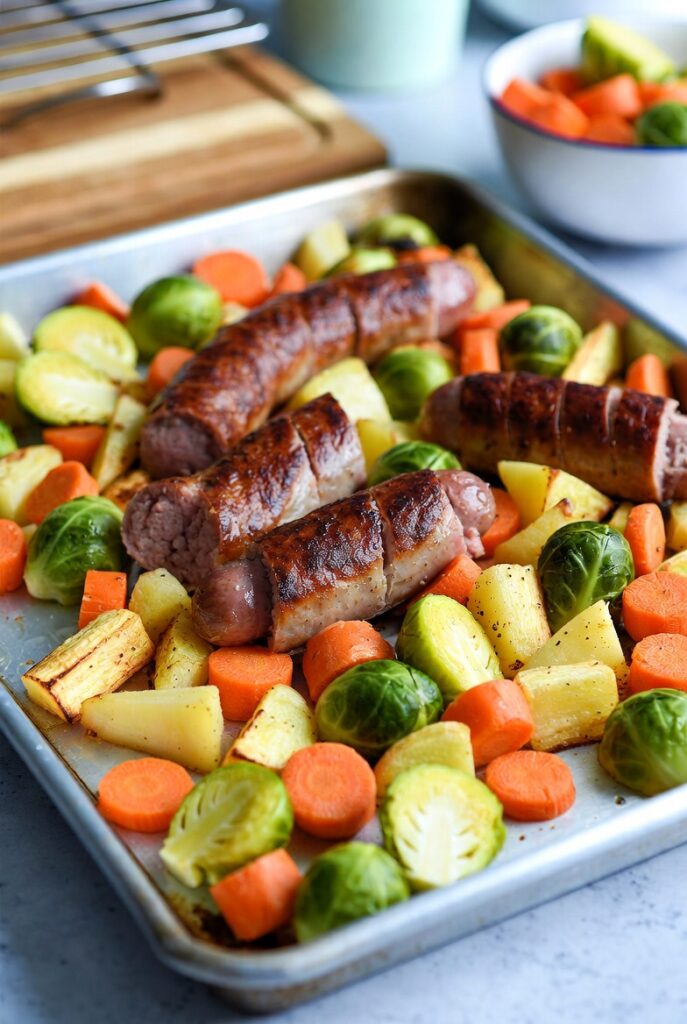
- High-Quality Smoked Sausage: Kielbasa, Andouille, or Chicken Apple Sausage. Pre-cooked smoked sausages are superior for sheet pans because they are already emulsified and won’t “burst” or lose excessive moisture.
The Root Matrix
- Sweet Potatoes or Yams: For Vitamin A and a soft, creamy texture.
- Parsnips or Carrots: For a floral, earthy sweetness. Parsnips, in particular, provide a sophisticated “peppery” finish.
- Red or Yukon Gold Potatoes: These hold their shape better than Russets and develop a “waxy-crisp” exterior.
The Aromatic Catalysts
- Red Onion: Cut into thick wedges to provide a “jammy” contrast to the dense roots.
- Fresh Rosemary and Thyme: The “Woody Herbs” are sturdy enough to withstand 30 minutes of high heat without turning bitter.
- Extra Virgin Olive Oil: The “conveyor” of heat and the medium for spice adhesion.
6. The “Crowding” Trap: Avoiding the Steam Effect
The most common failure in Sheet Pan Sausage and Root Vegetables is “Atmospheric Crowding.” If you attempt to cook too many vegetables on a single pan, they will release their internal moisture into the air. If the pieces are touching, this moisture becomes trapped, creating a “steam pocket.” Instead of roasting and browning, your vegetables will boil.
To achieve the “Master Draft” finish, follow the “20% Rule”: 20% of the pan’s surface area should be visible metal. This allows the hot air to circulate $360^\circ$ around each cube. If you are feeding a larger group, utilize two pans on separate racks and rotate them halfway through. This technical adjustment is the difference between a soggy tray and a tray of golden, caramelized Sheet Pan Sausage and Root Vegetables.
7. Deep Dive: Resistant Starch and Gut Health
Why are the root vegetables in Sheet Pan Sausage and Root Vegetables so beneficial for the microbiome? It centers on a concept called Resistant Starch. When root vegetables (especially potatoes) are cooked and then allowed to cool slightly, a portion of their starch undergoes “retrogradation,” turning into resistant starch.
Unlike regular starch, resistant starch is not digested in the small intestine. Instead, it travels to the colon, where it acts as a prebiotic, feeding the beneficial bacteria in your gut. This process produces butyrate, a short-chain fatty acid that supports the lining of the gut and reduces inflammation. By preparing a large batch of Sheet Pan Sausage and Root Vegetables for meal prep, you are actually enhancing the nutritional profile of the leftovers.
8. Step-by-Step Instructions: The Master Blueprint
Step 1: The Thermal Calibration
Preheat your oven to $400^\circ F$ (200°C). Position your oven rack in the center. If using two pans, use the upper and lower thirds.
Step 2: The Micronization Phase
Peel and cut your sweet potatoes, parsnips, and regular potatoes into 1-inch uniform cubes. Slice the red onion into thick wedges and the sausage into 1-inch coins. The uniformity of the Sheet Pan Sausage and Root Vegetables is the key to even cooking.
Step 3: The Emulsion Toss
In your large mixing bowl, combine 3 tablespoons of olive oil, 1 teaspoon of sea salt, 1/2 teaspoon of black pepper, 1 tablespoon of chopped rosemary, and 1 teaspoon of garlic powder. Add the vegetables and sausage. Use your hands to “massage” the oil into every crevice.
Step 4: The Strategic Spread
Line your pan with parchment paper. Pour the contents of the bowl onto the pan and spread them out. Ensure the sausage coins are in direct contact with the pan surface to facilitate browning.
Step 5: The Mid-Point Rotation
Roast for 15 minutes. Remove the pan and use a large spatula to toss the ingredients. This ensures the “bottom-sear” is redistributed. Rotate the pan $180^\circ$ and return to the oven.
Step 6: The Final Caramelization
Roast for an additional 15–20 minutes. Look for “Char-Edges” on the onions and a “Puffed” appearance on the potatoes. The Sheet Pan Sausage and Root Vegetables should smell aromatic and nutty.
Step 7: The “Bright” Finish
Remove from the oven and immediately sprinkle with fresh parsley or a squeeze of lemon juice. The acidity “wakes up” the heavy fats of the sausage and the sugars of the roots.
9. Expert Tips and Variations
- The “Brussels” Swap: If you want to increase the sulfur-rich vegetable content, add halved Brussels sprouts to the mix. They thrive in the same thermal window as root vegetables.
- The “Apple” Pivot: For a true “Autumnal Standard,” add a diced Granny Smith apple during the last 15 minutes of roasting. The tartness pairs exceptionally well with the sausage.
- Variations: * The “Spicy” Standard: Use Chorizo sausage and add a teaspoon of smoked paprika and a pinch of cayenne.
- The “Maple” Glaze: Drizzle 1 tablespoon of maple syrup over the vegetables during the final 5 minutes for a “high-gloss” sweetness.
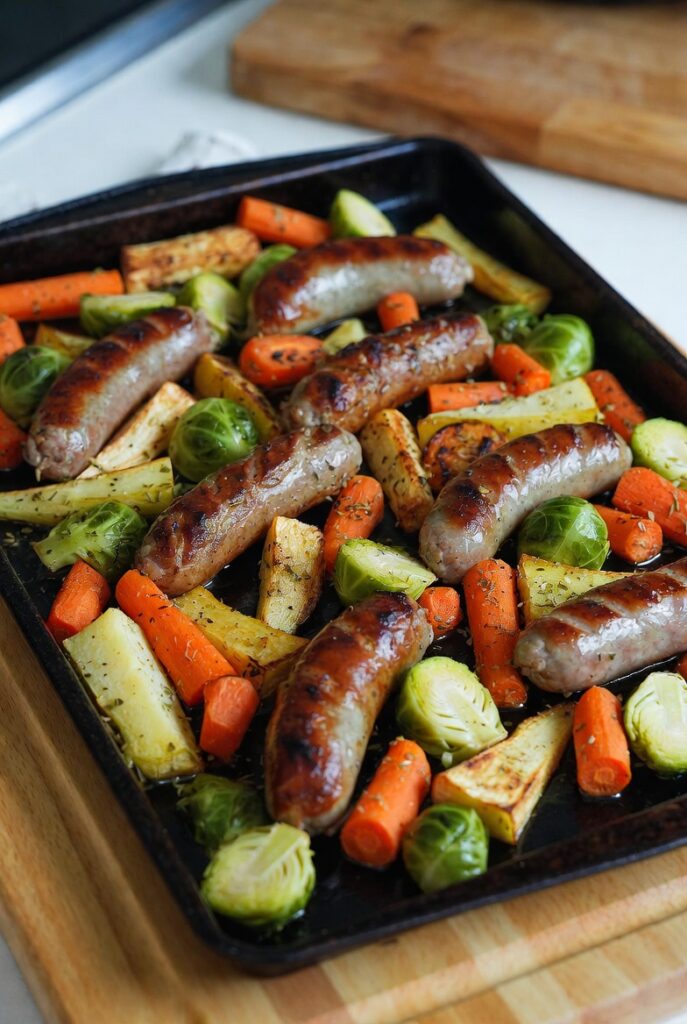
10. Satiety and the “Volume Eating” Strategy
The Sheet Pan Sausage and Root Vegetables is a premier example of “Volume Eating.” Because root vegetables are high in fiber and water content, they allow you to consume a physically large portion of food for a relatively moderate caloric load. This triggers the stretch receptors in the stomach, sending “fullness” signals to the brain earlier than processed foods would.
By balancing the volume of the roots with the high-density protein of the sausage, you are creating a meal that satisfies both the “sensory” hunger (the need to chew and taste) and the “nutritional” hunger (the need for amino acids and glucose). This makes it a perfect dish for weight management and metabolic health, providing a “Full-Plate” experience that leaves you energized rather than lethargic.
11. Storage and Reheating Logistics
One of the primary reasons the Sheet Pan Sausage and Root Vegetables is a “Meal Prep Titan” is its resilience in the refrigerator.
- Refrigeration: Store in glass airtight containers for up to 5 days. The flavors of the herbs and sausage will actually “marinate” the vegetables further as they sit.
- The Reheat: Avoid the microwave if you want to maintain the “crisp” edges. Instead, use an air fryer at $375^\circ F$ (190°C) for 4 minutes or a dry skillet for 5 minutes.
- The “Breakfast” Pivot: Leftover Sheet Pan Sausage and Root Vegetables can be tossed into a skillet and topped with a fried egg for a high-performance “Sheet Pan Hash.”
12. Frequently Asked Questions (FAQ)
Q: Do I need to peel the potatoes?
A: For Yukon Gold or Red potatoes, the skin provides extra fiber and a great texture. For Sweet Potatoes or Parsnips, peeling is recommended to remove the “woody” exterior.
Q: Can I use raw sausage?
A: You can, but you must ensure it reaches $165^\circ F$ (74°C). Raw sausage will also release significantly more liquid, which might “steam” your vegetables. Smoked, pre-cooked sausage is the superior choice for this specific sheet pan method.
Q: Why are my parsnips tough?
A: Parsnips have a “woody core” if they are very large. When prepping your Sheet Pan Sausage and Root Vegetables, try to choose medium-sized parsnips or remove the very center of the thickest part.
13. Nutritional Information
(Per serving – approx. 1/4 of the pan)
| Nutrient | Amount |
| Calories | 380 kcal |
| Protein | 18g |
| Total Fat | 22g |
| Net Carbs | 28g |
| Fiber | 7g |
| Potassium | 20% DV |