1. Introduction: The Architecture of the “Anglo-Indian” Icon
In the expansive taxonomy of global gastronomy, Chicken Tikka Masala represents a fascinating study in “Cross-Cultural Culinary Engineering.” Often cited as Britain’s true national dish, its brilliance lies in the “Biphasic Cooking Method.” Unlike standard curries where meat is simmered in sauce, Tikka Masala requires the meat to be pre-treated through a Char-Induced Sear (Tikka) before being integrated into a velvety, tomato-based emulsion (Masala).
A true “Master Draft” of this recipe aims to achieve the depth of a 48-hour marination and the smokiness of a traditional clay Tandoor within a simplified, domestic framework. We focus on “Aromatic Layering”—the science of building flavor through successive thermal stages rather than a singular “Dump-and-Go” approach. For the modern professional, the high-volume meal-prepper, or the weekend gourmet, this is the “Platinum Standard” of comfort food: it delivers a “High-Resolution” flavor profile with a streamlined logistical chain.
2. The Science of the “Double-Transition” Marinade
To master Chicken Tikka, one must move beyond the spice jar and understand the mechanics of Proteolysis and Acid-Base Balancing. The secret to that “melt-in-your-mouth” texture is the use of Yogurt.
Unlike vinegar-based marinades that can turn meat “Mushy” by denaturing surface proteins too aggressively, yogurt contains Lactic Acid. Lactic acid works at a lower velocity, gently breaking down the connective tissues while the Calcium in the yogurt activates enzymes within the chicken that further tenderize the fibers. This creates a “Micro-Porous” surface area, allowing the spices—specifically the fat-soluble compounds in ginger and garlic—to penetrate the meat’s “Molecular Matrix.” This isn’t just a flavor coating; it is a structural transformation.
3. Recipe Overview: The Master Blueprint
- Cuisine Type: Anglo-Indian / Global Comfort
- Difficulty Level: Medium (Focus on “Sequential Sautéing”)
- Total Preparation Time: 20 Minutes (plus 1–4 hours marination)
- Total Cooking Time: 30 Minutes
- Total Time: Approx. 4 Hours (including marination)
- Dietary Classifications: Gluten-Free, High-Protein, Keto-Friendly (if served with cauliflower rice).
- Yield: Serves 4–6
4. Equipment and Tools: The Essentials of “Thermal Mass”
- Large Cast Iron Skillet or Heavy-Bottomed Pot: To maintain “Thermal Inertia” when adding the sauce.
- Large Mixing Bowl: For the “Proteolytic Immersion” (marination).
- High-Powered Blender (Optional): To achieve the “Silken-Masala” texture favored by high-end restaurants.
- The “Tandoor-Simulator” (Oven Broiler): To achieve the necessary “Char-Points” on the chicken.
5. Ingredients Section: Sourcing for “Chromatographic” Vibrancy
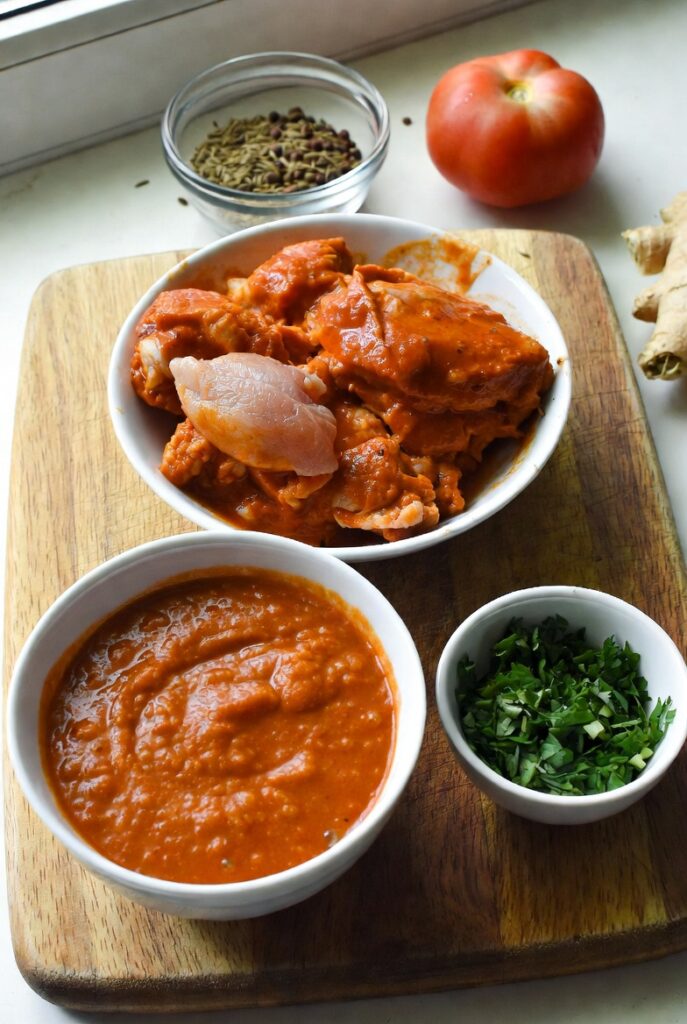
In a dish defined by its “Acid-to-Cream” ratio, the “Purity” of the spices and the “Lipid Content” of the dairy dictate the final “Sensory Resolution.”
The Protein Anchor
- Chicken Thighs: 2 lbs.
- The Master Hack: Use Boneless, Skinless Thighs. They contain more intramuscular fat than breasts, ensuring they remain “Succulent” under the high heat of the broiler and the subsequent simmer.
The “Tikka” Marinade (Phase 1)
- Full-Fat Greek Yogurt: 1 cup. (The “Enzymatic Catalyst”).
- Lemon Juice: 2 tbsp. (The “Acidic High-Note”).
- Ginger-Garlic Paste: 2 tbsp. (Freshly grated for maximum “Allicin” impact).
- Garam Masala: 2 tsp.
- Turmeric: 1 tsp.
- Kashmiri Red Chili Powder: 1 tbsp. (Provides a “Mahogany Hue” without excessive capsaicin burn).
The “Masala” Sauce (Phase 2)
- Butter (Ghee): 3 tbsp. (The “Lipid Carrier”).
- Canned Tomato Puree: 1.5 cups. (Provides a “Concentrated Acidic Base”).
- Heavy Cream: 1 cup. (To create the “Velvet Emulsion”).
- Yellow Onion: 1 large, finely minced.
- Spices: Cumin, Coriander, and extra Garam Masala.
- Dried Fenugreek Leaves (Kasuri Methi): 1 tbsp. (The “Secret Ingredient” for an authentic restaurant aroma).
6. The “Maillard-Char” Protocol: Simulating the Tandoor
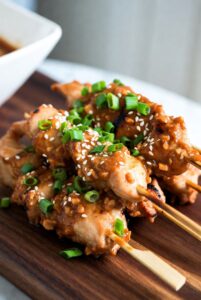
The defining characteristic of an authentic Tikka is the Smoke-Char. In a home kitchen, we utilize the “Broiler-Flash Protocol.” Instead of pan-frying the marinated chicken, thread the pieces onto skewers or lay them on a wire rack over a baking sheet. Place them 3 inches under the oven broiler on high for 6–8 minutes per side.
- The Result: The yogurt marinade “Blisters,” creating “Carbonized flavor-peaks.” These charred bits will eventually dissolve into the sauce, providing a “Synthetic Smoke” profile that elevates the dish from a “Stew” to a “Tikka Masala.” This is “Atmospheric Simulation” applied to poultry.
7. Deep Dive: The “Capsaicin-Cream” Equilibrium
Why is this sauce so addictive? It centers on “Phosphate-Lipid Emulsification.” The tomatoes provide a sharp, high-acidity base, while the heavy cream and butter provide high-density fats. When combined, the cream “Coats” the tongue, protecting the taste buds from the sharp edges of the spices.
This creates a “Time-Released Flavor Experience.” You first taste the “Creamy Sweetness,” followed by the “Acidic Brightness” of the tomato, and finally the “Warm Glow” of the Garam Masala. This is “Linear Sensory Delivery,” designed to prevent palate fatigue and encourage high-volume consumption.
8. Step-by-Step Instructions: The Master Blueprint
Step 1: The “Proteolytic” Immersion
In a large bowl, whisk together the yogurt, lemon juice, and marination spices. Add the chicken thighs (cut into 1.5-inch cubes). Massage the marinade into the meat. Cover and refrigerate for at least 1 hour (4 hours is the “Gold Standard”).
Step 2: The “Tandoor-Flash”
Preheat your broiler to high. Place the chicken on a wire rack. Broil until the edges are “Slightly Charred” and the chicken is $80\%$ cooked. Remove and set aside.
Step 3: The “Aromatic Foundation”
In a large pot, melt the ghee or butter. Add the minced onion and sauté until “Translucent-Gold.” Add the ginger-garlic paste and sauté for 60 seconds until the “Raw Sulfur” aroma disappears.
Step 4: The “Spice Blooming”
Add the cumin, coriander, and chili powder directly to the hot fat. Stir for 45 seconds. This “Blooms” the fat-soluble flavors, ensuring they are “Integrated” into the sauce matrix rather than just sitting on top.
Step 5: The “Emulsion” Synthesis
Pour in the tomato puree and a splash of water. Simmer on low for 15 minutes. The sauce will darken as the sugars in the tomato “Caramelize.”
Step 6: The “Velvet” Polish
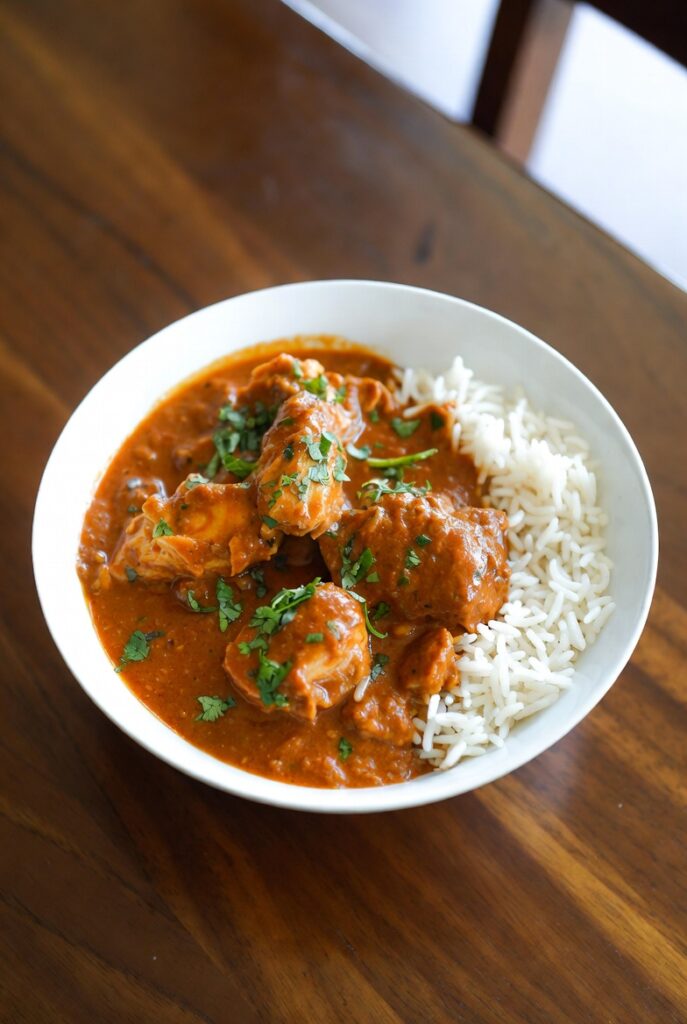
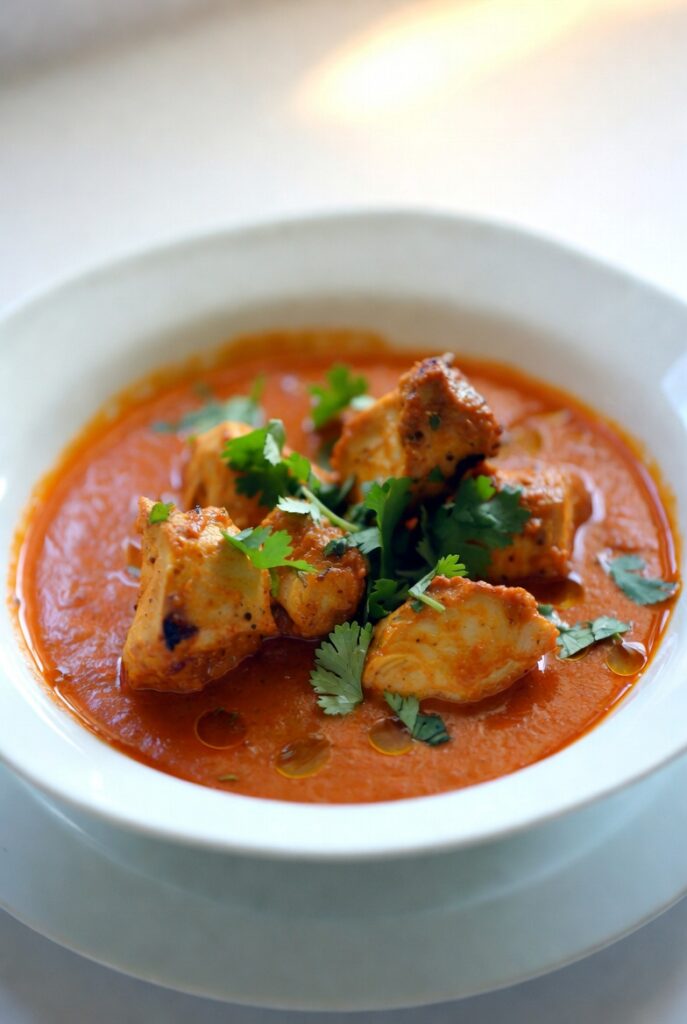
Stir in the heavy cream. The sauce will transition from “Deep Red” to a “Saffron-Orange.” Add the broiled chicken and any accumulated juices. Simmer for 5–10 minutes to finish the cooking.
Step 7: The “Kasuri Methi” Finale
Crush the dried fenugreek leaves between your palms and stir them in. This provides a “Nutty, Maple-like” aroma that is the hallmark of professional Indian cuisine.
9. Satiety and the “Stabilized energy” Curve
Authentic Chicken Tikka Masala provides “High-Resolution Satiety”:
- The Lipid Buffer: The combination of yogurt and heavy cream slows the absorption of spices, providing a “Stable Metabolic Burn.”
- The High Protein Density: Chicken thighs offer essential amino acids and collagen, supporting tissue repair and muscle maintenance.
- The Thermogenic Factor: The ginger and chili powders increase “Diet-Induced Thermogenesis,” subtly boosting the metabolic rate during digestion.
10. Modular Customization: The “Flavor Pivots”
- The “Inferno” Draft: Add 2 chopped Thai green chilies during the onion sauté for a “Capsaicin High-Note.”
- The “Vegan” Standard: Replace chicken with Extra-Firm Tofu or Roasted Cauliflower, and use Coconut Cream in place of dairy.
- The “Light” Utility: Substitute heavy cream with Whole Milk Yogurt added at the very end (off-heat) to prevent curdling.
11. Storage and “Aromatic Maturation”
- Refrigeration: Store in an airtight container for up to 3 days.
- The “Overnight” Rule: Like all complex curries, Tikka Masala improves after 24 hours. The “Char-Bits” from the chicken fully dissolve into the cream, resulting in a deeper, more “Cohesive” flavor profile.
- The Reheat: Reheat gently on the stove over low heat. If the sauce has thickened too much, add a tablespoon of water or broth to restore the “Silken Viscosity.”
12. Frequently Asked Questions (FAQ)
Q: Why is my sauce “Grainy”?
A: This usually happens if the onions aren’t minced finely enough or if the ginger-garlic paste wasn’t fully sautéed. For a “Professional-Polish,” you can blend the sauce (before adding the cream and chicken) in a high-speed blender.
Q: Can I use chicken breast?
A: Affirmative. However, chicken breast dries out at a much lower temperature. If using breast, reduce the broiler time and ensure the chicken is only just cooked through when it hits the sauce.
Q: Is the Fenugreek (Kasuri Methi) necessary?
A: It is the “Soul of the Dish.” While the curry will taste good without it, it will lack that specific “Restaurant Finish” that makes the flavor haunt the palate.
13. Nutritional Information
(Per serving – approx. 1.5 cups)
| Nutrient | Amount |
| Calories | 480 kcal |
| Protein | 34g |
| Total Fat | 32g |
| Net Carbs | 12g |
| Vitamin A | 20% DV |
14. Summary: The Master Draft of Anglo-Indian Utility
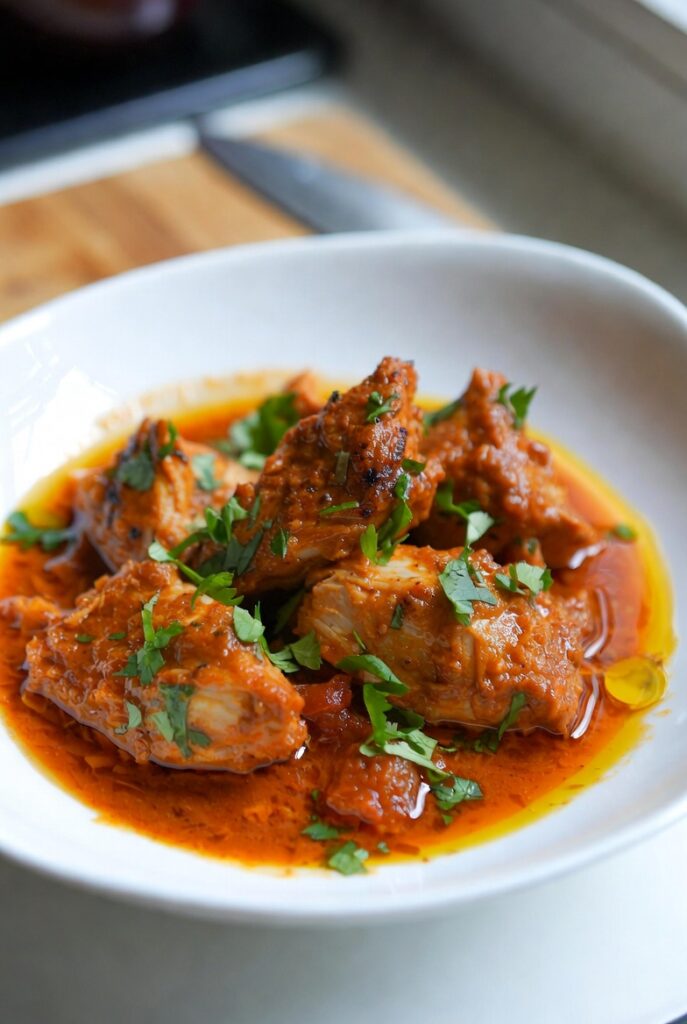
The Authentic Chicken Tikka Masala (Simplified) is more than a recipe; it is a “Vessel for Intentional Synergy.” It proves that “Gourmet Results” can be achieved through the mastery of “Proteolytic Marination” and the “Broiler-Flash Protocol.” By respecting the “Sequential Sautéing” of the spices and the “Lipid-Acid Balance” of the cream and tomatoes, you are delivering a dish that is visually “Saffron-Gold,” nutritionally dense, and sensorially perfect.