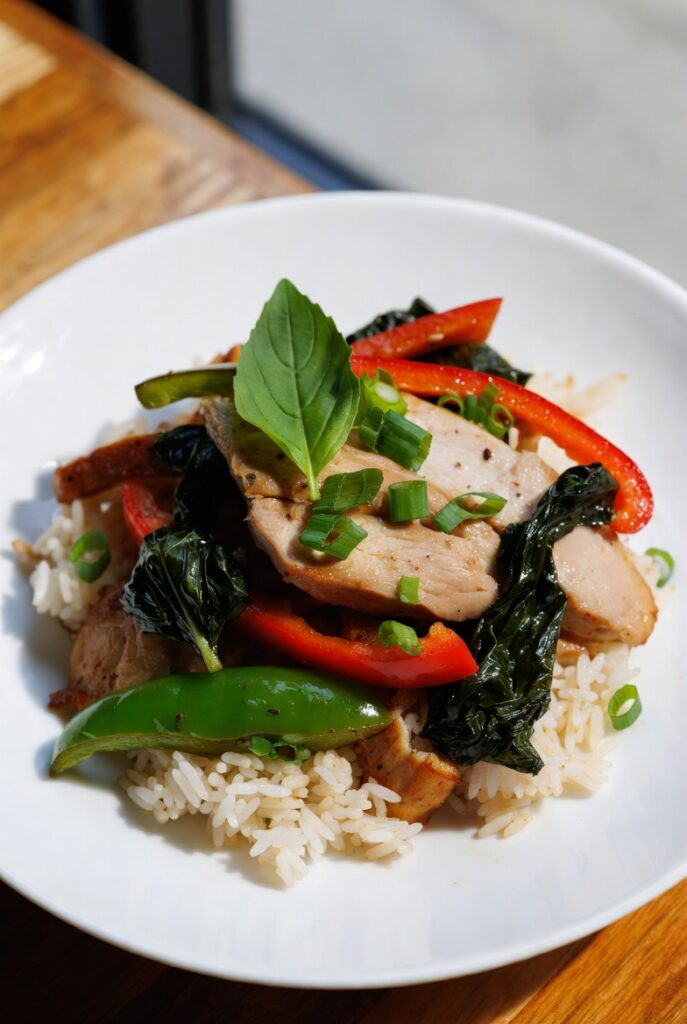
1. Introduction: The Architecture of the “Street-Style” High-Note
In the hierarchy of Southeast Asian gastronomy, Thai Basil Chicken, known natively as Pad Krapow Gai, represents the pinnacle of “Culinary Immediacy.” It is a dish that rejects the heavy, coconut-laden complexities of traditional red or green curries in favor of “Aromatic Intensity” and “Wok-Fired Kinetic Energy.” This is the undisputed “People’s Choice” of Bangkok—a dish defined by its “high-resolution” heat, its savory-sweet sauce matrix, and the unmistakable, peppery punch of holy basil.
The brilliance of this dish lies in its “Thermal Velocity.” Executed properly, the cooking process takes less than five minutes, utilizing extreme heat to “flash-sear” ground chicken while simultaneously blooming the essential oils of chilies and garlic. For the modern professional, the performance athlete, or the culinary strategist, this is the “Platinum Standard” of weeknight recovery fuel: it is high-protein, relatively low-calorie, and delivers a massive dose of “Capsaicin-Driven Dopamine.” It is a dish that understands that “Gourmet” is not about the duration of the cook, but the precision of the “Maillard-Aromatic Loop.”
2. The Science of “Holy” vs. “Thai” Basil
To master Pad Krapow, one must understand the molecular biology of the herb that gives the dish its name. In the West, “Thai Basil” (the purple-stemmed, licorice-scented O. basilicum) is often used as a substitute. However, the authentic “Master Draft” requires Holy Basil (Ocimum tenuiflorum), known as Krapow.
Holy basil contains high concentrations of Eugenol—the same compound found in cloves. This gives the herb a distinctively peppery, “numbing” heat that intensifies when subjected to the high temperatures of a wok. Unlike sweet basil, which becomes “muddled” and floral when cooked, holy basil undergoes a “Thermal Transformation,” deepening into a savory, clove-like aromatic that binds the chicken and chili together. If you cannot find Holy Basil, the “Thai” variety is an acceptable “Social Substitute,” but for the “Platinum Result,” the peppery bite of Krapow is the essential variable.
3. Recipe Overview: The Master Blueprint
- Cuisine Type: Authentic Thai Street Food / High-Velocity Utility
- Difficulty Level: Easy (Focus on “Mise en Place” and Heat Management)
- Total Preparation Time: 15 Minutes (Includes hand-chopping)
- Total Cooking Time: 5 Minutes
- Total Time: 20 Minutes
- Dietary Classifications: High-Protein, Low-Carb (if served without rice).
- Yield: Serves 2–3
4. Equipment and Tools: The Essentials of “Kinetic Heat”
- Carbon Steel Wok or 12-inch Cast Iron Skillet: High “Thermal Mass” is required. The pan must be able to maintain its temperature even when the cold meat is introduced.
- Mortar and Pestle: The most critical tool in the Thai kitchen. Pounding the aromatics creates a “Paste” that releases more essential oils than knife-mincing.
- Wok Spatula (Chuan): For the rapid “Lift-and-Fold” motion essential for even searing.
5. Ingredients Section: Sourcing for “Umami-Heat” Balance
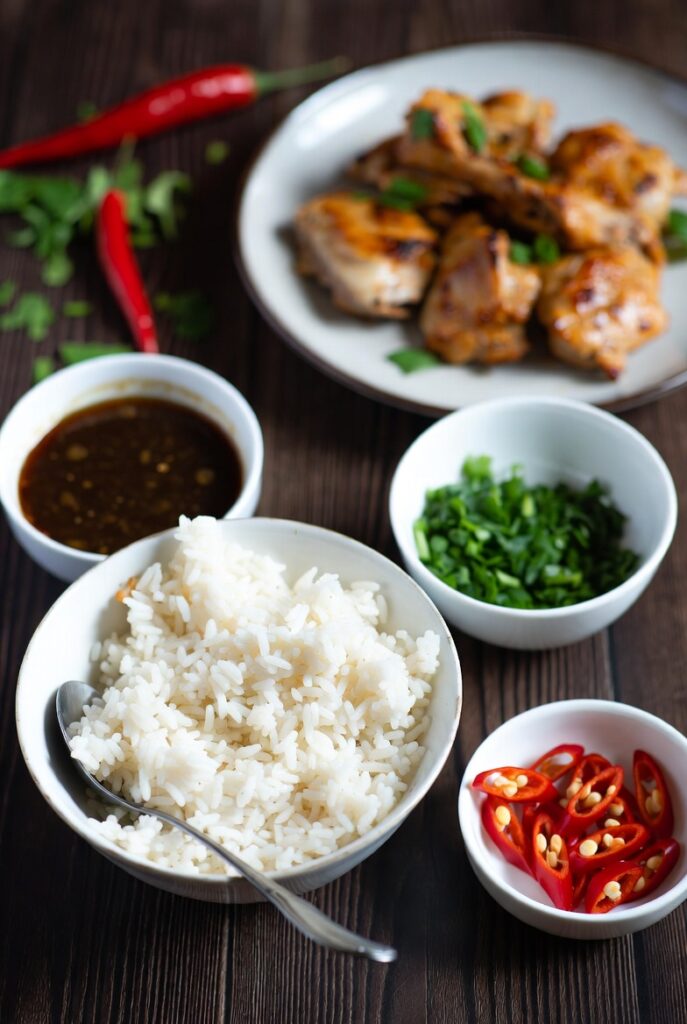
In a dish with zero “Fillers,” the quality of the fermented sauces and the freshness of the aromatics dictate the “Aromatic Ceiling.”
The Protein Anchor
- Chicken Thighs: 1 lb.
- The Master Hack: Avoid “Pre-Ground” supermarket chicken. Hand-chop skinless, boneless thighs into a “Coarse Mince.” This preserves the “Textural Integrity” and ensures the meat stays juicy under high heat.
The “Aromatic High-Notes”
- Thai Bird’s Eye Chilies: 5–10 (Adjust for your “Capsaicin Tolerance”).
- Garlic: 5 cloves.
- Shallot: 1 small, finely sliced. (Adds a “Caramelized Sweetness”).
The “Liquid Matrix” (The Sauce)
- Oyster Sauce: 2 tbsp. (The “Umami Anchor”).
- Light Soy Sauce: 1 tbsp. (The “Saline Driver”).
- Dark Soy Sauce: 1 tsp. (For the “Caramel Color” and “Molasses Depth”).
- Fish Sauce (Nam Pla): 1 tsp. (The “Pungency Spike”).
- Sugar: 1 tsp. (To facilitate the “Maillard Reaction” and balance the heat).
The “Jade” Finish
- Holy Basil Leaves: 2 cups, packed. (Add more than you think—they shrink by $80\%$).
- Oil: 2 tbsp. (Neutral oil with a high smoke point, like Avocado or Peanut).
6. The “Aromatic-Paste” Protocol
The most common failure in Thai Basil Chicken is “Boiled Aromatics.” To achieve a “Master Draft” finish, you must utilize the “Aromatic-Paste Protocol.”
Do not simply slice your chilies and garlic. Place them in a mortar with a pinch of salt and pound them until they form a “Coarse, Ragged Paste.” This mechanical destruction of the cell walls releases the Allicin in the garlic and the Capsaicin in the chilies, creating an “Integrated Heat” that coats the oil. When this paste hits the hot wok, it “blooms” instantly, creating the characteristic “Bangkok Aroma” that defines the dish.
7. Deep Dive: The “Wok Hei” and the Maillard Loop
Why is the “Wok-Fire” so essential? It centers on “Wok Hei” (The Breath of the Wok). At temperatures exceeding $200^\circ C$, the sugars in the soy sauce and the proteins in the chicken undergo a rapid, multi-stage Maillard Reaction.
Because the chicken is minced, the surface area is maximized. This allows for thousands of “Micro-Sears” across the meat. Simultaneously, the “Atomized Oil” droplets in the wok catch fire for a fraction of a second, introducing a “Smoky Complexity” that cannot be replicated on a low-heat stove. This is “Chemical Sophistication” disguised as street food—concentrating flavor through extreme thermal stress.
8. Step-by-Step Instructions: The Master Blueprint
Step 1: The “Mise en Place” Preparation
Combine the oyster sauce, soy sauces, fish sauce, and sugar in a small bowl. Hand-chop your chicken thighs. Pound your chilies and garlic into a paste. Crucial: Once you start cooking, you will not have time to prep.
Step 2: The “Aromatic Bloom”
Heat your wok over High Heat until it begins to smoke. Add the oil and swirl. Toss in the chili-garlic paste and shallots. Stir-fry for exactly 30 seconds—you want the garlic to turn golden, not brown.
Step 3: The “Protein-Sear” Phase
Add the minced chicken. Use your spatula to spread it into a single layer against the hot walls of the wok. Let it sit for 45 seconds to develop a “Golden Crust.”
Step 4: The “Kinetic Agitation”
Begin stir-frying vigorously. Break up any large clumps of chicken. Cook until the meat is $90\%$ opaque (approx. 2 minutes).
Step 5: The “Liquid-Matrix” Integration
Pour the sauce mixture over the chicken. The liquid will sizzle and immediately begin to reduce, coating the meat in a “High-Gloss Lacquer.” Toss for 30 seconds until the sauce has “tightened” around the chicken.
Step 6: The “Jade-Wilt” Finish
Turn off the heat. Add the holy basil. Toss the chicken over the basil until the leaves have “Flash-Wilted” from the residual heat. This preserves the “Volatile Eugenol” and the vibrant green color.
Step 7: The “Prik Nam Pla” Garnish
Serve over jasmine rice, traditionally topped with a “Crispy Fried Egg” (Kai Dao) with a lacy, browned edge and a runny yolk.
9. Satiety and the “Capsaicin-Protein” Plateau
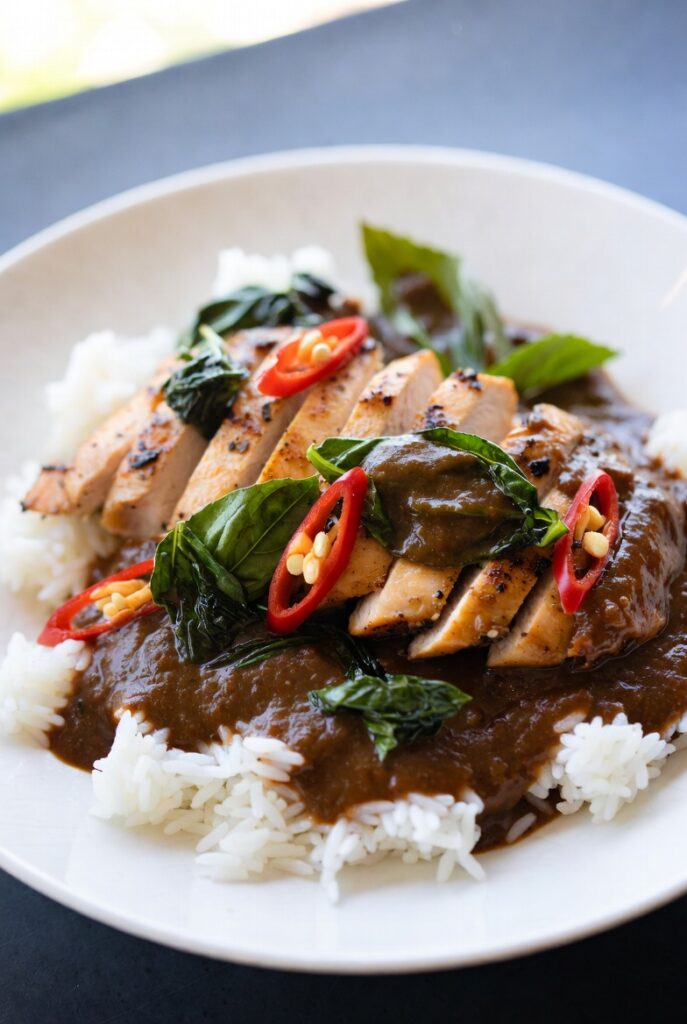
Thai Basil Chicken provides “High-Resolution Satiety.” 1. The Capsaicin Spike: The chilies trigger a mild “Thermogenic Effect,” increasing the metabolic rate and releasing endorphins.
2. The Leucine Load: Chicken thighs are rich in Leucine, the primary amino acid responsible for stimulating muscle protein synthesis.
When paired with the “Rapid Glucose” of jasmine rice, this meal provides a perfect “Anabolic Window” for recovery. However, for those on a “Ketogenic Draft,” the chicken and basil alone provide a “Lipid-Buffered” satiety that lasts for hours. It is “Tactical Nutrition” for the high-performance individual.
10. Modular Variations: The “Flavor Pivots”
- The “Coastal” Draft (Pad Krapow Talay): Replace chicken with a mix of shrimp and squid. Reduce cooking time to prevent “Rubbery Texture.”
- The “Plant-Based” Standard: Use crumbled extra-firm tofu or minced “King Oyster Mushrooms” to replicate the “Fibrous Chew” of the chicken.
- The “Lanna” Shift: Add a pinch of white pepper and long beans for a “Northern Thai” textural variation.
11. Storage and the “Aromatic Decay”
- Refrigeration: Store in an airtight container for up to 3 days.
- The Reheat: Like all basil-centric dishes, the aromatics will “decay” slightly over time. To restore the “Master Draft” quality, reheat in a hot skillet (not a microwave) and toss in a handful of fresh basil at the very end to “re-awaken” the flavor profile.
12. Frequently Asked Questions (FAQ)
Q: Can I use chicken breast?
A: You can, but it is a “Sub-Optimal Choice.” Breast meat lacks the fat content to survive the high-intensity heat of the wok, often resulting in a “Chalky” texture. Thighs are the “Elite Standard.”
Q: Why is my dish watery?
A: This is usually caused by “Crowding the Pan.” If you cook too much chicken at once, the temperature drops and the meat “stews” in its own juices. Cook in batches if necessary to maintain the “Sear-Inertia.”
Q: I can’t find Holy Basil. What is the best substitute?
A: Use “Thai Basil” (purple stems) and add a crack of fresh black pepper. This mimics the “Peppery Heat” of the eugenol found in true Holy Basil.
13. Nutritional Information
(Per serving – approx. 1 cup chicken mixture)
| Nutrient | Amount |
| Calories | 320 kcal |
| Protein | 32g |
| Total Fat | 18g |
| Net Carbs | 6g |
| Iron | 15% DV |
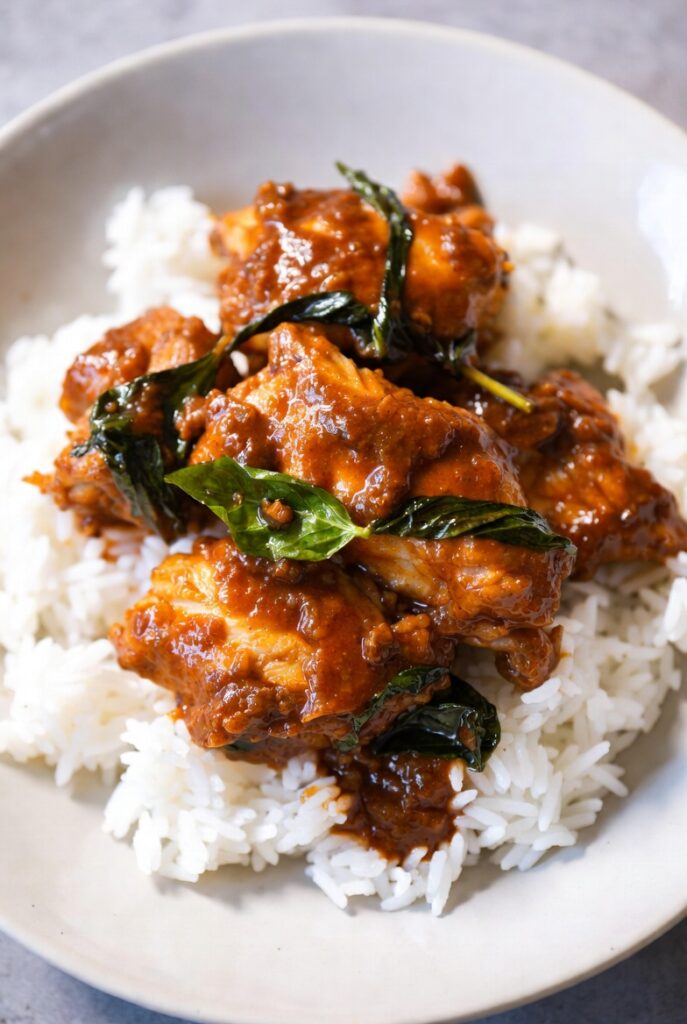
14. Summary: The Master Draft of High-Velocity Satisfaction
The Thai Basil Chicken is more than a recipe; it is a “Vessel for Intentional Heat.” It proves that the most “Vibrant” and “Addictive” flavors in the world do not require long-form braising—they require “Aromatic Precision” and “High-Intensity Conduction.” By mastering the “Aromatic-Paste Protocol” and the “Jade-Wilt Finish,” you are delivering a dish that is biologically satisfying, culturally authentic, and sensorially perfect.
It is the ultimate “Social Anchor”—a “Glistening, Chili-Flecked” testament to the power of the wok and the beauty of the basil leaf.