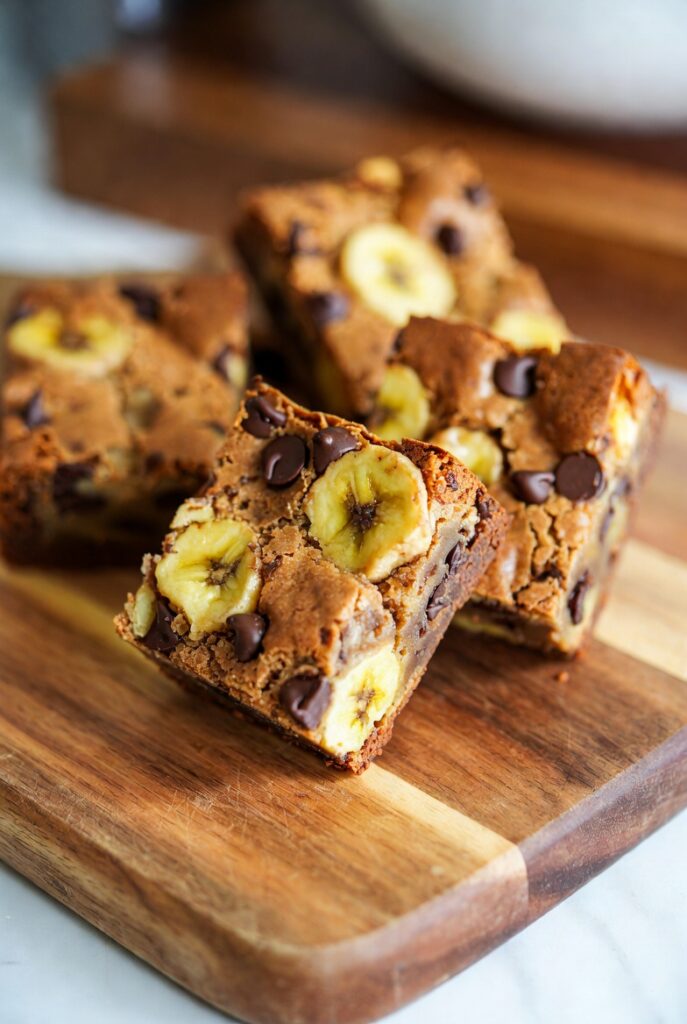
1. Introduction: The Architecture of “Hybrid-Crumb Engineering”
In the evolving landscape of functional pastry, the Banana Bread Brownie represents a landmark achievement in “Starch-Lipid Fusion.” While a traditional brownie relies on the high-fat, high-cocoa “Fudgy-Matrix,” the Banana Bread Hybrid introduces the humectant properties of “Leopard-Spot” banana puree. This is not simply a brownie with banana flavoring; it is a structural redesign of the crumb itself.
This document serves as the “Technical Manifesto” for the dish. We move beyond the rudimentary “fruit-in-batter” logic and examine the mechanics of “Enzymatic-Browning Cycles.” By balancing the increased moisture content of the banana with high-cocoa solids, we achieve a result that possesses the dense, “Pull-Apart” tenderness of a fudge brownie with the aromatic, nutty depth of a master-tier banana bread. For the culinary strategist, this is the “Platinum Standard” of comfort gastronomy.
2. The Science of “Enzymatic-Sugar Concentration”
To master the Banana Bread Brownie, one must understand the behavior of Amylase-Driven Ripening and Lipid-Stability.
2.1 The “Leopard-Spot” Requirement
The success of this dough depends on the starch-to-sugar ratio of the bananas. We require bananas in the “Over-Ripe Phase”—where the yellow peel is at least 50% covered in black spots. At this stage, the enzyme amylase has converted the majority of the fruit’s starches into simple sugars. This provides two key benefits:
- Natural Hygroscopy: The high sugar content pulls moisture from the air, ensuring the brownies remain soft for 72+ hours.
- Accelerated Maillard Reaction: The increased fructose levels interact with the cocoa solids to create a “Deep-Amber” crust that traditional brownies cannot achieve.
2.2 The “Moisture-to-Fat” Paradox
Bananas are approximately 75% water. Introducing them to a brownie batter threatens to “Cake-ify” the structure, stripping away that classic, dense fudgy texture. To counteract this, we use “High-Cocoa Solids” (minimum 70% dark chocolate) and a “Lipid-Buffer” (browned butter). This combination ensures that the banana moisture supports the chocolate, rather than diluting it.
2.3 The “Lattice-Stability” of Cocoa Butter
Cocoa butter is unique because it is a solid at room temperature but melts at body temperature. When you introduce banana puree, you are creating a “Hydrated-Lattice.” If the temperature of your butter is too high when you add the banana, the emulsion breaks, leading to a greasy, separated brownie. We must maintain a “Temperature-Equilibrium” during the mixing phase.
3. The Blueprint Overview: Technical Specifications
- Cuisine Type: Modern Fusion / Hybrid Patisserie
- Difficulty Level: Medium (Focus on “Emulsion-Consistency”)
- Total Preparation Time: 25 Minutes
- Total Cooling Time: 2 Hours (Non-Negotiable)
- Total Cooking Time: 30–35 Minutes
- Yield: 16 “High-Density” Brownie Squares
- Dietary Classifications: High-Carbohydrate, Vegetative-Comfort, High-Fiber.
4. Equipment and Tools: The Essentials of “Radiant Mass”
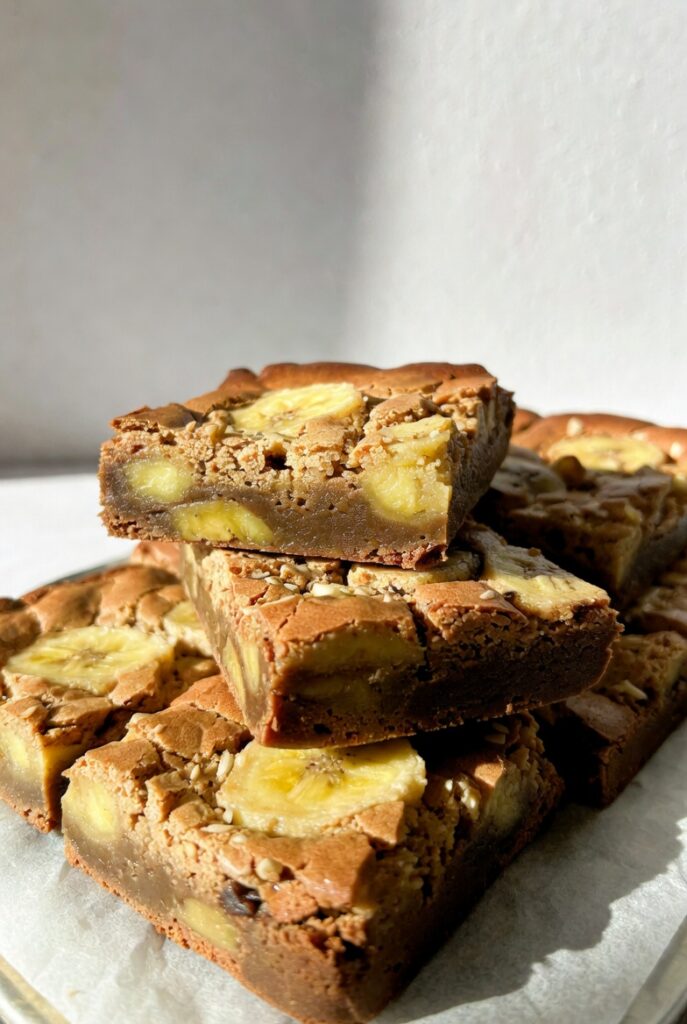
- 8×8 Inch Ceramic Baking Dish: Ceramic provides the “Slow-Radiant” heat necessary to cook the moisture-heavy banana center without charring the cocoa-rich exterior.
- Precision Kitchen Scale: Mandatory. You cannot estimate the “Hydration-to-Cocoa” ratio with cups; this is a chemistry-first process.
- Offset Spatula: For leveling the dense, viscous batter.
- Whisk/Stand Mixer: Required to achieve the “Ribbon-Stage” with the eggs.
5. Ingredients Section: Sourcing for “Complex-Carb” Resolution
The “Ripeness-Index” of the banana dictates the final “Sensory Resolution.”
5.1 The “Enriched Scaffold” (The Batter)
- 70% Dark Chocolate: 200g (Coarsely chopped for “Pools” of flavor).
- Unsalted European Butter: 150g (Browned to “Nutty-Amber” stage).
- Over-Ripe Banana Puree: 1 cup (Approx. 2 large, fully mashed to a liquid).
- Dark Brown Sugar: 180g (For molasses content).
- Large Eggs: 2 units (Room temperature).
- Vanilla Bean Paste: 1 tsp.
- Dutch-Processed Cocoa Powder: 60g (Sifted).
- All-Purpose Flour: 100g.
- Fine Sea Salt: 1/2 tsp.
- Espresso Powder: 1 tsp (To “Brighten” the cocoa notes).
6. The “Gluten-Banana” Protocol: Mastering the Synthesis
The primary failure point of hybrid doughs is “Structural Collapse.” To achieve a “Master-Tier” result, you must utilize the “Incremental-Hydration Technique.”
Phase 1: The Lipid-Banana Emulsion
Brown your butter until it smells like toasted hazelnuts. Immediately whisk in the dark chocolate until melted. Let this cool to room temperature. Whisk in the banana puree. This creates the “Fudgy-Scaffold,” ensuring the banana moisture is fully emulsified in the butterfat. If the mixture is too hot, the fat will separate.
Phase 2: The Protein-Set (The Ribbon Stage)
Whisk eggs and brown sugar for 3 full minutes. You are aiming for a “Ribbon-Stage” consistency where the mixture creates a visible, folding trail when you lift the whisk. Fold in the chocolate-banana emulsion, then the dry ingredients. Do not overmix. Once you see no streaks of flour, stop.
Phase 3: The “Thermal-Deployment”
Bake at 170°C (335°F). This lower-than-average temperature is critical. Because of the banana’s natural sugar, higher temperatures will cause the exterior to burn while the center remains wet.
7. Deep-Dive: Why the “Resting Phase” Changes Everything
The “Fudgy-Matrix” of a brownie doesn’t truly set until it reaches room temperature. When you pull the banana bread brownie from the oven, it will appear slightly under-baked. This is the goal.
During the cooling phase, the fats re-crystallize. Because you have banana puree in the mix, this crystallization is slower than in a traditional brownie, which is why these brownies are significantly softer on day two than day one. We call this the “Crystallization-Delay Effect.” It creates a texture that is impossibly smooth and dense, almost like a truffle.
8. Troubleshooting the Architecture: Common Failure Modes
- My brownies are “Cakey” instead of “Fudgy”: You likely added too much flour or over-whipped the eggs after adding the flour. Ensure your scale is set to grams.
- The center is raw after 40 minutes: Ensure you are using a ceramic or glass dish, not metal. Metal conducts heat too quickly for this moisture-heavy hybrid and will burn the edges before the center has a chance to undergo the Maillard reaction.
- The banana flavor is too faint: Use more spots on the peel. The darker the peel, the more concentrated the flavor of the banana. You can also roast the bananas at 200°C for 15 minutes before mashing if you want a “Deep-Caramel” banana intensity.
- The top looks matte: You did not dissolve your sugar sufficiently into the eggs. Make sure your “Ribbon-Stage” is truly established.
9. Advanced Customization: The “Aromatic Pivots”
- The “Black-Forest” Shift: Add 1/2 cup of tart cherry compote to the batter before baking. The acidity of the cherries cuts through the richness of the banana-chocolate.
- The “Walnut-Crust” Draft: Toast walnuts with a bit of maple syrup and press them into the top of the batter before baking. This adds “Textural-Friction” to an otherwise soft dessert.
- The “Spiced-Banana” Utility: Add 1/2 tsp of ground cardamom to the dry ingredients. Cardamom has a floral note that elevates the banana flavor without competing with the cocoa.
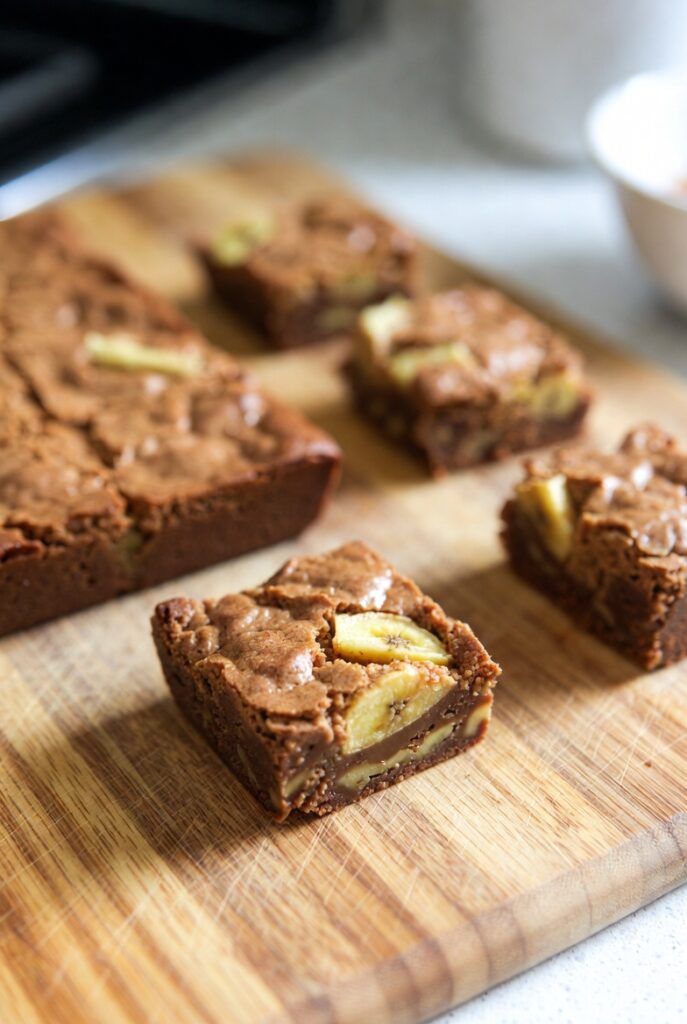
10. The Physiology of Satiety: Why this Dessert Works
Banana Bread Brownies provide a “Tier-1 Satiety” profile compared to standard sweets:
- The “Slow-Digest” Fiber: The inclusion of whole fruit puree introduces pectin and fiber, which slows the digestion of the refined flour and sugars. This prevents the “Sugar-Lethargy” typical of standard brownies.
- The Lipid-Buffer: The high fat content from the browned butter slows gastric emptying, providing a longer “Energy-Plateau.”
- The Volumetric Satisfaction: Because these brownies are denser and more “Starch-Heavy” than typical cocoa-only brownies, a single unit provides significant physical fullness.
11. Storage and Thermal Recovery
- Refrigeration: Store in an airtight container for up to 5 days.
- The Recovery Method: Avoid the microwave for long durations. To restore the “Oven-Fresh” resolution, heat in a 150°C (300°F) oven for 8 minutes. This “Re-Activates” the fats in the crumb without making it rubbery.
12. The “Visual Gravity” of Presentation
- The “Pull-Apart” Reveal: Serve the brownies in the ceramic dish to emphasize the “Community-Dining” aspect.
- The “Gloss-Finish”: Drizzle a small amount of dark chocolate ganache over the top after they have fully cooled. This hides any cracks and adds a “High-Gloss” sheen.
- The “Salt-Dusting”: A final dusting of smoked sea salt turns the “Comfort-Banana” profile into something sophisticated and “Gourmet-Tier.”
13. Advanced “Laboratory” Notes for the Home Baker
If you want to take this recipe to the next level, experiment with the “Cocoa-Type.” Using a Dutch-processed cocoa powder will give you a darker, more mellow, earthy brownie. Using natural cocoa powder will result in a lighter, more acidic, fruit-forward brownie. Given the banana’s natural sweetness, Dutch-processed is generally the superior “Structural-Partner.”
Furthermore, the choice of “Dark Chocolate” is paramount. If you use 50% cacao, you will have a very sweet dessert. If you use 85% cacao, you will have a very intense, almost savory brownie. For this “Hybrid-Crumb,” 70% is the “Goldilocks-Zone,” balancing bitterness, sweetness, and melting-point.
14. Conclusion: The Master Draft of Hybrid Utility
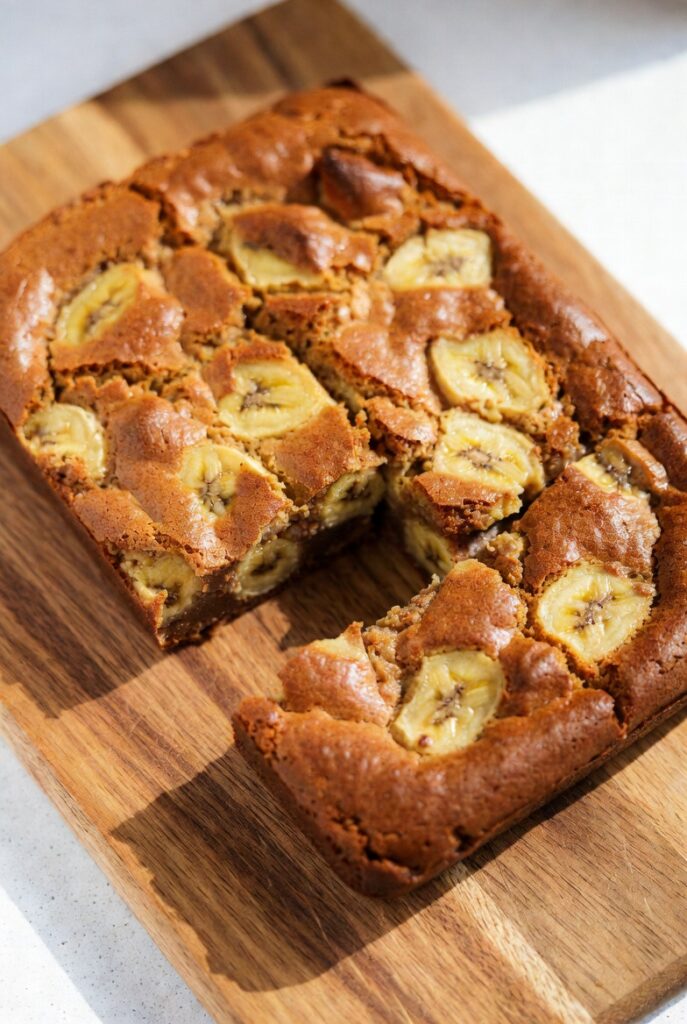
The Starch-Lipid Hybrid protocol proves that the most successful pastries are those that respect the chemistry of their base components. By mastering the “Enzymatic-Sugar Concentration” and the “Gluten-Banana Protocol,” you are delivering a dessert that is visually “Bold,” nutritionally substantial, and sensorially perfect.
It is the ultimate “Comfort-Anchor”—a “Dark-Chocolate-and-Banana” testament to the power of precise culinary engineering. Whether you serve these at a brunch, a formal dinner, or just keep them for yourself throughout the week, these brownies are a masterclass in how simple, over-ripe fruit can completely transform a classic recipe.