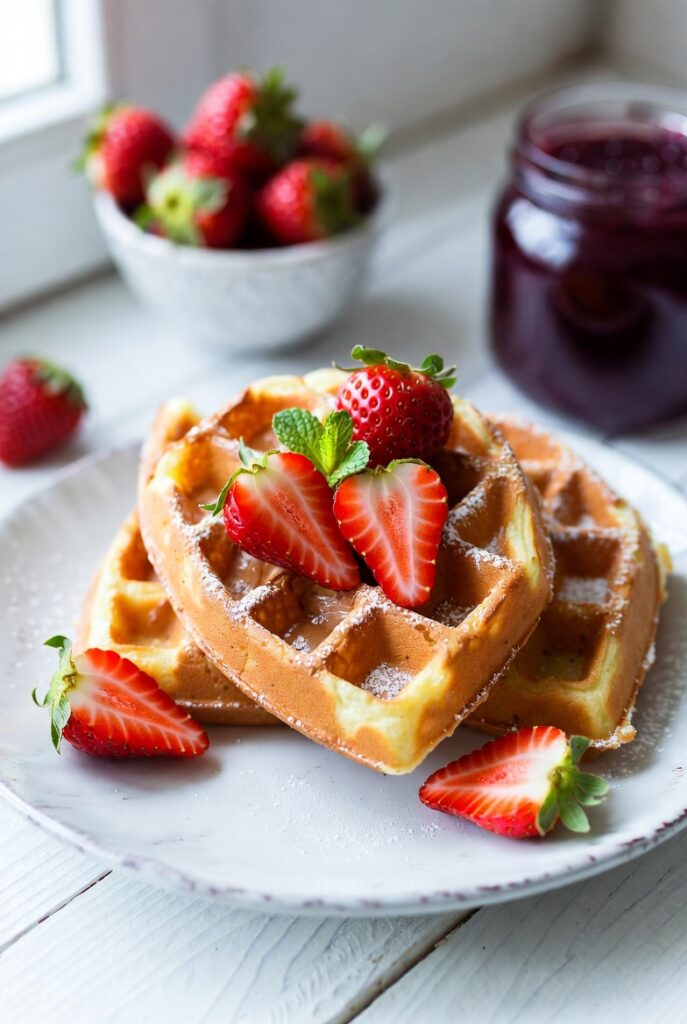
1. Introduction: The Architecture of “Geometric Crispness”
In the specialized taxonomy of breakfast engineering, the Belgian Waffle represents the absolute peak of “Surface-Area Optimization.” Unlike a standard pancake, which is essentially a two-dimensional heat-transfer exercise, or the thinner “American-style” waffle, the Belgian variant utilizes a “Deep-Chamber Toroidal Lattice” (the iconic thick grid) to maximize the contact point between the batter and the radiant heat of the iron. This structural design creates a high ratio of “Structural-Crunch” to “Cloud-Soft” interior, allowing for a multifaceted sensory experience that is both substantial and airy.
This document serves as the “Master Specification” for the dish. We move beyond the rudimentary “just-add-liquid” logic of boxed mixes and enter the realm of “Dual-Action Aeration.” By utilizing a synergy of chemical leavening and the mechanical whipped-protein technique, we create a result that is “Vapor-Light” and “Glistening-Gold.” For the high-performance weekend host, the culinary enthusiast, or the breakfast strategist, this is the “Platinum Standard” of waffle utility.
2. The Science of “Thermal Crystallization”
To master the Best Belgian Waffle, one must understand the behavior of Starch Gelatinization, Gluten Suppression, and Lipid-Crisping.
2.1 The Cornstarch Variable
The secret to a waffle that “shatters” upon the first bite lies in the ratio of All-Purpose Flour to Cornstarch. While flour provides the protein (gluten) necessary for structure, too much gluten results in a “Bready” or “Chewy” waffle. By replacing a significant portion of the flour with cornstarch—an amylose-heavy starch—we inhibit excessive gluten development. This ensures that the waffle remains crisp for a longer duration, preventing the “Steam-Softening” that typically occurs as a waffle cools on the plate.
2.2 The Buttermilk Synergy
The use of Buttermilk is not merely for flavor; it is a critical chemical reagent. The lactic acid in the buttermilk reacts instantaneously with Baking Soda to create an immediate release of $CO_2$ gas. This “First-Action” lift provides the initial expansion within the iron’s chambers, while the Baking Powder provides a “Second-Action” lift as the internal temperature of the batter rises during the cook cycle.
2.3 The Lipid-Barrier and Flavor Profiling
Melted butter serves a dual purpose. Beyond its “Nutty-Aromatic” profile, it creates a “Hydrophobic Barrier” on the surface of the lattice. This barrier prevents maple syrup from immediately soaking into the interior crumb, thereby maintaining the “Structural-Crunch” even as the waffle is being consumed. We recommend unsalted European-style butter for its lower water content and higher fat percentage.
3. The Blueprint Overview: Technical Specifications
- Cuisine Type: Belgian-American Fusion / Culinary Engineering
- Difficulty Level: Medium (Focus on “Protein Folding”)
- Total Preparation Time: 25 Minutes
- Total Cooking Time: 20 Minutes (Variable by Iron Output)
- Total Time: 45 Minutes
- Dietary Classifications: High-Carbohydrate, Vegetarian-Comfort.
- Yield: 6–10 Large Belgian Waffles
4. Equipment and Tools: The Essentials of “Radiant Mass”
- High-Output Belgian Waffle Iron: A flip-style (rotary) iron is the “Gold Standard,” as it uses gravity to ensure the batter fills the upper and lower lattices evenly for maximum volume.
- Electric Hand Mixer or Stand Mixer: Mandatory for achieving the “Stiff-Peak” protein stability required for the aeration phase.
- Wire Cooling Rack: The Most Critical Tool. Never stack waffles on a plate; the residual steam will destroy the starch crystallization in seconds.
- Sieve/Sifter: To ensure the “Starch Scaffold” is homogeneously aerated before hydration.
- Large Mixing Bowls: Three units (One for the Dry Scaffold, one for the Wet Emulsion, and one for the Protein Foam).
5. Ingredients Section: Sourcing for “High-Resolution” Texture
The “Fat-to-Starch” ratio dictates the final “Sensory Resolution.”
5.1 The “Starch Scaffold” (Dry Mix)
- All-Purpose Flour: 1.5 cups (Sifted to remove density).
- Cornstarch: 1/2 cup (The “Crystalline-Agent”).
- Granulated Sugar: 2 tbsp (Required for the Maillard Reaction browning).
- Baking Powder: 1.5 tsp.
- Baking Soda: 1/2 tsp.
- Fine Sea Salt: 1/2 tsp (To heighten flavor perception).
5.2 The “Liquid-Emulsion” (Wet Mix)
- Buttermilk: 2 cups (Full-fat, room temperature to prevent butter clumping).
- Unsalted Butter: 1/2 cup (1 stick), melted and cooled slightly.
- Large Eggs: 2 units (Strictly separated).
- Vanilla Bean Paste: 1 tsp (For deep aromatic complexity).
6. The “Dual-Action” Protocol: Mastering the Volume
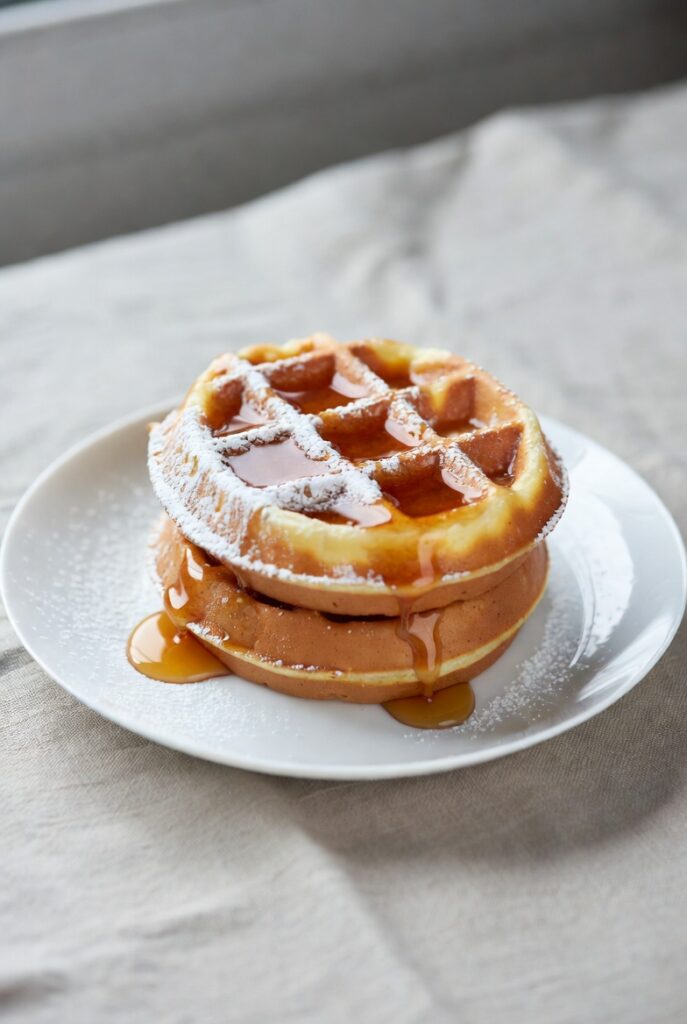
The primary failure point of a homemade Belgian waffle is “Doughy Density.” To achieve a “Master-Tier” result, you must utilize the “Triple-Phase Synthesis.”
Phase 1: The Starch-Base Formation
In a large bowl, whisk together the dry starch scaffold. In a separate medium bowl, whisk together the buttermilk, egg yolks, melted butter, and vanilla. Make a well in the dry ingredients and pour in the wet. Stir with a spatula until just combined. Lumps are required. Over-mixing at this stage will activate the gluten and ruin the texture.
Phase 2: The Protein-Foam Aeration
In a meticulously clean bowl, whip the egg whites at high speed. As they begin to foam, you may add a pinch of cream of tartar for stability. Continue whipping until “Stiff Peaks” form. This creates a mechanical protein scaffold that will trap air within the batter during the “Thermal-Deployment.”
Phase 3: The Fold-Integration
Gently fold one-third of the egg whites into the starch base to lighten the density. Then, fold in the remaining whites using a “Cutting-and-Lifting” motion. Stop before the mixture is perfectly uniform; you want to see small “Clouds” of white. This preserves the air bubbles.
7. Step-by-Step Instructions: The Master Execution
Step 1: Thermal Calibration
Preheat your waffle iron. Most Belgian irons require at least 5–8 minutes to reach “Radiant Equilibrium.” If your iron has a setting, choose Medium-High. A low setting will steam the waffle rather than crisping it.
Step 2: The Sifting Ritual
Sift the flour and cornstarch into a large bowl. This “Nano-Aeration” of the dry ingredients ensures that the chemical leaveners can react instantly upon hydration.
Step 3: Emulsion and Synthesis
Follow the Dual-Action Protocol detailed in Section 6. Ensure your butter is melted but not “Scalding-Hot,” or it will denature the egg yolks prematurely.
Step 4: Deployment and Gravity Dynamics
Grease the iron lightly with a neutral oil spray. Pour approximately 3/4 to 1 cup of batter (depending on iron size) into the center. If using a rotary iron, close the lid and flip immediately. This allows the batter to flow into the deep pockets of the bottom plate before the “Initial-Set.”
Step 5: The “Steam-Signal” Monitoring
The most accurate indicator of doneness is not a timer, but Steam Evolution. As the waffle cooks, steam will pour out of the sides. When the steam nearly stops or becomes a faint wisp, the internal moisture has evaporated, and the starch lattice has crystallized.
Step 6: The “Wire-Rack” Recovery
Using a fork or tongs, lift the waffle from the iron. Do not put it on a plate. Place it directly onto a wire cooling rack for 60 seconds. This allows the exterior to “Crisp-Set” as the steam escapes freely into the air.
8. Satiety and the “Crunch-to-Crumb” Arc
Belgian Waffles provide a “High-Resolution Satiety” profile that simple pancakes cannot match:
- The Volumetric Reward: The deep pockets increase the total volume of the meal without necessarily increasing the caloric load, tricking the brain into a state of “Early-Satiety.”
- The Structural-Satisfaction: The audible “Crunch” of the exterior provides a sensory feedback loop. Studies in gastrophysics suggest that “Crunchy” sounds increase the perception of food quality and satisfaction.
- The Lipid-Anchor: The high butter content and egg proteins provide “Long-Form” energy that prevents the mid-morning insulin crash often associated with high-sugar cereals.
9. Modular Customization: The “Flavor Pivots”
- The “Pearl-Sugar” Shift (Liège Style): Fold in 1/2 cup of Belgian pearl sugar into the batter just before cooking. The sugar will caramelize against the iron, creating “Crunch-Gems” of burnt sugar.
- The “Bacon-Infusion” Draft: Place cooked, crumbled bacon on the iron before pouring the batter. This creates a “Savory-Contrast” within the lattice.
- The “Cacao-Resolution”: Replace 1/4 cup of flour with dark cocoa powder and add 1/2 cup of mini chocolate chips for a dessert-tier waffle.
10. Storage and “Thermal Recovery”
Waffles are exceptionally “Batch-Stable” and meal-prep friendly.
- Freezing: Allow waffles to cool completely on the wire rack. Place in a freezer bag with parchment paper between layers. They will remain stable for 3 months.
- The Recovery Method: Never use a microwave. To restore the “Lattice-Crunch,” place frozen or refrigerated waffles in a Standard Toaster or an air fryer at 180°C for 3 minutes. This “Flash-Re-Crystallizes” the starch.
11. Frequently Asked Questions (FAQ)
Q: Why are my waffles soft and limp? A: You likely skipped the Wire Cooling Rack or used too much liquid. If you place a hot waffle on a flat plate, the steam from the bottom gets trapped and “re-hydrates” the crust, turning it into mush.
Q: Can I use regular milk? A: You can, but you will lose the “Chemical-Lift” provided by the buttermilk/baking soda reaction. If using regular milk, omit the baking soda and increase the baking powder to 1 tbsp.
Q: My iron is sticking. What happened? A: Either the iron was not hot enough during deployment, or there is a “Sugar-Residue” buildup. Ensure the iron is at full temperature before adding batter, and never use a metal knife to scrape the plates.
12. Nutritional Information
(Per serving – 1 Large Belgian Waffle)
| Nutrient | Amount |
| Calories | 380 kcal |
| Protein | 8g |
| Total Fat | 18g |
| Net Carbs | 46g |
| Calcium | 15% DV |
13. The “Visual Gravity” of Presentation
- The “Symmetry-Stack”: Serve two waffles overlapping slightly to emphasize the deep grids.
- The Berry-Inclusion: Place fresh berries inside the pockets rather than on top to create “Jeweled-Chambers.”
- The “Snow-Cap” Dusting: Sift powdered sugar from a height of 12 inches to ensure even, light coverage that looks like freshly fallen snow.
14. Conclusion: The Master Draft of Geometric Utility
The Lattice-Crunch Protocol is more than a recipe; it is a “Vessel for Intentional Synergy.” It proves that “Gourmet Results” are achieved not through complex ingredients, but through the mastery of “Protein-Aeration” and “Starch-Gelatinization.” By respecting the “Wire-Rack Recovery” and the “Dual-Action Protocol,” you are delivering a breakfast that is visually “Golden-and-Bold,” nutritionally dense, and sensorially perfect.
It is the ultimate “Morning Anchor”—a “Crunch-and-Cloud” testament to the power of culinary engineering.