The Nostalgia Standard: Creamy Tomato Soup & Gourmet Grilled Cheese
1. Introduction: The Architecture of the Ultimate Comfort Synergy
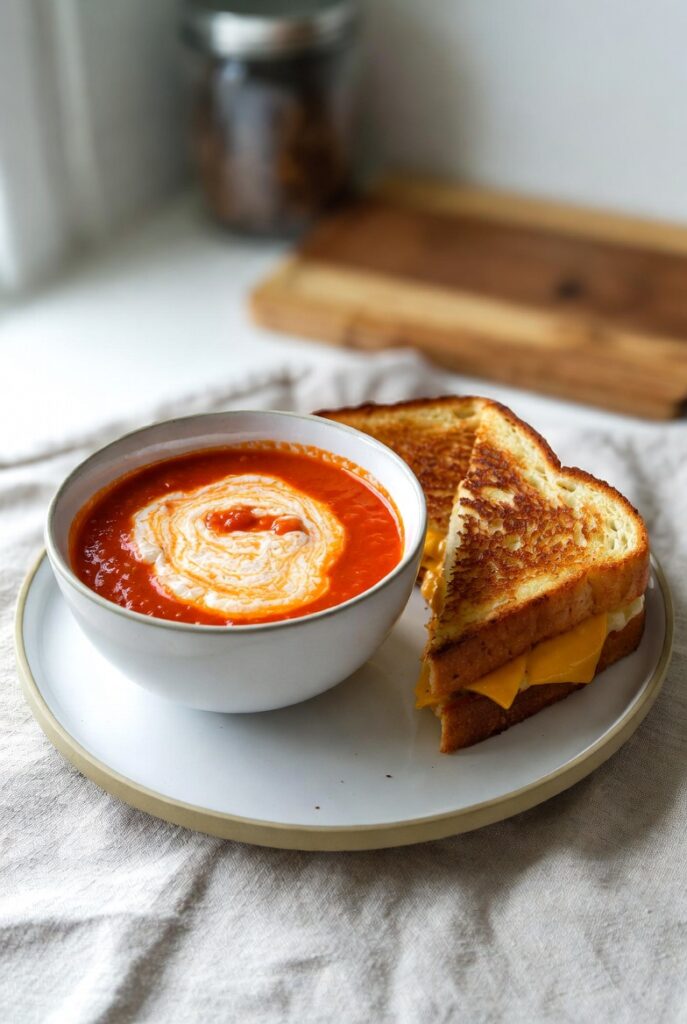
In the global lexicon of culinary pairings, few duos possess the “Emotional Resonance” and “Structural Harmony” of Creamy Tomato Soup and Grilled Cheese. This is not merely a meal; it is a “Symbiotic System.” The soup provides a high-acid, liquid “Solvent,” while the sandwich offers a high-lipid, crispy “Solute.” When combined, they trigger a “Palate Equilibrium” that addresses every major taste receptor: sweet, sour, salty, and umami.
The Creamy Tomato Soup in this draft represents an “Epicurean Pivot” from the metallic, sugar-heavy canned versions of childhood. It is a study in “Lycopene Concentration,” utilizing roasted aromatics and a “Velvet Emulsion” of heavy cream to create a sophisticated, high-density base. Complementing this is the Gourmet Grilled Cheese, a masterwork of “Textural Engineering” that utilizes a multi-cheese matrix and sourdough “Infrastructural Integrity.” For the high-performance individual, this duo is the ultimate “Recovery Fuel”—a meal that provides psychological comfort while delivering a potent dose of antioxidants and sustained-energy fats.
2. The Science of the “Acid-Fat Emulsion”
To master the Creamy Tomato Soup, one must understand the chemical behavior of the tomato. Tomatoes are naturally acidic (pH≈4.5). When combined with dairy, this acidity can cause the milk proteins to “curdle” or denature.
The secret to a professional-grade result is the “Thermal Buffer.” By slowly tempering the cream into the hot tomato base and utilizing a high-speed “Mechanical Emulsion” (blending), we create a stable matrix where the fat globules are suspended evenly. This results in a “Reflective Sheen” and a silken mouthfeel that coats the palate, neutralizing the sharp “bite” of the tomato acid without masking its vibrant character.
On the “Crunch” side of the equation, the Gourmet Grilled Cheese relies on the Maillard Reaction. By applying a “Lipid Barrier” (butter or mayonnaise) to the exterior of the bread and subjecting it to “Low-and-Slow” thermal conduction, we facilitate the breakdown of amino acids and sugars. This creates a “shatter-crisp” crust that serves as the perfect “dipping vessel” for the soup.
3. Recipe Overview: The Master Blueprint
- Cuisine Type: Modern American Comfort
- Difficulty Level: Easy (Precision timing focus)
- Total Preparation Time: 20 Minutes
- Total Cooking Time: 40 Minutes
- Total Time: 1 Hour
- Dietary Classifications: Vegetarian, High-Antioxidant, High-Calcium.
- Yield: Serves 4
4. Equipment and Tools: The Essentials of Consistency
The success of this duo depends on the “Thermal Uniformity” of your cookware.
- 5-Quart Dutch Oven: For the soup. The thick walls prevent the tomato sugars from scorching during the reduction phase.
- Immersion Blender (Stick Blender): Essential for achieving the “Velvet Standard” without the danger of transferring hot liquids to a countertop blender.
- Heavy Cast Iron Skillet: The “Platinum Standard” for the sandwich. It provides the “High-Inertia Heat” required for an even, golden-brown crust.
- Fine Mesh Sieve: For those seeking “Elite-Tier” smoothness, passing the blended soup through a sieve removes any remaining skin or seed fragments.
5. Ingredients Section: Sourcing for Depth
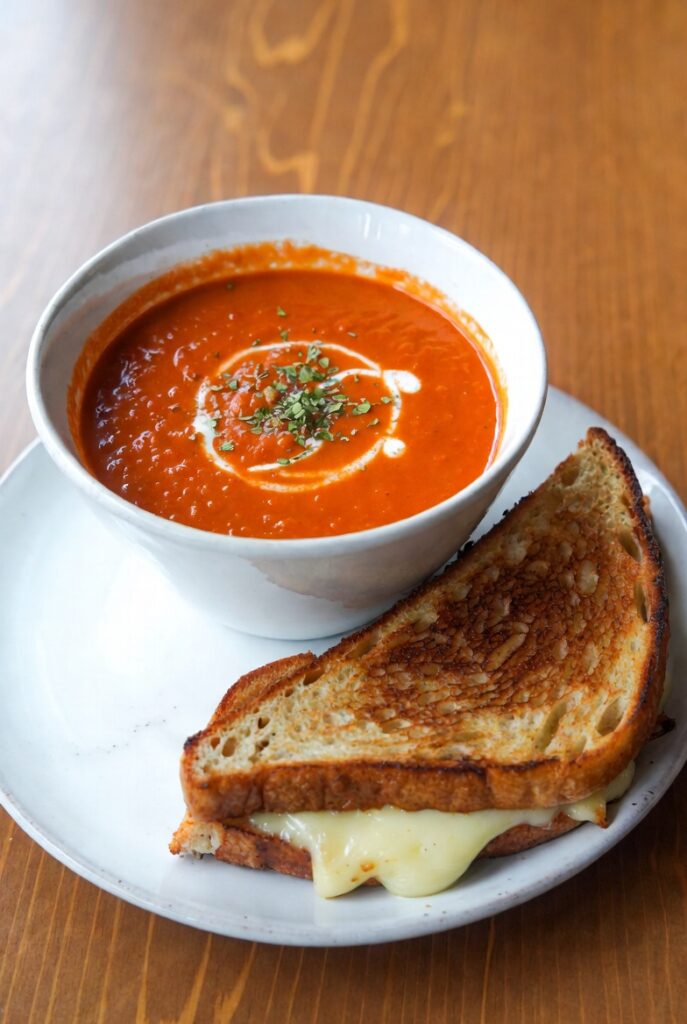
In a pairing this iconic, the “Molecular Quality” of the tomatoes and the “Aged Character” of the cheese dictate the final outcome.
The Tomato Engine
- San Marzano Tomatoes: 2 cans (28 oz each), whole peeled. These are the “Industry Standard” for their low acidity and high pulp density.
- Vegetable or Chicken Stock: 2 cups. To adjust the “Viscosity.”
- Heavy Cream: 1/2 cup. The “Emulsion Catalyst.”
- Aromatics: 1 large yellow onion, 4 cloves garlic, and 2 tablespoons tomato paste (for “Color Fortification”).
- Fresh Basil: 1/4 cup. For the “Volatile Oil” finish.
The Grilled Cheese Matrix
- Sourdough Bread: 8 thick slices. The “Infrastructural Anchor.” Its fermented tang balances the rich cheese.
- The Cheese Trinity: 1. Sharp Cheddar: For the “Salt Spike.” 2. Gruyère: For the “Nutty Depth” and “Elasticity.” 3. Fontina or Havarti: For the “Superior Melt.”
- The Lipid Barrier: Salted butter (softened) or high-quality Mayonnaise (for a higher smoke point).
6. The “Sourdough-Mayonnaise” Strategy
The most common failure in a grilled cheese is “Localized Scorching”—where the bread burns before the cheese center is molten. To achieve a “Master Draft” finish, we employ two specific techniques:
- The Mayonnaise Method: Spread a thin, even layer of mayonnaise on the outside of the bread. Mayonnaise is an emulsion of oil and egg; the egg solids promote a more uniform “Golden Brown” color than butter, while the oil provides the “Crisp.”
- The Lid-Cover Technique: Once the sandwich is in the skillet, cover it with a lid for the first 2 minutes. This creates a “Mini-Oven” effect, trapping the heat and ensuring the “Cheese Matrix” reaches a molten state at the exact moment the bread achieves “Max-Crisp.”
7. Deep Dive: Lycopene and the Bioavailability Advantage
Why is Creamy Tomato Soup a functional health powerhouse? It centers on Lycopene. Tomatoes are the primary source of this antioxidant, but in their raw state, lycopene is locked within the cellular walls.
The “High-Performance” Fact: Heat treatment (cooking the soup) breaks down these cell walls, and the addition of fats (cream and butter) makes the lycopene “Bioavailable.” Your body can absorb up to 4x more lycopene from a cooked, creamy soup than from a raw tomato. This makes this meal a tactical tool for cardiovascular health and skin protection against UV oxidative stress. It is “Nutritional Engineering” disguised as a rainy-day classic.
8. Step-by-Step Instructions: The Master Blueprint
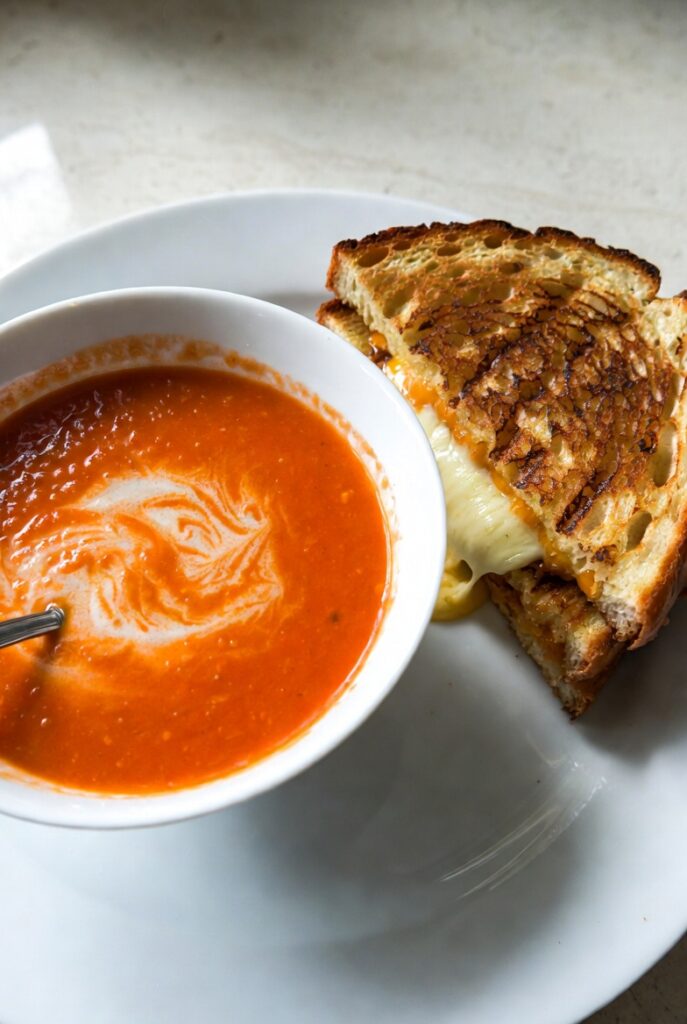
Phase 1: The Soup Assembly
- The Sauté: In your Dutch oven, melt 2 tablespoons of butter. Add the onion and sauté over medium heat until “Translucent Gold” (8 minutes).
- The Aromatic Bloom: Add the minced garlic and tomato paste. Stir for 2 minutes. The tomato paste should turn a deep rust color—this is the “Concentration Phase.”
- The Simmer: Add the San Marzano tomatoes (crushing them with your spoon) and the stock. Bring to a boil, then reduce to a low simmer for 25 minutes.
- The Emulsion: Remove from heat. Add the fresh basil. Use your immersion blender to process the soup until it reaches the “Velvet Standard.”
- The Tempering: Slowly stir in the heavy cream. Season with salt and a “Spike” of black pepper. Keep warm on the lowest setting.
Phase 2: The Gourmet Grilled Cheese
- The Prep: Spread your “Lipid Barrier” (mayonnaise or butter) on one side of each bread slice.
- The Matrix Build: On the non-greased side, layer a generous amount of the Cheese Trinity (Cheddar, Gruyère, Fontina). Close the sandwich.
- The Conduction: Place the sandwich in a cold cast-iron skillet, then turn the heat to Medium-Low. This “Slow-Start” ensures the heat penetrates to the center.
- The Flip: Once the bottom is “Mahogany Gold” (about 4–5 minutes), flip and cook the other side until the cheese begins to “Leopard Spot” out the sides.
9. Satiety and the “Glucose-Lipid” Balance
The Tomato Soup & Grilled Cheese duo is designed for “Steady-State Satiety.” The complex carbohydrates of the sourdough pair with the high proteins of the cheese to create a “Metabolic Buffer.”
This prevents the “Insulin Spike” common with white-bread sandwiches. Furthermore, the high fluid volume of the soup increases “Gastric Distension,” signaling the brain’s satiety centers that the meal is complete. For the high-performance individual, this means 4–5 hours of mental clarity without the “Post-Lunch Lethargy.”
10. Storage and the “Second-Day” Acid Profile
- Refrigeration: Store the soup in glass jars for up to 5 days. The “Acid Profile” of the tomato will actually mellow over 24 hours, often making it taste better on Day 2.
- The Reheat: Reheat the soup on the stove over low heat to prevent the cream from separating.
- The “Sandwich” Recovery: Never microwave a leftover grilled cheese. Reheat it in a dry skillet or air fryer to restore the “Structural Crisp.”
11. Frequently Asked Questions (FAQ)
Q: Can I use fresh tomatoes? A: You can, but only during “Peak Summer.” In any other season, San Marzano canned tomatoes provide a more consistent “Sugar-to-Acid” ratio than grocery store “Fresh” tomatoes.
Q: Why is my soup grainy? A: This usually happens if the garlic was burned or if the seeds weren’t fully pulverized. Pass the soup through a fine-mesh sieve for a “Refined Texture.”
Q: What is the best bread substitute? A: If sourdough is unavailable, a thick-cut Brioche offers a “Luxury Pivot,” though it has a lower “Infrastructural Integrity” for dipping.
12. Nutritional Information
(Per serving – 1.5 cups soup + 1 sandwich)
| Nutrient | Amount |
| Calories | 680 kcal |
| Protein | 24g |
| Total Fat | 38g |
| Net Carbs | 42g |
| Lycopene | 25mg |
13. Summary: The Master Draft of Synergistic Dining
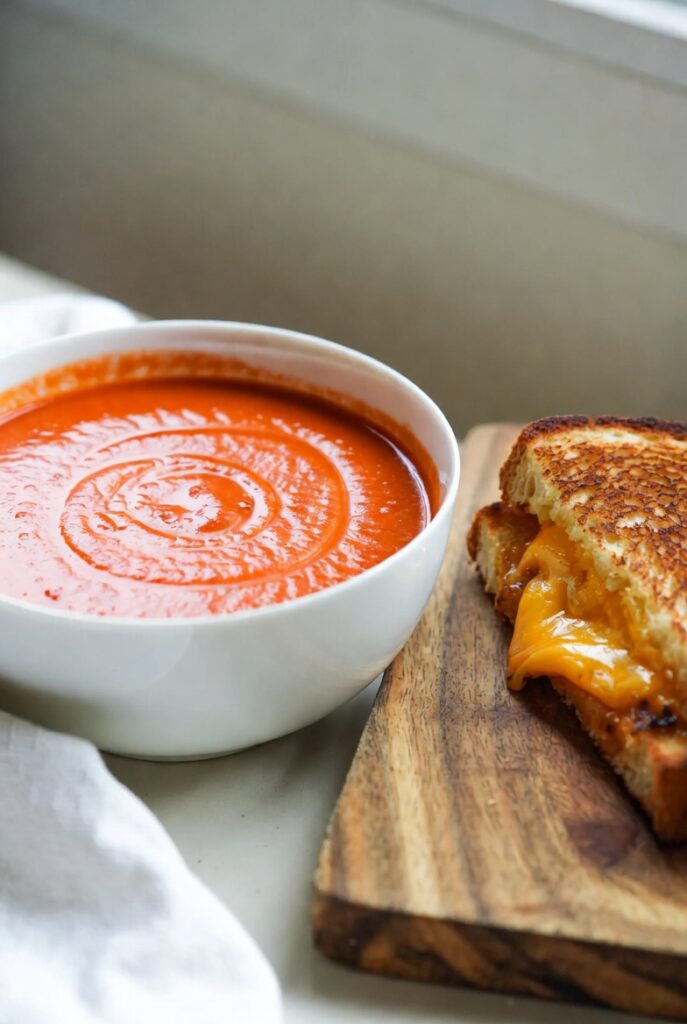
The Creamy Tomato Soup & Gourmet Grilled Cheese is more than a meal; it is a masterclass in “Contrast Management.” It proves that the most basic ingredients—bread, cheese, and tomatoes—can be elevated to a “Gourmet Standard” through the precise application of pH balance and thermal conduction. By mastering the “Mayonnaise Method” and the “Velvet Emulsion,” you are delivering a dish that is biologically satisfying, emotionally comforting, and visually iconic.