1. Introduction: The Architecture of “Lipid-Layered Saturation”
In the high-tier landscape of brunch engineering, the Croissant French Toast Bake represents the definitive evolution of the classic pain perdu. While traditional French toast utilizes a singular, dense starch scaffold (such as Brioche, Challah, or Texas Toast), the Croissant Bake leverages a “Multilayered Lamination Matrix.“ Because a croissant is composed of alternating layers of yeast-leavened dough and high-fat European-style butter, it creates a unique structural opportunity: the custard can infiltrate the “Honeycomb-Air-Galleries” between layers. This results in a dish that defies simple categorization; it is simultaneously a soufflé, a bread pudding, and a high-end pastry. This document serves as the “Structural Manifesto” for the dish, moving beyond “bread-in-pan” logic into the mechanics of “The Infiltration Phase.” By utilizing the hollow architecture of the croissant, we achieve a “Velvet-Custard” interior while maintaining a “Shatter-Crisp” top layer. For the culinary strategist, this is the “Platinum Standard” of morning utility.
2. The Science of “Lipid-to-Egg Ratios” and Saturation
To master the Croissant French Toast Bake, one must first understand the behavior of Stale-Starch Absorption.
The Dehydration Necessity
Fresh croissants contain too much internal moisture for a successful bake. If you introduce a liquid custard to a high-moisture pastry, the result is a collapsed, gummy texture. To achieve maximum “Custard-Uptake,” the croissants must be “Stale” or “Flash-Toasted.” This creates a dry “Capillary-Network” that pulls the liquid egg mixture into the very center of the pastry.
The Emulsion Physics
Because croissants are already approximately 30–40% butter by weight, the custard must be chemically balanced to prevent “Lipid-Separation.” We use a specific ratio of whole eggs and heavy cream to provide the “Protein-Binding” necessary to hold the heavy, buttery crumb together during the rise. Without enough egg protein, the fat from the butter would simply leach out into the bottom of the pan.
The Steam-Lift Principle
As the bake reaches the critical threshold of 75°C (167°F), the moisture in the custard turns to steam. Because the croissant layers are trapped under a “Sugar-Crust,” this steam provides a “Secondary-Rise.” This is what gives the bake its characteristic “Puff,” ensuring a light, airy texture rather than a dense, soggy mass.
3. The Blueprint Overview: Technical Specifications
- Cuisine Type: French-American Fusion / Brunch Engineering
- Difficulty Level: Easy (Focus on “Saturation Timing”)
- Total Preparation Time: 20 Minutes
- Infiltration Phase (Resting): 30 Minutes to 12 Hours
- Total Cooking Time: 40–50 Minutes
- Total Time: Approximately 1 Hour 10 Minutes (Plus resting)
- Dietary Classifications: High-Lipid Comfort, Vegetarian-Friendly.
- Yield: 8–10 Servings
4. Equipment and Tools: The Essentials of “Thermal Retention”
- 9×13 Inch Ceramic or Glass Baking Dish: Ceramic is the “Gold Standard” here for its “Slow-Radiant” properties, which ensure the center of the bake sets before the edges char.
- Large Stainless Steel Whisk: Essential for achieving a “High-Velocity” emulsion.
- Offset Spatula: For the “Submersion-Press” technique.
- Aluminum Foil: Used to manage “Surface-Browning” and prevent premature caramelization.
- Digital Instant-Read Thermometer: To verify the “Internal-Set” at 71°C.
5. Ingredients Section: Sourcing for “High-Resolution” Texture
The quality of the butter in your croissants dictates the final “Sensory Resolution” of the dish.
The “Starch Scaffold” (The Foundation)
- Large All-Butter Croissants: 10–12 units. (Must be “Day-Old” or dry to the touch).
- Unsalted Butter: 2 tbsp. (For pan preparation).
The “Emulsion-Liquid” (The Custard)
- Large Eggs: 8 units. (Higher egg count ensures structural “Set”).
- Whole Milk: 2 cups.
- Heavy Cream: 1.5 cups. (The “Silker-Resolution” driver).
- Granulated Sugar: 3/4 cup.
- Dark Brown Sugar: 1/4 cup. (For “Molasses-Depth”).
- Vanilla Bean Paste: 1 tbsp. (High concentration for aromatic impact).
- Cinnamon & Nutmeg: 1.5 tsp and 1/2 tsp respectively.
- Orange Zest: 1 tsp. (Optional: To provide a “Citrus-Brightness” to the lipids).
The “Structural Garnish” (The Finish)
- Powdered Sugar: For the “Snow-Capped” finish.
- Maple Syrup: High-viscosity Grade A Amber.
- Toasted Pecans: (Optional: For “Textural-Friction”).
6. The “Honeycomb-Infiltration” Protocol: Mastering the Soak
The primary failure point of a croissant bake is “Internal-Dryness” or “Surface-Sogginess.” ### 6.1 The Hand-Tear Method
Never use a knife to cut croissants for this bake. Tearing the pastry by hand creates “Jagged-Surface-Area.” This increases the rate of liquid absorption and creates more “Crispy-Peaks” on the top layer, providing a better contrast between the soft interior and crunchy exterior.
6.2 The Submersion-Press
Once the liquid custard is poured over the croissants, you must execute the “Submersion-Press.” Use an offset spatula or clean hands to physically compress the pastry into the liquid. This forces air out of the honeycomb air-galleries and creates a vacuum that pulls the custard deep into the laminated layers.
6.3 The “Phase-Resting” Window
The 30-minute rest is the “Minimum Viable Duration.” During this time, the proteins in the eggs begin to “Pre-Bind” with the starches. For a truly “Homogeneous-Custard” experience, an overnight soak (8–12 hours) in the refrigerator is recommended.
7. Step-by-Step Instructions: The Master Execution
Step 1: The “Dehydration” Phase
If your croissants are fresh, tear them into 2-inch chunks and spread them on a baking sheet. Bake at 150°C (300°F) for 10–12 minutes. This “Flash-Staling” ensures they possess the capillary strength to hold the custard without disintegrating.
Step 2: The “Emulsion-Synthesis”
In a large bowl, whisk the eggs vigorously. Add the milk, cream, sugars, vanilla, zest, and spices. Whisk for at least 90 seconds to ensure the sugar is fully dissolved and the eggs are “Nano-Integrated” into the dairy.
Step 3: The “Assembly-Matrix”
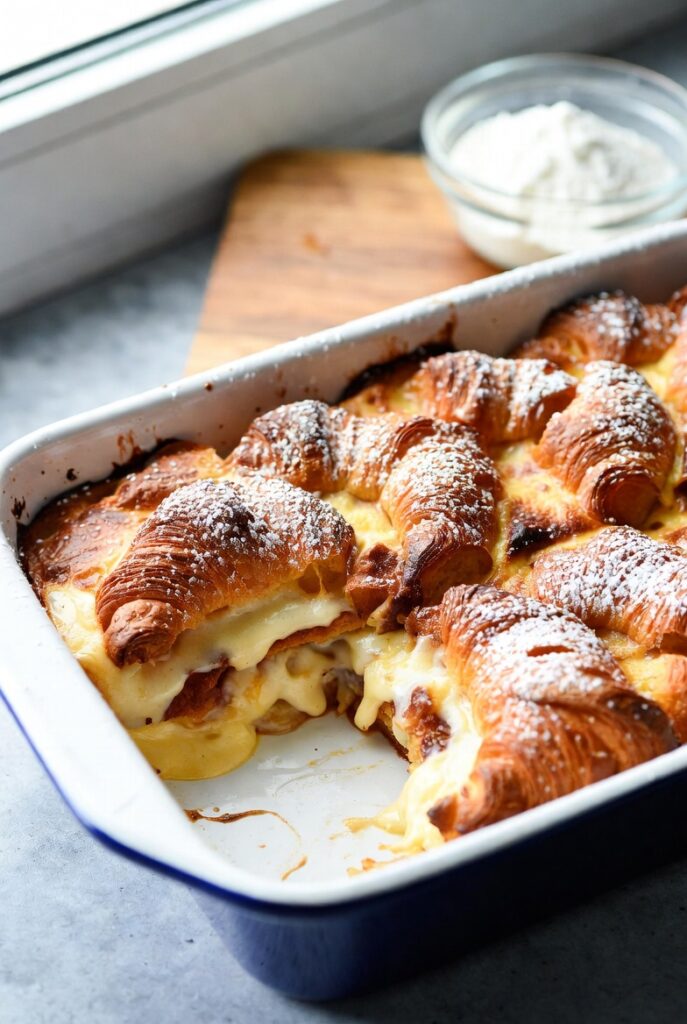
Generously butter your ceramic baking dish. Arrange the torn croissant chunks in a “Ruffled” pattern. Ensure the jagged, laminated edges are facing upward—these will become the “Shatter-Crisp” peaks.
Step 4: The “Infiltration” Cycle
Pour the custard slowly over the croissants, ensuring every chunk is moistened. Execute the Submersion-Press. Cover with plastic wrap and let sit for at least 30 minutes.
Step 5: The “Thermal-Deployment”
Preheat oven to 175°C (350°F). Remove the cover. For an extra “Caramel-Lace” finish, sprinkle a tablespoon of turbinado sugar over the top peaks.
Step 6: The “Dual-Stage” Bake
- Stage 1: Bake for 30 minutes uncovered. This develops the crust.
- Stage 2: Check for browning. If the peaks are dark amber, tent the dish loosely with foil. Bake for another 15–20 minutes.
- Verification: The bake is complete when the center is “Springy-Firm” and the internal temperature reaches 71°C (160°F).
8. Satiety and the “Lipid-Carb” Equilibrium
The Croissant French Toast Bake provides a “Deep-Satiety” profile that simple grain-based breakfasts cannot match:
- The Lipid-Buffer: The high butter content from the croissants (the “Lamination-Fats”) slows the rate of gastric emptying. This prevents the “Glucose-Spike” common with standard French toast, providing a 4–6 hour energy plateau.
- The Protein-Density: With 8 eggs and significant dairy solids, each serving provides the “Amino-Anchor” necessary for a long-lasting sense of fullness.
- The Volumetric Satisfaction: The “Puff” created by the lamination creates a large visual portion that occupies more space in the stomach while maintaining a “Moderate-Caloric” density per cubic inch.
9. Modular Customization: The “Flavor Pivots”
The croissant base is a “Universal Receiver” for various flavor profiles:
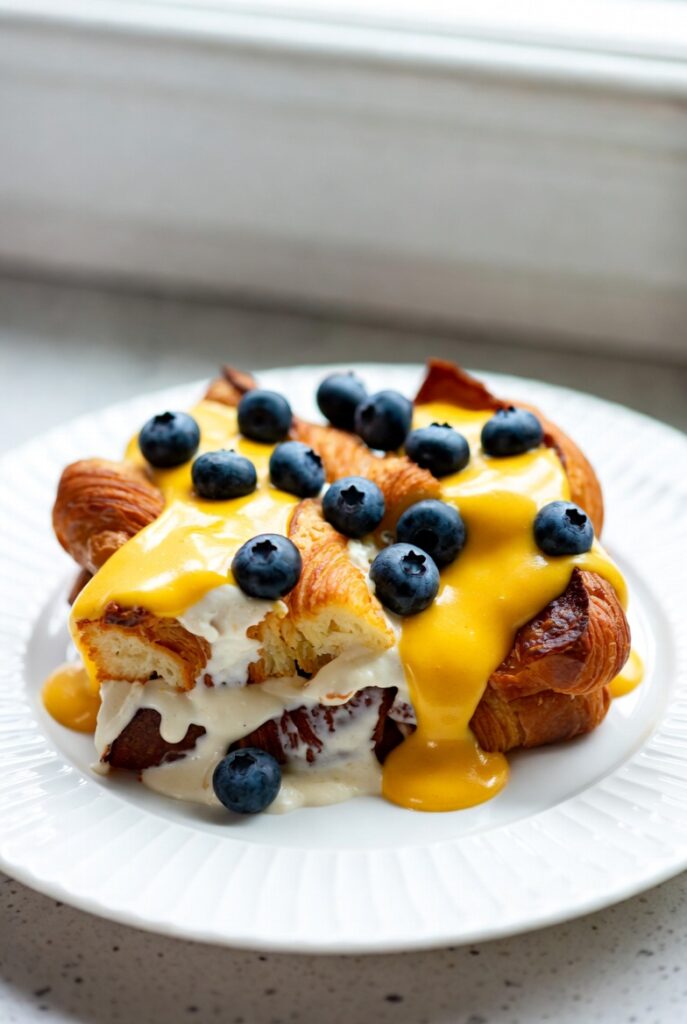
- The “Berry-Burst” Shift: Fold 1.5 cups of fresh blueberries or raspberries between the croissant layers before the custard pour. The “Acid-High-Note” cuts through the richness of the butter.
- The “Almond-Croissant” Draft: Add 1.5 tsp of pure almond extract to the custard and top with 1/2 cup of sliced almonds before baking. This mimics the classic croissant aux amandes.
- The “Chocolate-Pain” Utility: Use a mix of plain and chocolate croissants (Pain au Chocolat) for a “Semi-Bitter” cocoa resolution.
- The “Savory-Platinum” Pivot: Omit the sugar and vanilla. Use 4 cups of milk/cream, 8 eggs, 1 cup of shredded Gruyère, and 1/2 cup of diced ham. Season with salt, pepper, and thyme for a “Croissant Strata.”
10. Storage and “Thermal Recovery”
- Refrigeration: Store in an airtight container for up to 3 days.
- The Recovery Method: Never use a microwave. Microwaving excites water molecules too quickly, causing the delicate croissant layers to become rubbery and the custard to “Weep.”
- The Re-Crisping Protocol: Reheat a slice in a 160°C (325°F) oven or air fryer for 8–10 minutes. This “Re-Aerates” the layers and restores the “Shatter-Crisp” top.
11. Frequently Asked Questions (FAQ)
Q: Why is there liquid pooling at the bottom of my pan?
A: This is a biological process called “Syneresis.” It occurs when the egg proteins are overcooked; they contract so tightly that they squeeze out the water they were holding. To avoid this, pull the bake from the oven the moment the center is set.
Q: Can I use low-fat milk or a milk substitute?
A: Technically affirmative, but discouraged. The “Structural-Silkiness” of this dish relies on the milk fat (lipids) to emulsify with the croissant butter. Non-dairy milks often lack the protein density to create a stable custard curd.
Q: Can I use “Store-Bought” pre-sliced croissants?
A: Negative. Pre-sliced croissants are often too thin and lack the structural “Air-Galleries” needed for a proper bake. Use whole, large croissants for the best “Infiltration.”
12. Nutritional Information
(Per serving – Based on 10 servings)
| Nutrient | Amount |
| Calories | 510 kcal |
| Protein | 14g |
| Total Fat | 34g |
| Net Carbs | 41g |
| Calcium | 15% DV |
| Vitamin D | 10% DV |
13. The “Visual Gravity” of Presentation
- The Snow-Cap Effect: Use a fine-mesh sieve to dust powdered sugar over the bake only after it has cooled for 5–10 minutes. Doing it too early will cause the sugar to melt into a glaze.
- The Ribbon Drizzle: Pour maple syrup from a height of 10 inches to create a “Ribboning” effect that highlights the jagged peaks.
- The Slate-Contrast: Serve on a dark slate or navy-blue plate to make the “Golden-Amber” crust of the croissants visually pop.
14. Conclusion: The Master Draft of Laminated Utility
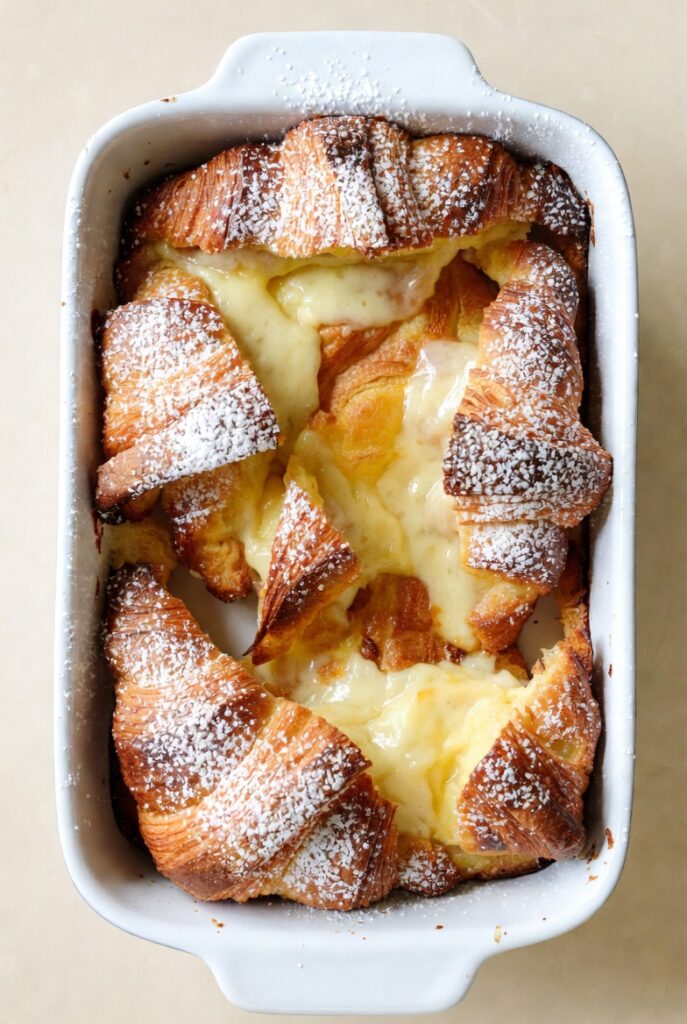
The Laminated Custard Protocol proves that world-class results are achieved through the mastery of “Starch-Hydration” and “Lipid-Management.” By respecting the “Honeycomb-Infiltration” phase and the “Dual-Stage Bake,” you are delivering a breakfast that is visually “Architectural,” nutritionally substantial, and sensorially perfect.
It is the ultimate “Social Anchor”—a “Soft-and-Substantial” testament to the power of dairy, eggs, and buttered dough.