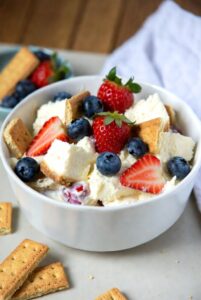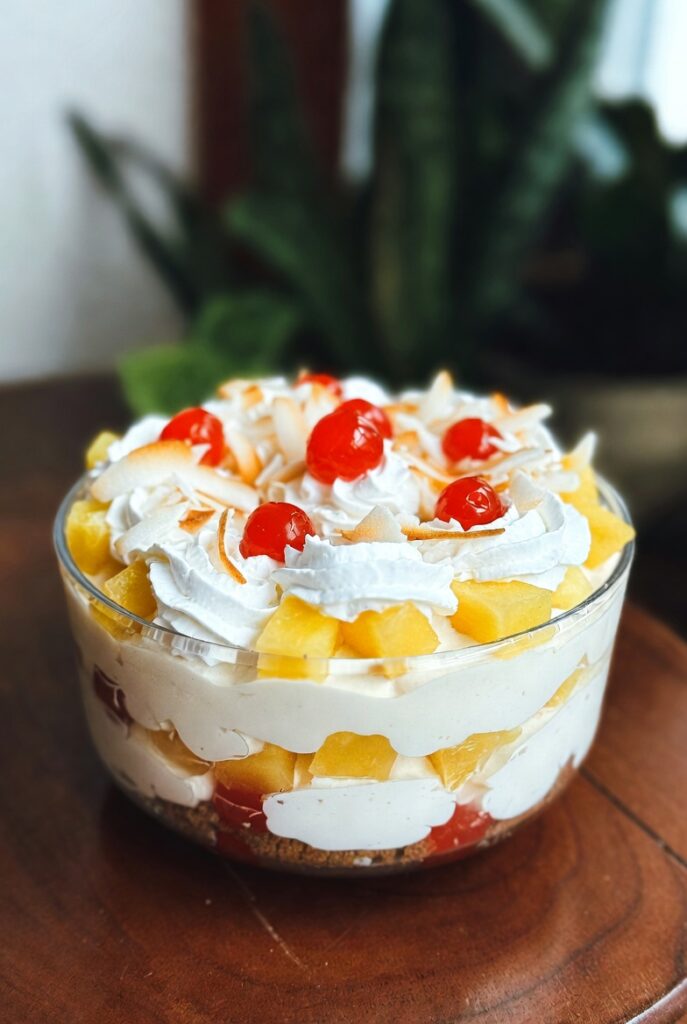
In the taxonomy of modern confectionery, the Hawaiian Cheesecake Salad represents a bold departure from traditional dessert structures. Unlike a standard baked cheesecake, which relies on a dense, egg-bound protein scaffold, the Hawaiian Cheesecake Salad is a study in “Cold-Whip Stabilization.” It is a complex landscape of bright, acidic tropical fruits, creamy, lipid-rich dairy, and the quintessential Hawaiian textural anchor: the toasted coconut-macadamia crunch.
This document serves as the “Technical Manifesto” for the dish. We move beyond the rudimentary “toss-and-serve” logic and examine the mechanics of “Solute-Stable Aeration.” By balancing the high water content of tropical fruit with a stabilized cream cheese mousse, we achieve a result that is “Vapor-Light” in flavor but “Lipid-Dense” in texture. For the high-performance entertainer, this is the “Platinum Standard” of low-effort, high-impact confectionery.
1. The Science of “Tropical-Solute Stabilization”
To master the Hawaiian Cheesecake Salad, one must understand the behavior of Osmotic Pressure and Lipid-Based Suspensions.
1.1 The Fruit-Lipid Paradox
Tropical fruits—specifically pineapple and mango—are notorious for their high water content and proteolytic enzymes (like bromelain in pineapple). When these are introduced to a dairy-based mousse, the enzymes can break down the proteins in the cream cheese, causing the salad to weep or become runny. We mitigate this through a “pH-Stabilization Protocol.”
1.2 The Lipid-Stabilization
We rely on the “Cold-Whip Scaffold.” By whipping heavy cream (36% fat) to stiff peaks and gently folding it into a sugar-stabilized cream cheese base, we create a suspension that resists the water leaching from the fruit.
2. The Blueprint Overview: Technical Specifications
- Cuisine Type: Tropical Fusion / Deconstructed Confectionery
- Difficulty Level: Low-Medium (Focus on “Emulsion-Consistency”)
- Total Preparation Time: 20 Minutes
- Total Cooling Time: 1 Hour (Optimal for set-point)
- Yield: 8–10 “Performance-Tier” Servings
- Dietary Classifications: High-Satiety, Indulgent, Tropical-Aromatic.
3. Equipment and Tools: The Essentials of “Precision Deployment”
- Stand Mixer with Whisk Attachment: Vital for achieving the “Maximum-Overrun” of the whipping cream.
- Fine-Mesh Sieve: For straining pineapple chunks to ensure minimal surface-liquidity.
- Silicone Spatula: For the “Fold-Integration” of the fruit payload without bruising.
- Large Mixing Bowl: Must be chilled to ensure the fat stays stable during the whipping process.
4. Ingredients Section: Sourcing for “Chromatographic” Brilliance
The “Fiber-to-Protein” ratio dictates the final “Sensory Resolution.”
4.1 The “Emulsion-Base” (The Mousse)
- Full-Fat Cream Cheese: 450g (Room temperature—essential for a lump-free base).
- Heavy Whipping Cream (36%+ Fat): 250ml.
- Powdered Sugar (Sifted): 150g (The cornstarch content in powdered sugar aids in structure).
- Vanilla Bean Paste: 2 tsp (Provides aromatic complexity).
4.2 The “Tropical Payload”
- Fresh Pineapple (Diced): 2 cups. Must be drained.
- Fresh Mango (Diced): 1 cup.
- Mandarin Oranges (Segmented): 1 cup.
- Toasted Coconut Flakes: 1 cup.
- Macadamia Nuts (Roasted/Salted): 1/2 cup (Crushed for “Textural-Friction”).
5. The “Tropical-Stabilization” Protocol: Mastering the Synthesis
The primary failure point of a Hawaiian Cheesecake Salad is “Structural Collapse”—the mixture becomes thin because the fruit releases too much liquid. To achieve a “Master-Tier” result, utilize the “Incremental-Hydration Technique.”
Phase 1: The Lipid-Stabilization
Whip the heavy cream to “Stiff-Peak” consistency. This is the “Air-Scaffold” of your salad. Set aside. In a separate bowl, cream the room-temperature cream cheese and powdered sugar until it reaches a “Velvet-Consistency” with no lumps.
Phase 2: The Emulsion-Synthesis
Fold the whipped cream into the cream cheese mixture in three stages. The first stage serves to “lighten” the dense cheese; the final two stages build the volume. This creates a stable “Mousse-Base.”
Phase 3: The “Solute-Integration”
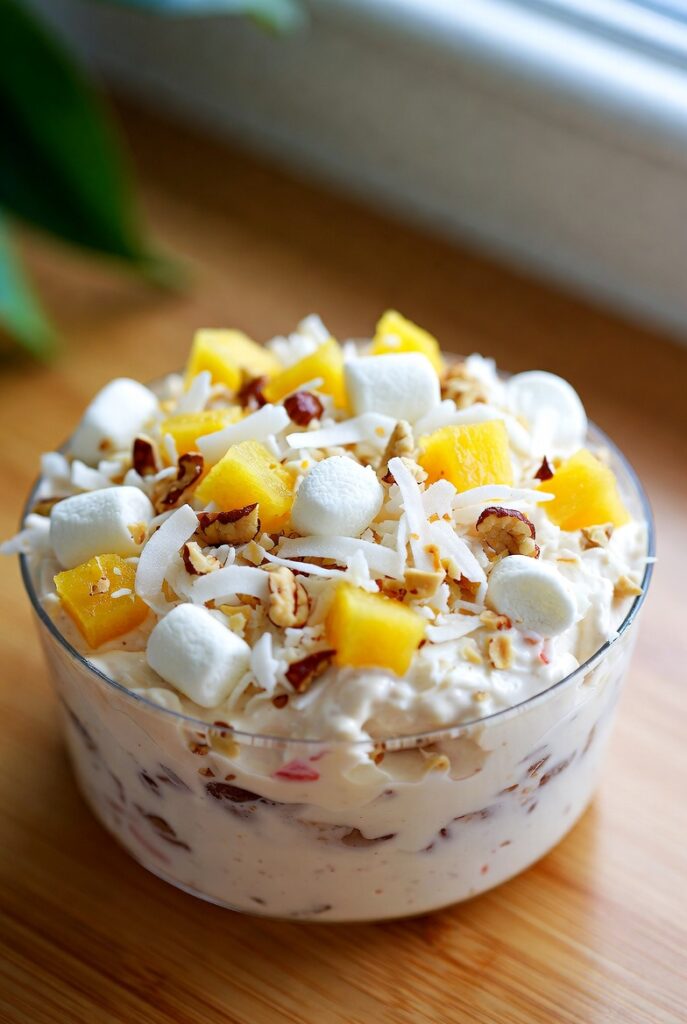
The fruit and the crunch must be added at the last possible moment before serving. If you add the toasted coconut too early, it will absorb moisture and become chewy rather than crisp.
6. Deep-Dive: Why the “Setting Phase” Changes Everything
Even without baking, this salad benefits from a “Cold-Crystallization Period.” Once assembled, refrigerate the base (without the coconut and nuts) for 60 minutes. This allows the milk fats in the cream cheese and whipping cream to undergo a minor phase transition, hardening slightly and giving the salad that “Classic-Cheesecake-Mouthfeel.”
7. Troubleshooting the Architecture: Common Failure Modes
- The salad is runny: You likely used a low-fat cream cheese or didn’t whip the cream sufficiently. Always use full-fat products for structural stability.
- The fruit is weeping liquid: You didn’t strain your pineapple well enough. Pro-Tip: Place the diced pineapple on paper towels for 10 minutes before folding it in.
- The coconut is soft: You added the “Crunch-Factor” too early. Always fold in the coconut and nuts immediately before service.
8. Advanced Customization: The “Aromatic Pivots”
- The “Lilikoi-Shift”: Drizzle a small amount of passion fruit puree on top for a “Bright-Acidic-Punch.”
- The “Ginger-Resolution”: Fold in 1/2 tsp of freshly grated ginger to the cream cheese base for an “Earthier-Depth.”
- The “Macadamia-Brittle-Utility”: If you want more crunch, create a quick stovetop brittle with macadamia nuts and brown sugar before crushing it over the salad.
9. The Physiology of Satiety: Why this Dessert Works
The Hawaiian Cheesecake Salad provides a unique “Sensory-Saturation” profile:
- The “Slow-Release” Experience: Because the salad is rich in healthy fats (macadamias and cream cheese), it slows gastric emptying, providing a longer “Energy-Plateau” compared to high-sugar fruit salads.
- The “Lipid-Acid” Balance: It offers the warmth of tropical fruit and the bright, acidic punch of pineapple, providing a sophisticated flavor contrast to the heavy cream cheese.
10. Storage and Thermal Recovery
- Shelf-Life: Ideally consumed within 4 hours of final assembly.
- Recovery: If the mixture softens, chill it for 20 minutes to re-stabilize the milk fats. Never attempt to freeze, as the thawing process will destroy the emulsion and leave you with separated dairy curds.
11. The “Visual Gravity” of Presentation
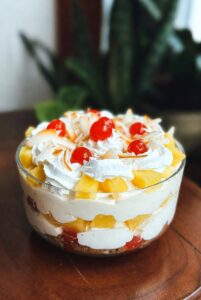
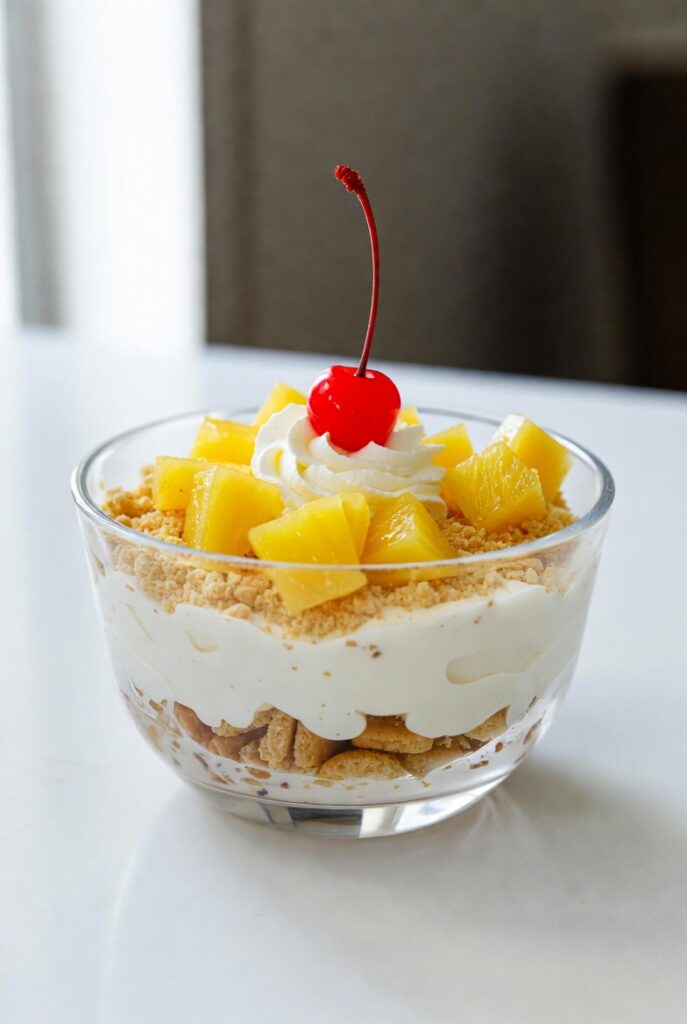
- The “Layered-Aesthetics”: Instead of a toss-and-mix, layer the fruit and the cheesecake mousse in a clear glass bowl. This creates a “Parfait-Effect” that is visually stunning.
- The “Garnish-Crown”: A final dusting of toasted coconut flakes or a maraschino cherry provides the “High-Contrast” visual finishing touch.
- The “Serving-Vehicle”: Serve with a side of extra macadamia brittle to allow guests to customize their “Crunch-Ratio.”
12. Conclusion: The Master Draft of Confectionery Utility
The Tropical-Lipid Emulsification Protocol proves that sophisticated dessert engineering does not require a complex oven-based baking cycle. By mastering the “Cold-Whip Stabilization” and the “Fruit-Draining Procedure,” you are delivering a dessert that is visually “Stunning,” structurally complex, and sensorially perfect.
It is the ultimate “Comfort-Anchor”—a “Creamy-and-Crunchy” testament to the power of precise culinary logic. Whether you are catering a summer party or just seeking an indulgent weekend treat, this salad elevates simple ingredients into a gourmet-tier experience through simple but precise structural choices.