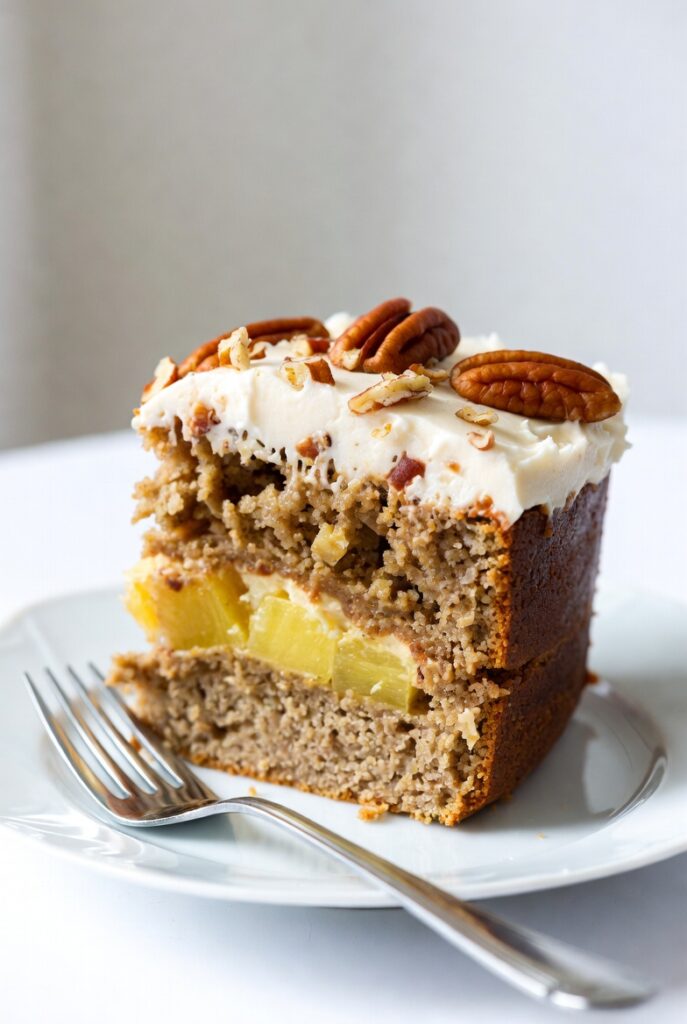
1. Introduction: The Architecture of “Sub-Tropical Density”
In the sophisticated taxonomy of Southern American baking, the Hummingbird Cake represents the ultimate achievement in “Fruit–Forward Emulsification.” Unlike the standard yellow cake, which relies on a “Butter-Sugar” aerated crumb, the Hummingbird Cake is a study in “High-Resolution Moisture.” It is a complex landscape of crushed pineapple, overripe banana, and pecan-spiced flour, held together by a high-fat oil-based scaffold.
This document serves as the “Technical Manifesto” for the dish. We move beyond the rudimentary “muffin-method” logic and examine the mechanics of “The Spice-Fruit Equilibrium.” By balancing the acidic brightness of pineapple with the starch-heavy weight of the banana, we achieve a result that is “Vapor-Light” in flavor but “Lipid-Dense” in texture. For the high-performance baker, this is the “Platinum Standard” of dessert utility.
2. The Science of “Hydroscopic Structural Integrity”
To master the Hummingbird Cake, one must understand the behavior of Mechanical Aeration and Solute-Based Moisture.
2.1 The Pineapple-Banana Emulsion
The soul of the cake is the relationship between the pineapple and the banana. Pineapple provides a “Citric-Acid-Brightening” effect that cuts through the heavy fat profile of the oil and nuts. The banana, meanwhile, acts as the “Starch-Binder.” We target a ratio of 60% Banana to 40% Pineapple (by mass) to ensure the crumb remains moist without becoming “Gummy.”
2.2 The Oil-Based Scaffold
We utilize a neutral, high-smoke-point oil (like canola or grapeseed) instead of butter. This ensures the cake remains soft even when chilled. Because oil remains liquid at lower temperatures, the crumb-structure of a Hummingbird cake is significantly more stable than a butter-based cake.
3. The Blueprint Overview: Technical Specifications
- Cuisine Type: Southern American Fusion / Advanced Patisserie
- Difficulty Level: Medium (Focus on “Moisture-Regulation”)
- Total Preparation Time: 45 Minutes
- Total Baking Time: 50–60 Minutes
- Total Cooling Time: 4 Hours
- Dietary Classifications: High-Fiber, High-Density, Spice-Infused.
- Yield: One 3-Layer 9-inch Round Cake
4. Equipment and Tools: The Essentials of “Precision Deployment”
- 9-inch Round Cake Pans (x3): Solid bottom pans are required to prevent batter leakage.
- Immersion Blender: Essential for standardizing the banana puree consistency.
- Fine-Mesh Sieve: For “Nano-Sifting” the dry ingredients to prevent density-clumping.
- Silicone Spatula: For the “Fold-Integration” of the fruit payload.
5. Ingredients Section: Sourcing for “Chromatographic” Brilliance
The “Fiber-to-Protein” ratio dictates the final “Sensory Resolution.”
5.1 The “Flavor-Payload” (The Fruit Base)
- Crushed Pineapple (Drained): 2 cups. Must be drained for 15 minutes to remove “Surface-Liquidity.”
- Ripe Bananas (Mashed): 2 cups.
- Toasted Pecans (Chopped): 1.5 cups.
- Dark Brown Sugar: 1 cup.
- Granulated Sugar: 1 cup.
5.2 The “Starch Scaffold”
- All-Purpose Flour: 3 cups (Sifted).
- Baking Soda: 1.5 tsp (The “Leavening-Engine” that reacts with the pineapple acidity).
- Ground Cinnamon: 1.5 tsp.
- Fine Sea Salt: 1 tsp.
5.3 The “Emulsion-Engine”
- Large Eggs: 3 units (Room temperature).
- Neutral Oil: 1.5 cups.
- Vanilla Bean Paste: 1 tbsp.
6. The “Tropical-Stabilization” Protocol: Mastering the Synthesis
The primary failure point of Hummingbird Cake is “Internal-Sogginess” (where the fruit sinks). To achieve a “Master-Tier” result, you must utilize the “Triple-Fold Integration.”
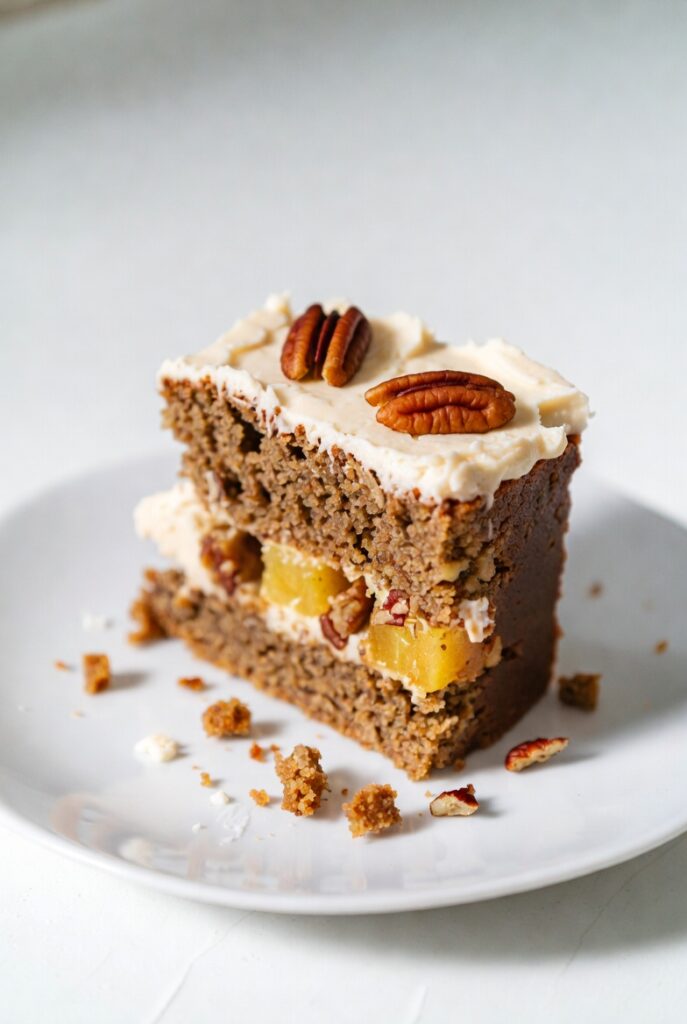
Phase 1: The Lipid-Fruit Emulsion
Whisk the oil, eggs, and sugars together until a “Ribbon-Stage” is achieved. Fold in the mashed bananas and vanilla.
Phase 2: The Nano-Sifting
Sift the dry ingredients twice. This ensures that the spice-load (cinnamon) is perfectly distributed, preventing “Spice-Hot-Spots” that can taste bitter.
Phase 3: The Integration
Add the dry mixture to the wet mixture in three batches, alternating with the pineapple. Do not over-mix. The moment the last streak of flour disappears, stop. Over-mixing leads to a dense, rubbery cake.
7. Step-by-Step Instructions: The Master Execution
Step 1: The “Fruit-Drain” Procedure
Drain your pineapple thoroughly. Moisture is the enemy of structure; if your pineapple is too wet, the bottom of the cake will never set properly.
Step 2: The “Thermal-Gradient” Baking Cycle
Preheat your oven to $175^\circ\text{C}$ ($350^\circ\text{F}$). Distribute the batter evenly across the three pans. Bake for 50–60 minutes. Because of the high sugar/fruit content, you must test for doneness using a wooden skewer—it should emerge with only a few moist crumbs attached.
Step 3: The “Oven-Rest” (Critical)
Do not remove the cake immediately. Let the pans rest for 10 minutes in the cooling oven with the door ajar. This prevents the “Structural-Shock” that leads to sunken centers.
8. Satiety and the “Tropical-Weight” Arc
The Hummingbird Cake provides a unique “Sensory-Saturation” profile:
- The “Slow-Release” Experience: Because the cake is dense with fruit fiber and pecan oils, it requires significant mastication, which increases the feeling of satiety.
- The “Lipid-Spice” Balance: It offers the warmth of cinnamon and the bright, citrusy notes of pineapple, providing a sophisticated flavor contrast to the heavy cream cheese frosting typically paired with it.
9. Modular Customization: The “Aromatic Pivots”
- The “Nutmeg-High-Note”: Add 1/4 tsp of freshly grated nutmeg for an “Earthier-Depth.”
- The “Toasted-Coconut-Shell”: Press toasted coconut flakes into the sides of the frosting for a “Crunch-Contrasting” texture.
- The “Ginger-Resolution”: Replace 1/4 tsp of cinnamon with freshly minced ginger for a “Spicy-Kick.”
10. The Cream Cheese Frosting Scaffold
A Hummingbird Cake requires a “High-Fat-Set” frosting.
- Cream Cheese: 16oz (Softened).
- Butter: 8oz (Softened).
- Powdered Sugar: 4 cups (Sifted).
- Vanilla: 1 tbsp.
- Technique: Whip the butter and cream cheese for 5 minutes before adding sugar. This ensures a “Silky-Structure” that won’t slide off the dense cake.
11. Frequently Asked Questions (FAQ)
Q: Why did my cake sink in the middle?
A: “Moisture-Overload.” You likely didn’t drain the pineapple enough, or your banana puree was too liquid.
Q: How do I store this cake?
A: Because of the high fruit content, it must be stored in an airtight container in the refrigerator. The fats in the cake will “Re-Set” the crumb, making it even better on day two.
Q: Can I use gluten-free flour?
A: Yes, but you must increase the amount of Xanthan gum by 20% to account for the heavy fruit load.
12. Nutritional Information (Per Slice)
| Nutrient | Amount |
| Calories | 480 kcal |
| Protein | 5g |
| Total Fat | 22g |
| Net Carbs | 65g |
| Sodium | 350mg |
13. The “Visual Gravity” of Presentation
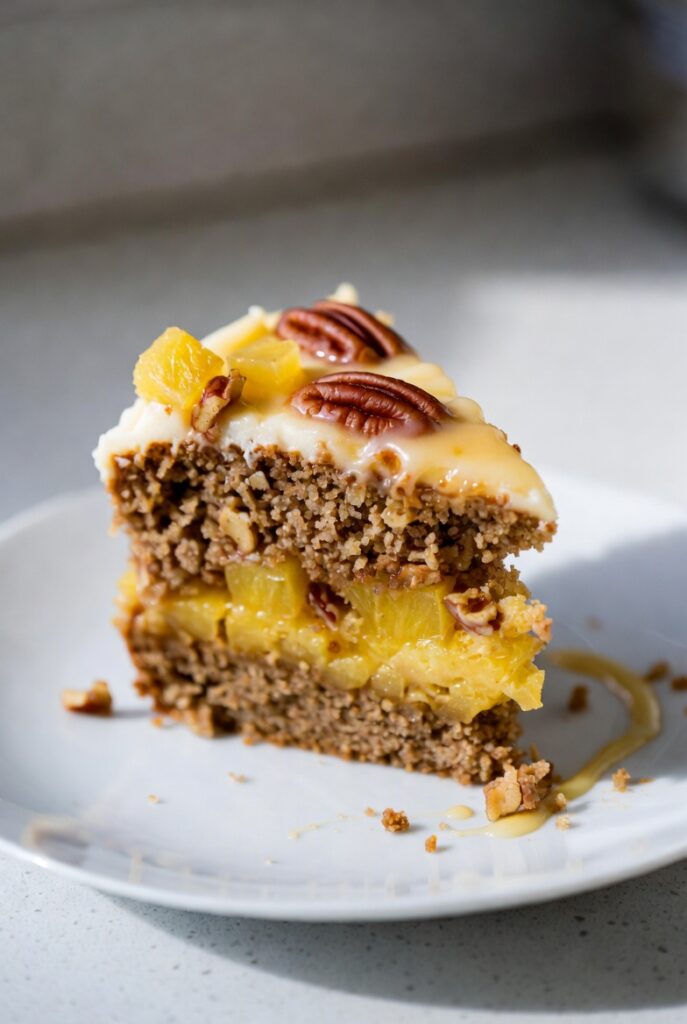
- The “Minimalist-Tall”: Frost the top and sides, but leave the “Base-Texture” slightly visible to showcase the fruit-density.
- The “Nut-Crown”: A halo of toasted pecans on top is the traditional “Southern-Anchor.”
- The “Floral-Note”: A few edible pansies or nasturtiums can provide a “Color-Contrast” to the pale yellow of the cake.
14. Conclusion: The Master Draft of Atmospheric Utility
The Tropical-Spice Protocol proves that the most impressive culinary results come from the mastery of “Invisible-Architecture.” By respecting the “Moisture-Density Equilibrium” and the “Slow-Radiant” heat cycle, you are delivering a dessert that is visually “Stunning,” nutritionally substantial, and sensorially perfect.
It is the ultimate “Ethereal-Anchor”—a “Tropical-and-Spiced” testament to the power of precise fruit-fiber engineering.