1. Introduction: The Architecture of “One-Pan” Structural Synergy
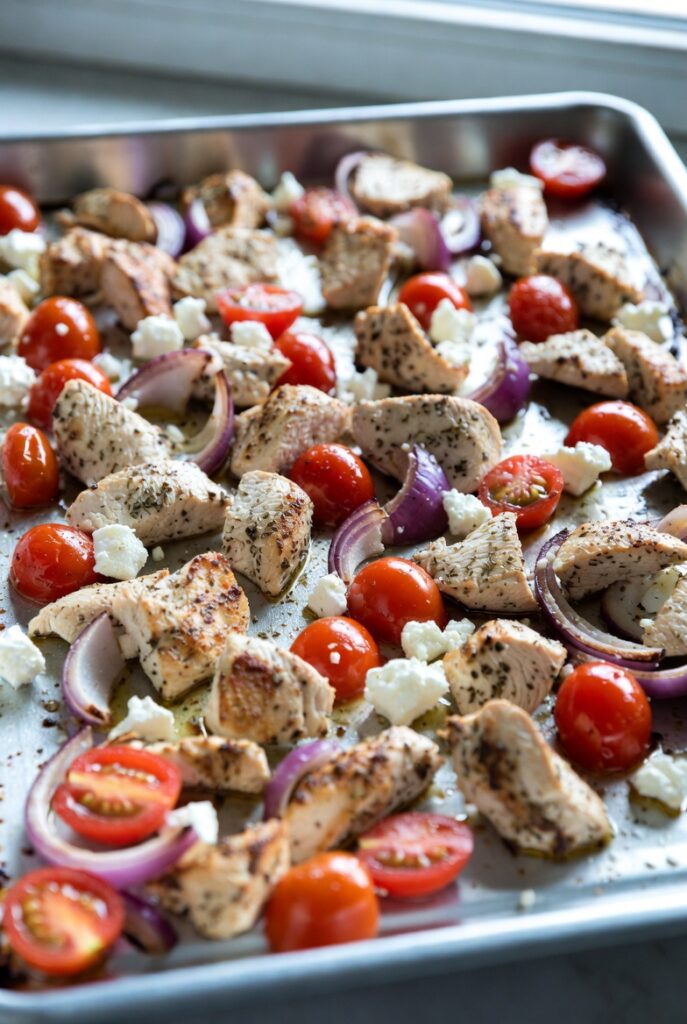
In the sophisticated taxonomy of modern home gastronomy, the Sheet Pan Greek Chicken with Feta represents the pinnacle of “High-Velocity Utility.” Far from being a simple “tray bake,” this dish is a landmark study in “Thermal Conduction and Moisture Management.” The brilliance of the “Mediterranean Blueprint” lies in its ability to take diverse ingredients—high-protein poultry, porous tubers, and brine-stabilized lipids—and subject them to a singular radiant heat source, resulting in a “Unified Flavor Matrix.”
A true “Master Draft” of this recipe focuses on the “Density-to-Heat” ratio. The primary failure of the amateur sheet pan meal is the “Asynchronous Finish”—where the vegetables turn to mush before the chicken reaches its target internal temperature. By utilizing “Size-Modulation” and a “Layered-Acid” marinade, we ensure that every component reaches its peak sensory resolution simultaneously. For the high-performance professional or the parent seeking “Zero-Friction” nutrition, this is the “Platinum Standard” of culinary engineering.
2. The Science of the “Citrus-Herb” Denaturation
To master this dish, one must move beyond the spice jar and understand the mechanics of “Acidic Surface Tension.” The secret to the “Shatter-Snap” of the chicken skin and the “Velvet-Cream” interior is the use of Lemon Juice and Extra Virgin Olive Oil ($EVOO$).
Unlike heavy, sugar-based marinades that “Caramelize and Burn” under high heat, the Mediterranean marinade acts as a “Protective Emulsion.” The citric acid in the lemon juice initiates a “Low-Velocity Denaturation” of the surface proteins, while the polyphenols in the $EVOO$ act as a “Conductive Fluid,” frying the skin from the outside in. This creates a “Micro-Seared” barrier that locks in the intracellular moisture of the chicken. This is “Biochemical Optimization” disguised as a rustic dinner.
3. The Blueprint Overview: Technical Specifications
- Cuisine Type: Modern Hellenic / Performance Utility
- Difficulty Level: Easy (Focus on “Knife Consistency”)
- Total Preparation Time: 15 Minutes (plus 30 minutes optional marination)
- Total Cooking Time: 25–30 Minutes
- Total Time: 45 Minutes
- Dietary Classifications: Gluten-Free, Keto-Friendly, High-Protein.
- Yield: Serves 4–6
4. Equipment and Tools: The Essentials of “Thermal Distribution”
- Commercial-Grade Half-Sheet Pan ($18 \times 13$ inches): Non-Negotiable. A standard thin cookie sheet will “warp” under high heat and distribute energy unevenly. A heavy-gauge aluminum pan provides the “Thermal Mass” needed for consistent browning.
- Large Mixing Bowl: For the “Initial Saturation” phase.
- Instant-Read Thermometer: To ensure the chicken reaches exactly $74^\circ C$ ($165^\circ F$) without overshooting into “Fibrous” territory.
5. Ingredients Section: Sourcing for “Crystalline” Vibrancy
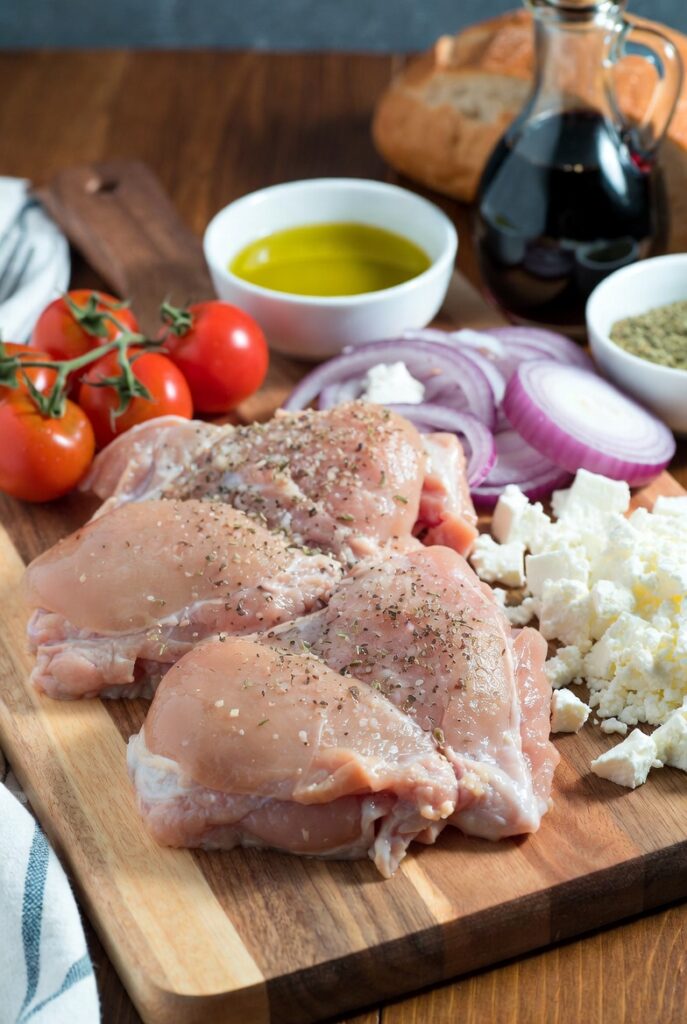
In a dish with a minimalist profile, the “Fat-to-Water” ratio of the vegetables and the “Brine Integrity” of the feta determine the final “Sensory Resolution.”
The Protein Anchor
- Chicken Thighs: 2 lbs.
- The Logic: Use Bone-In, Skin-On Thighs. The bone acts as an “Internal Heat Radiator,” cooking the meat from the inside while protecting against overcooking. The skin provides the essential “Lipid-Crunch” factor.
The “Aromatic Scaffold” (The Vegetables)
- Baby Potatoes: 1 lb, halved. (The “Starch Reservoir”).
- Red Onion: 1 large, cut into 1-inch wedges. (For “Pyrolytic Sweetness”).
- Bell Peppers: 2 units (Red and Yellow), coarsely chopped. (For “Capsaicin-Free Brightness”).
- Zucchini: 1 medium, sliced into “Half-Moons.”
The “Mediterranean Matrix” (The Marinade)
- Extra Virgin Olive Oil: 1/4 cup.
- Lemon Juice: 3 tbsp (Freshly squeezed).
- Garlic: 4 cloves, microplaned.
- Dried Oregano: 2 tsp. (The “Herbaceous Backbone”).
- Fine Sea Salt & Cracked Black Pepper: To taste.
The “Saline-Lipid” Capping
- Feta Cheese: 6 oz, coarsely crumbled. (The “Umami-Acid” driver).
- Kalamata Olives: 1/2 cup, pitted. (For “Brine-Depth”).
- Fresh Parsley: For “Chlorophyll Finish.”
6. The “Size-Modulation” Protocol
The most common failure in sheet pan cooking is “Textural Disparity.” To achieve a “Master-Tier” result, one must utilize the “Size-Modulation Protocol.”
Potatoes require the most “Thermal Energy” to soften. Therefore, they must be cut into small $1/2$-inch units. Conversely, zucchini and bell peppers contain high water content and soften rapidly; these should be cut into larger, $1$-inch “Macro-Units.” This “Inverse-Ratio” cutting ensures that the starch and the fiber finish cooking at the exact same moment the chicken reaches $74^\circ C$.
7. Deep Dive: The “Feta-Char” Phenomenon
Why do we add feta during the bake rather than after? It centers on “Protein Coagulation and Caramelization.” Unlike mozzarella, which melts into a “Stringy Fluid,” feta has a high-acid profile that causes it to maintain its “Structural Geometry” under heat.
As the feta bakes, the surface moisture evaporates, and the milk sugars undergo the Maillard Reaction. This results in “Golden-Brown Crags” of cheese that offer a “Crystalline Crunch” followed by a “Creamy Center.” This “Textural Contrast” is the hallmark of professional Mediterranean cooking, providing a “High-Frequency” salt kick that cuts through the fat of the chicken.
8. Step-by-Step Instructions: The Master Execution
Step 1: The “Saturation” Phase
In your large mixing bowl, whisk together the olive oil, lemon juice, garlic, and oregano. This is your “Emulsion Base.” Add the chicken thighs and toss until every “Pore” of the skin is coated.
Step 2: The “Vegetable-Armor” Coat
Add the potatoes, onions, and peppers to the bowl with the chicken. Toss vigorously. The vegetables will “Scavenge” the excess marinade from the chicken, ensuring a “Uniform Lipid Layer” across the entire tray.
Step 3: The “Grid-Geometry” Layout
Spread the contents of the bowl onto your heavy-duty sheet pan.
- The “Air-Flow” Rule: Ensure the chicken thighs are placed “Skin-Side Up” and are not covered by vegetables. Space the components out so the pan is not “Crowded.” Crowding leads to “Steaming”; spacing leads to “Roasting.”
Step 4: The “Primary Thermal” Blast
Preheat oven to $220^\circ C$ ($425^\circ F$). Place the pan on the center rack. Bake for 20 minutes. The high heat is necessary to “Flash-Render” the chicken fat.
Step 5: The “Inclusion” Phase
Remove the pan. Add the zucchini, kalamata olives, and the crumbled feta cheese.
- The Logic: Zucchini only needs 10 minutes to reach “Al Dente.” Adding it now prevents it from turning into a “Soggy Slurry.”
Step 6: The “Maillard-Polish” Finish
Bake for another 10–12 minutes.
- The Observation: You are looking for chicken skin that is “Translucent and Brittle” and feta that has developed “Amber-Brown Peaks.”
Step 7: The “Aromatic Resolution”
Remove from heat. Squeeze a fresh lemon wedge over the tray to “Re-Activate” the herb oils. Garnish with fresh parsley.
9. Satiety and the “Mediterranean Energy Curve”
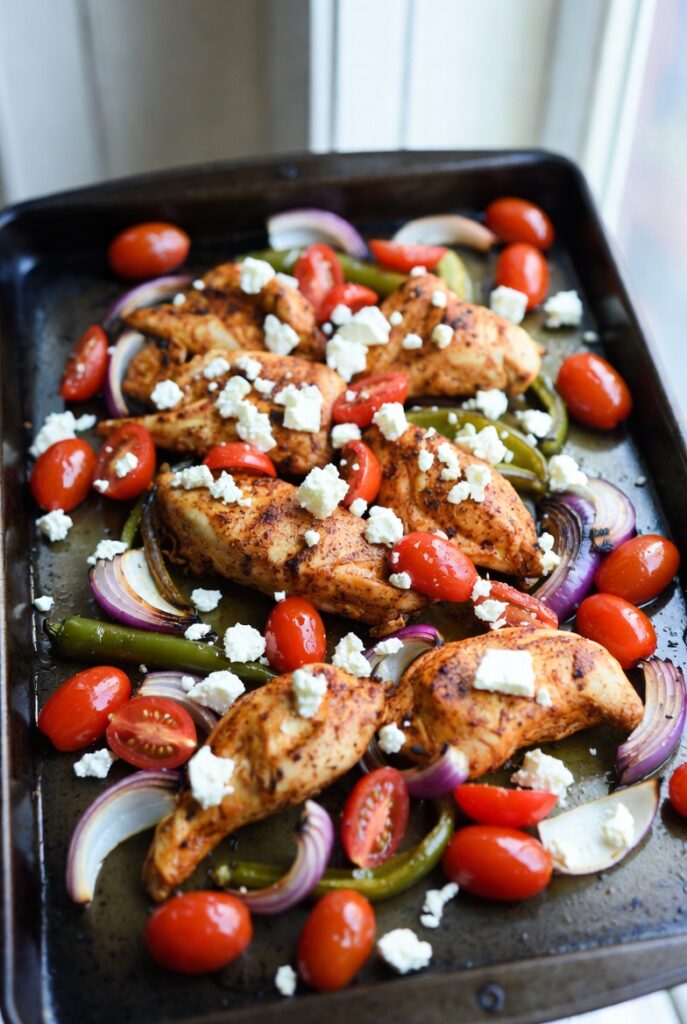
Sheet Pan Greek Chicken and Feta provides “High-Resolution Satiety”:
- The Complex Starch: Potatoes provide a “Slow-Release” glucose source, preventing a mid-evening energy crash.
- The High Protein Density: Chicken thighs offer essential amino acids and collagen for “Cellular Repair.”
- The Lipid Buffer: The $EVOO$ and feta provide healthy fats that signal “Nutritional Completion” to the brain.
This creates a state of “Stable Satiety”—you feel physically “Finished” without the “Lethargic Slump” associated with heavy cream or grain-heavy meals.
10. Modular Customization: The “Flavor Pivots”
- The “Inferno” Draft: Add 1 tsp of red pepper flakes to the marinade for a “Capsaicin High-Note.”
- The “Aegean” Standard: Add 2 tbsp of capers and replace zucchini with artichoke hearts for a “High-Brine” resolution.
- The “Low-Carb” Shift: Replace potatoes with Cauliflower Florets to reduce the glycemic index while maintaining the “Crunch Geometry.”
11. Storage and “Thermal Recovery”
- Refrigeration: Store in an airtight container for up to 3 days.
- The “Aqueous” Reality: The vegetables will release a small amount of water in the fridge. This is normal.
- The Recovery Method: Avoid the microwave. A microwave will turn the chicken skin “Rubbery.” Reheat in an air fryer or oven at $190^\circ C$ ($375^\circ F$) for 8 minutes. This “Re-Crisps” the skin and “Re-Activates” the feta lipids.
12. Frequently Asked Questions (FAQ)
Q: Why is my chicken skin not crispy?
A: This usually happens due to “Pan Overcrowding.” If the ingredients are touching, they trap steam. Ensure you use a large enough pan or split the recipe between two pans.
Q: Can I use chicken breast?
A: Affirmative. However, chicken breast dries out at $65^\circ C$ ($150^\circ F$). You must reduce the cook time and use “Thick-Cut” breasts to avoid a “Fibrous” texture.
Q: Do I need to peel the potatoes?
A: Negative. The skin provides “Structural Integrity” and extra fiber. Plus, the skin “Crisps” in the olive oil, adding to the “Textural Complexity.”
13. Nutritional Information
(Per serving – 1 thigh + 1 cup vegetables)
| Nutrient | Amount |
| Calories | 460 kcal |
| Protein | 32g |
| Total Fat | 28g |
| Net Carbs | 18g |
| Vitamin C | 60% DV |
14. The “Visual Gravity” of Presentation
In the 2026 culinary landscape, the “Aesthetic Payload” is as critical as the flavor.
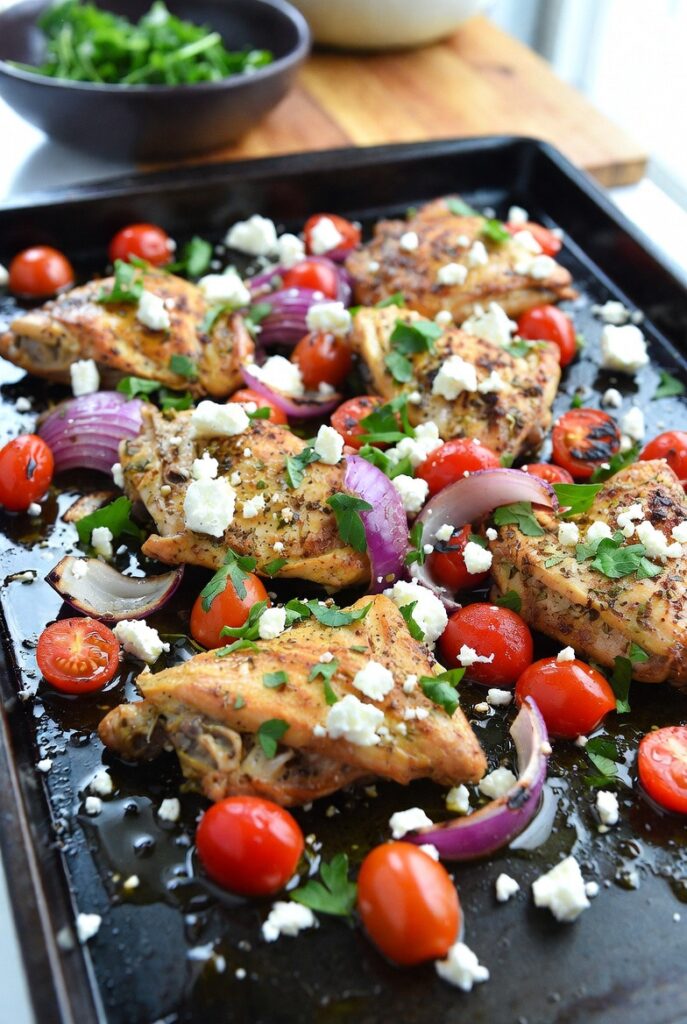
- The Color Spectrum: The “Red” of the peppers, “Green” of the parsley, and “Gold” of the chicken create a “High-Contrast” visual that stimulates the appetite.
- The “Rustic” Platter: Serve the dish directly from the sheet pan (on a trivet) to emphasize the “One-Pan” authenticity.
- The Lemon Garnish: Place charred lemon halves on the tray—they provide a “Professional-Finish” and extra juice for those who prefer higher acidity.
15. Conclusion: The Master Draft of Mediterranean Utility
The Mediterranean Blueprint is more than a recipe; it is a “Vessel for Intentional Synergy.” It proves that “Gourmet Results” can be achieved through the mastery of “Size-Modulation” and “Thermal Radiant Management.” By respecting the “Sequential Addition” of ingredients and the “Lipid-Acid Balance” of the marinade, you are delivering a dish that is visually “Jade-and-Gold,” nutritionally dense, and sensorially perfect.
It is the ultimate “Social Anchor”—a “One-Pan” testament to the power of fresh ingredients and high-heat conduction.