1. Introduction: The Architecture of the “Siam-Arachis” Equilibrium
In the expansive taxonomy of global “Street-Food” gastronomy, the Thai Peanut Chicken Skewer—culturally rooted in the Satay traditions of Southeast Asia—represents a landmark study in “Textural Synchronization.” To the untrained eye, it is simply poultry on a stick. To the culinary strategist, it is a sophisticated exercise in “Maximum Surface-to-Volume Ratio.” This document serves as the “Master Draft” for the dish. We move beyond the rudimentary “grill-and-dip” logic and enter the realm of “High-Frequency Aromatic Saturation.” By transitioning from large, monolithic cuts of meat to thin, ribboned “S-Pattern” strips, we exponentially increase the “Maillard Interface.” This ensures that every millimeter of the chicken is subjected to the “Pyrolytic Char” of the flame, creating a rugged, smoky anchor for the “Lipid-Heavy” velvet of the peanut emulsion.
For the high-performance host, the keto-conscious gourmet, or the “Zero-Friction” meal-prepper, this is the “Platinum Standard” of hand-held nutrition. It delivers a “Complex-Savory” profile with a profound “Portable Utility” that transcends the standard dinner plate.
2. The Science of “Lipid-Buffered” Marination
To master the Thai Skewer, one must move beyond the spice jar and understand the mechanics of Non-Polar Solvent Infusion. The primary failure of the amateur skewer is “Surface-Only Flavoring”—where the interior of the meat remains anemic while the outside burns.
The secret to a “Master-Tier” result is the “Lipid-Buffered Marinade.”
- The Curcumin Barrier: Turmeric (the source of the vibrant yellow hue) is hydrophobic. Its primary flavor compound, curcumin, does not dissolve in water. To move this “Earth-Toned” aromatic into the chicken fibers, it must be dissolved in a fat source.
- The Lauric Acid Catalyst: By using Full-Fat Coconut Milk as the carrier, we utilize medium-chain fatty acids (MCTs) to gently penetrate the chicken’s surface tension.
- The Enzymatic Softening: The natural acids in the coconut milk act as a “Low-Velocity Denaturant,” softening the protein matrix without making it “mushy,” as vinegar-based marinades often do.
This ensures the flavor is “Driven” into the protein core, resulting in a “Linear Sensory Experience” where the first bite is as vibrant as the last.
3. The Blueprint Overview: Technical Specifications
- Cuisine Type: Southeast Asian Fusion / Street-Food Utility
- Difficulty Level: Easy (Focus on “Threading Precision”)
- Total Preparation Time: 30 Minutes (plus 4-hour marination)
- Total Cooking Time: 10 Minutes
- Total Time: Approx. 5 Hours
- Dietary Classifications: Gluten-Free (with Tamari), Dairy-Free, High-Protein.
- Yield: 15–20 Skewers (Serves 6)
4. Equipment and Tools: The Essentials of “Radiant Conduction”
- Bamboo Skewers (10-inch): Non-Negotiable Submersion. You must soak these in water for a minimum of 60 minutes. This creates a “Moisture-Reservoir” within the wood, preventing the skewer from undergoing “Pyrolytic Failure” (snapping) when exposed to high-radiant heat.
- Heavy-Gauge Cast Iron Grill Pan or Charcoal Grill: To achieve the “Direct-Carbon” char required for the authentic “Smoky-Base.”
- Microplane: For the “Nano-Mince” of fibrous aromatics like lemongrass and galangal.
5. Ingredients Section: Sourcing for “Viscous” Adhesion
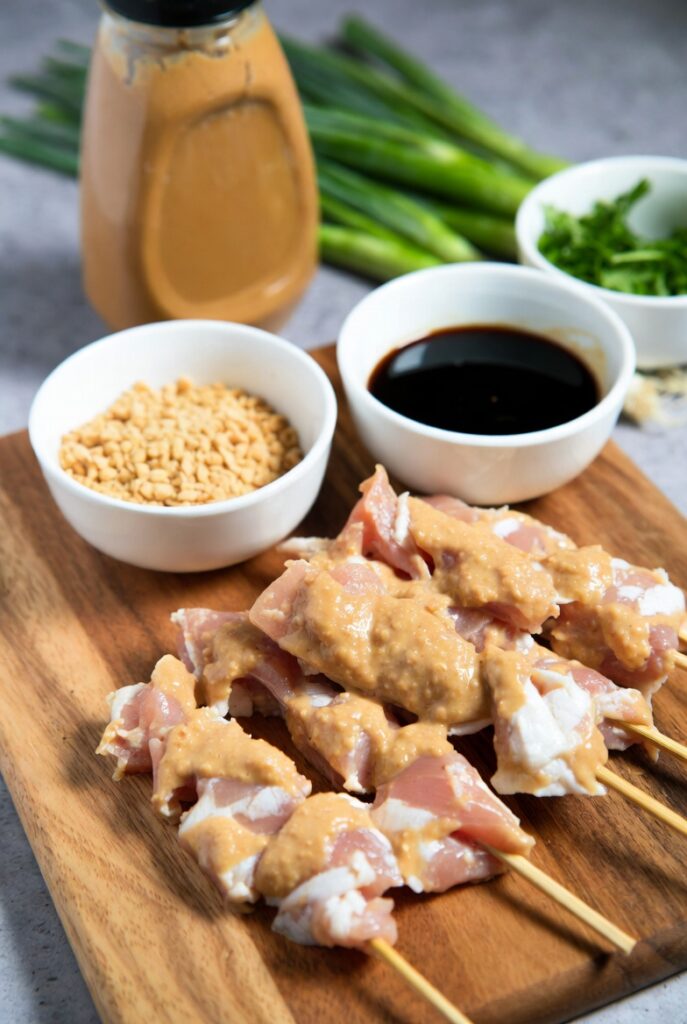
In a dish defined by its “Crunch-to-Cream” ratio, the “Roast-Profile” of the peanuts and the “Pungency” of the aromatics determine the final “Sensory Resolution.”
The Protein Anchor
- Chicken Thighs: 2 lbs.
- The Master Hack: Use Boneless, Skinless Thighs. While breast meat is popular, thighs contain the “Intramuscular Lipid” depth required to withstand the high-heat evaporation of the grill. Thighs remain “Succulent-Stable” even at high temperatures.
The “Siam-Infusion” (The Marinade)
- Full-Fat Coconut Milk: 1 cup. (The “Lipid Carrier”).
- Lemongrass: 2 stalks (tender white part only), microplaned into a paste.
- Turmeric, Cumin, & Coriander: 1 tsp each. (The “Aromatic Trinity”).
- Fish Sauce: 2 tbsp. (The “Fermented-Umami” driver).
- Brown Sugar: 1 tbsp. (The “Caramelization Catalyst”).
The “Arachis” Matrix (The Peanut Sauce)
- Natural Roasted Peanut Butter: 3/4 cup (Unsweetened/Unsalted for total control).
- Red Curry Paste: 2 tbsp. (For the “Capsaicin High-Note”).
- Coconut Milk: 1/2 cup (to adjust “Viscosity”).
- Lime Juice: 2 tbsp. (The “Acidic Resolution”).
- Soy Sauce or Tamari: 1 tbsp.
6. The “Ribbon-Threading” Protocol
This is the single most important technical step. To achieve the “Master-Tier” texture, you must abandon “Chunky Cubes.”
The Ribbon Method:
- The Precision Slice: Cut the chicken thighs into long, thin ribbons (approx. 1 inch wide and 1/4 inch thick).
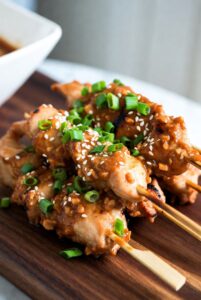
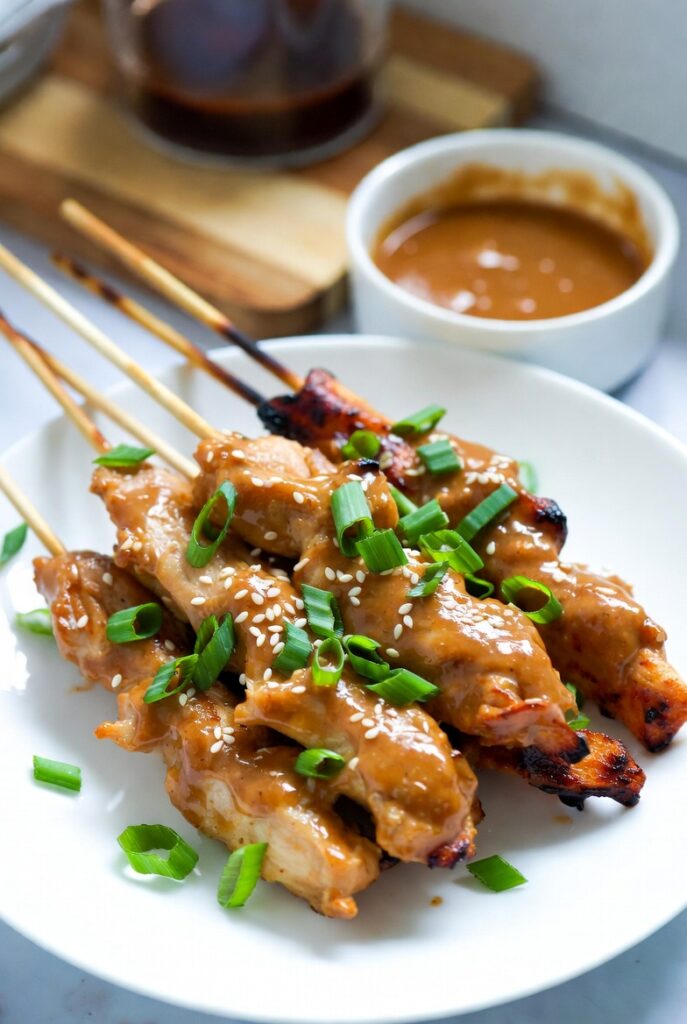
- The Accordion Weave: Thread the skewer through one end of the strip, then fold it back and forth in an “S-Pattern,” piercing through each fold.
- The Result: This “Ribboning” creates a massive surface area that “Flash-Sears” on the grill. The “Pockets” created by the folds act as “Flavor-Traps” for the peanut sauce, ensuring a “High-Density” coating in every bite.
7. The “Maillard-Char” Dynamics: Simulating the Street Grill
Authentic Satay requires “Direct Thermal Radiant Energy.” * The “No-Movement” Rule: When the skewers hit the hot grill, do not move them for at least 3 minutes. This allows the sugars and proteins to undergo the Maillard Reaction, bonding them into a “Savory-Crust.”
- The “Sizzle-Signal”: Listen for the rhythmic “Popping” of the coconut milk fats. This indicates the marinade is “Flash-Frying” the surface of the chicken, creating a “Micro-Crisp” veneer that protects the internal juices.
8. Deep Dive: The Chemistry of the Peanut Emulsion
Why is the sauce so addictive? It is a “Multi-State Emulsion.” Peanut butter provides the “Solid-Phase” fats, coconut milk provides the “Liquid-Phase” fats, and the red curry paste provides “Lipid-Soluble” aromatics. When whisked together over low heat, the proteins in the peanuts “Bind” the water and oil together.
The addition of Lime Juice at the very end is the “Molecular Clarifier.” The citric acid cuts through the heavy fat molecules, “Lifting” the flavor profile and preventing the palate from becoming “fatigued” by the richness. This is “Linear Flavor Engineering” designed for maximum consumption.
9. Step-by-Step Instructions: The Master Execution
Step 1: The “Proteolytic” Immersion
Whisk the marinade ingredients until homogenous. Submerge your chicken ribbons. Refrigerate for 4 hours. This allows the fish sauce and coconut milk to work in tandem to “Season the Core” of the protein.
Step 2: The “Arachis” Synthesis
In a small saucepan, sauté the red curry paste in 1 tsp of oil for 60 seconds (to “bloom” the spices). Whisk in the peanut butter, coconut milk, and soy sauce. Simmer until the sauce reaches a “Nappe Consistency” (it should coat the back of a spoon with a glistening, velvet sheen). Remove from heat and stir in the lime juice.
Step 3: The “Accordion” Assembly
Thread the chicken onto the soaked skewers using the Ribbon Protocol (Section 6). Ensure the meat is pushed together tightly to prevent “Thermal Over-Exposure” of the wood.
Step 4: The “High-Radiant” Sear
Preheat your grill to 230°C (450°F). Lightly oil the grates. Lay the skewers down in a single layer.
Step 5: The “Binary” Flip
Cook for 4 minutes on the first side. Flip and cook for another 3–4 minutes. The chicken should exhibit “Carbon-Char Peaks” while the interior remains $74^\circ C$.
Step 6: The “Visual Garnish”
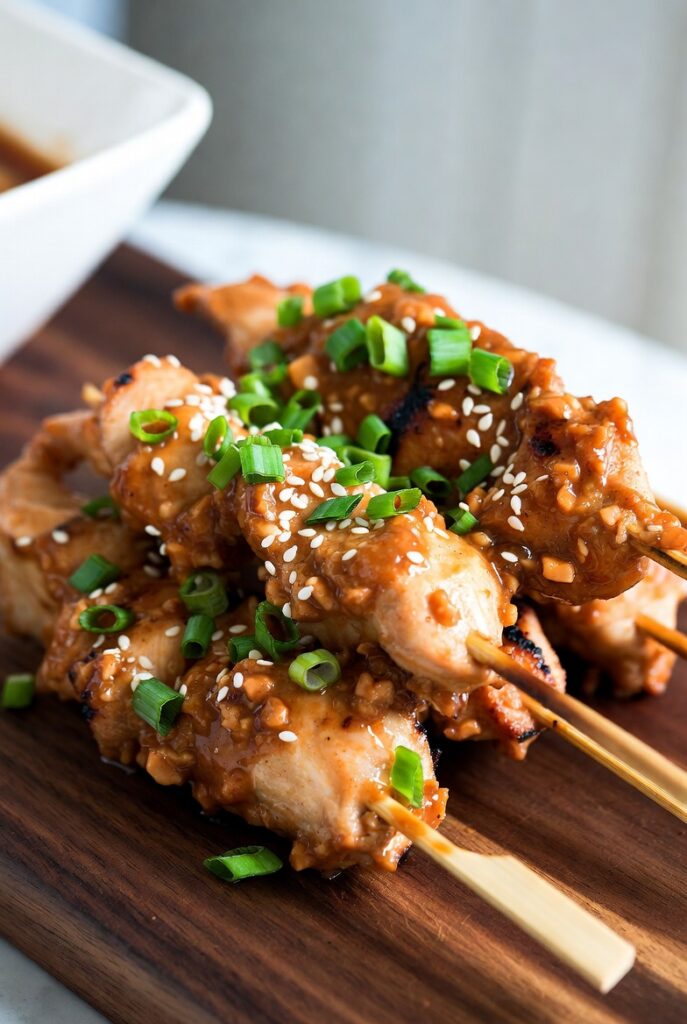
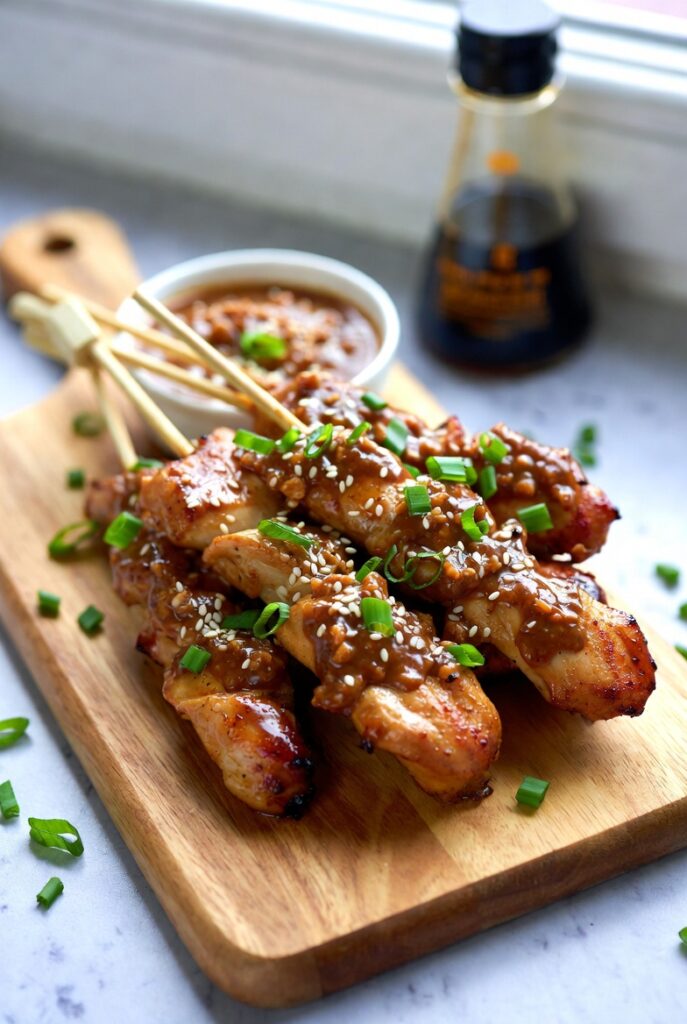
Arrange the skewers on a platter. Drizzle a “Starter-Layer” of sauce over the top. Garnish with crushed roasted peanuts (for “Textural Echo”), fresh cilantro, and sliced Thai chilies.
10. Satiety and the “MCT-Arachis” Energy Curve
Thai Peanut Chicken Skewers provide a unique form of “High-Resolution Satiety”:
- The Leucine Spike: Peanuts and chicken are both high in Leucine, an amino acid that triggers the “Anabolic Window” and signals to the brain that the body has received high-quality protein.
- The Lipid Buffer: The MCTs in the coconut milk provide “Immediate Energy,” while the denser peanut fats provide “Long-Form Satiety.”
- The Thermogenic Kick: The capsaicin in the curry paste increases “Diet-Induced Thermogenesis,” subtly boosting metabolic rate during the meal.
11. Modular Customization: The “Flavor Pivots”
- The “Bali” Draft: Replace the red curry paste with Sweet Soy Sauce (Kecap Manis) and a dash of coriander for a sweeter, Indonesian-style profile.
- The “Omega-3” Shift: Use Almond Butter or Cashew Butter for a “Nut-Profile Variation.”
- The “Inferno” Standard: Increase the red curry paste to 4 tbsp and add a drizzle of Sriracha to the marinade.
12. Storage and “Thermal Recovery”
- Refrigeration: Store in an airtight container for up to 3 days.
- The “Viscosity” Note: The peanut sauce will solidify in the fridge. This is normal.
- The Recovery Method: Avoid the microwave for the chicken. Reheat the skewers in an air fryer at 190°C for 4 minutes to “Re-Crisp” the Maillard crust. Warm the sauce in a small pan with a teaspoon of water to restore its “Velvet Fluidity.”
13. Frequently Asked Questions (FAQ)
Q: Why did my skewers catch fire?
A: You likely didn’t soak the bamboo long enough. For a “Platinum-Standard” result, soak them overnight. Alternatively, use stainless steel skewers for “Infinite Reuse.”
Q: My peanut sauce is “breaking” (oily). How do I fix it?
A: This happens if the sauce gets too hot. Whisk in a tablespoon of warm water or more coconut milk. The moisture will “Re-Emulsify” the oils and restore the “Silken Sheen.”
Q: Can I use chicken breast?
A: Affirmative. However, you must reduce the cooking time by 20%. Breast meat lacks the “Lipid-Buffer” of thighs and can transition from “Cooked” to “Dry-Fibrous” in under 60 seconds.
14. Nutritional Information
(Per serving – 3 large skewers)
| Nutrient | Amount |
| Calories | 480 kcal |
| Protein | 36g |
| Total Fat | 34g |
| Net Carbs | 9g |
| Potassium | 12% DV |
15. The “Visual Gravity” of Presentation
- The Platter: Use a long, narrow slate board to emphasize the linear geometry of the skewers.
- The Negative Space: Leave room for a “Dipping Reservoir” (the sauce bowl) at one end.
- The Color Contrast: The “Saffron-Yellow” of the chicken, the “Deep-Amber” of the sauce, and the “Vibrant-Green” of the cilantro create a “High-Contrast” visual that stimulates the appetite.
16. Conclusion: The Master Draft of Southeast Asian Utility
The Arachis-Siam Synthesis protocol is more than a recipe; it is a “Vessel for Intentional Synergy.” It proves that “Gourmet Results” can be achieved through the mastery of “Lipid-Buffered Marination” and the “Ribbon-Threading Protocol.” By respecting the “Thermal-Radiant Sear” and the “Peanut-Emulsion Stability,” you are delivering a dish that is visually “Gold-and-Amber,” nutritionally dense, and sensorially perfect.
It is the ultimate “Social Anchor”—a “Maillard-rich” testament to the power of fire, nuts, and poultry.