1. Introduction: The Architecture of the “Glycemic-Omega” Equilibrium
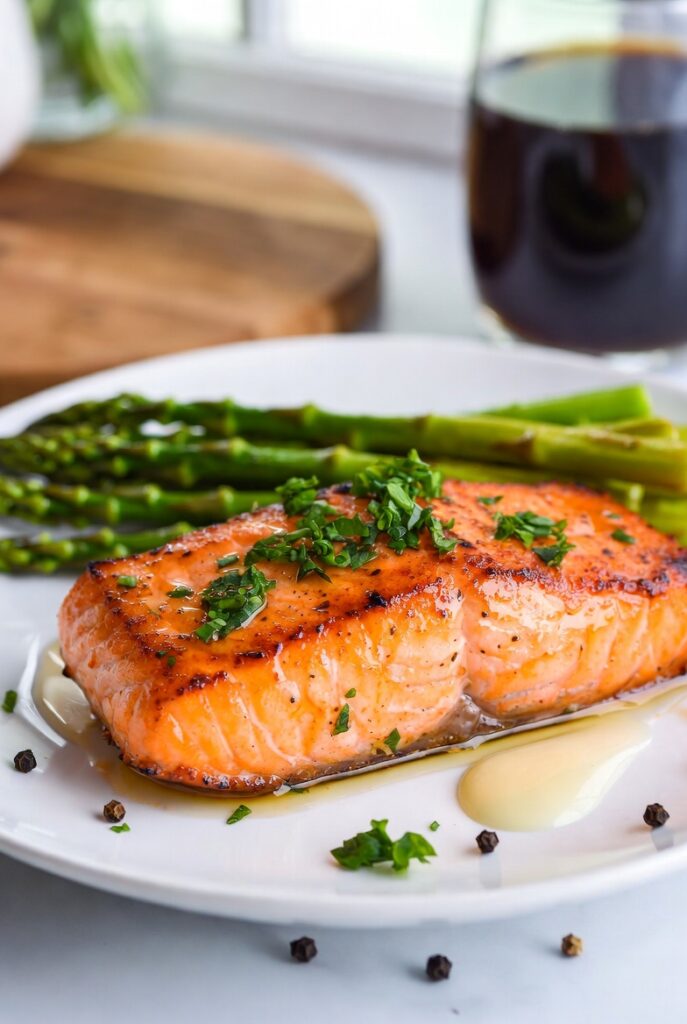
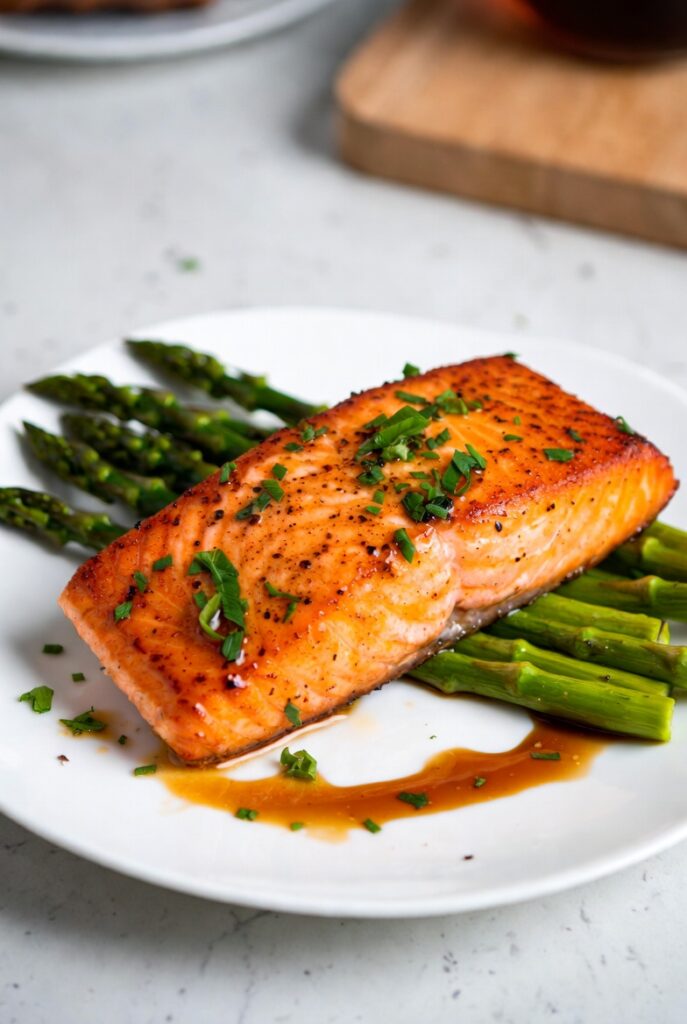
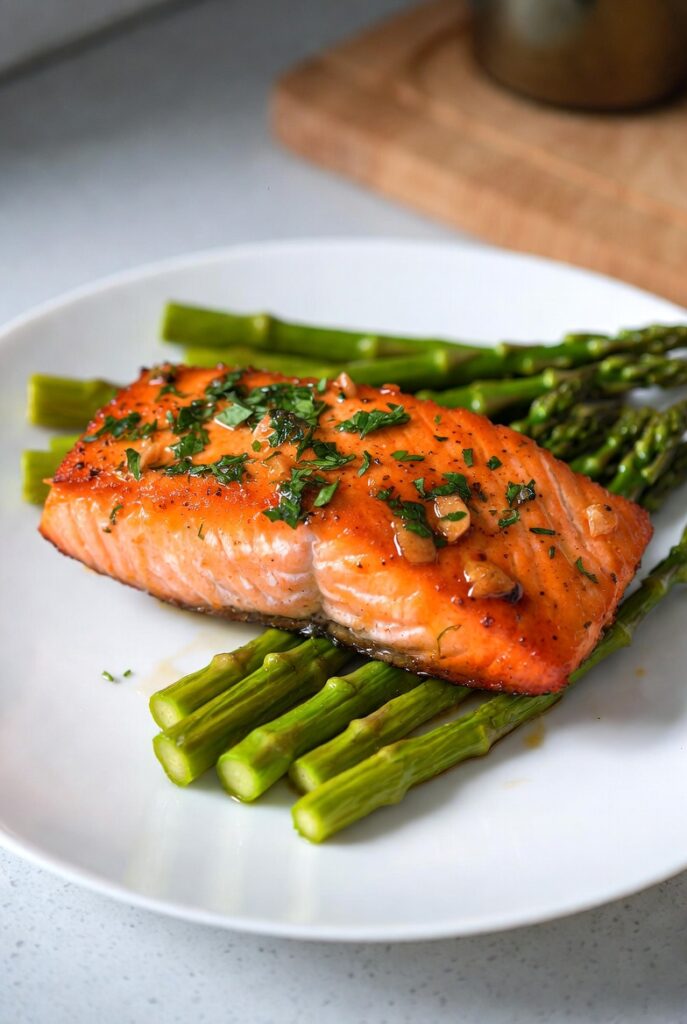
In the sophisticated taxonomy of “Performance Gastronomy,” Honey-Glazed Salmon with Asparagus stands as the quintessential “Bio-Hacking” meal. It is a dish that balances the “Lipid-Rich Density“ of cold-water salmon with the “Fibrous Alkalinity” of spring asparagus. While many perceive “Honey-Glazed” as a simple sweet topping, a true “Master Draft” of this dish is a study in “Caramelization Kinetics.” By utilizing the natural glucose in honey to facilitate a rapid Maillard Reaction on the surface of the fish, we create a “Crust-to-Crust” contrast: a shattered, sweet-and-savory exterior protecting a buttery, “Medium-Rare” interior.
The brilliance of this dish lies in its “Synchronous Cooking Cycle.” Unlike complex stews or tiered roasts, the salmon and asparagus share a near-identical “Thermal Requirement.” This allows for a “Single-Sheet Utility”—executing a high-resolution, gourmet dinner on a single pan in less than 15 minutes. For the modern professional, the high-performance athlete, or the weekend host, this is the “Platinum Standard” of efficiency: it is high-yield, low-cleanup, and delivers a level of “Palate Density” that triggers profound satiety without the “Post-Prandial Dip” (food coma) associated with heavy starches.
2. The Science of the “Glucose-Protein” Lacquer
To master Honey-Glazed Salmon, one must move beyond the bottle and understand the behavior of Honey under Thermal Stress. Honey is a complex mixture of fructose and glucose. Unlike granulated sugar, which has a higher melting point, honey begins to undergo “Pyrolysis” (browning) at a much lower temperature (approx. $140^\circ C$ to $150^\circ C$).
The secret to a professional-grade result is the “De-Glazing Buffer.” By whisking honey with a high-acid component (like lemon juice) and a fermented saline (like soy sauce), we raise the burning point and create a “Buffered Lacquer.” This allows the salmon’s surface proteins to denature and brown simultaneously with the honey’s caramelization. The result is a “Uniform Gloss”—a deep mahogany finish that adheres to the fish fibers, creating a “Shatter-Smooth” texture that is the hallmark of elite-tier seafood preparation.
3. Recipe Overview: The Master Blueprint
- Cuisine Type: Modern Coastal / High-Performance Nutrition
- Difficulty Level: Easy (Precision timing focus)
- Total Preparation Time: 10 Minutes
- Total Cooking Time: 12–15 Minutes
- Total Time: 25 Minutes
- Dietary Classifications: High-Protein, Omega-3 Rich, Gluten-Free (if using Tamari).
- Yield: Serves 2–4
4. Equipment and Tools: The Essentials of “Radiant Conduction”
- Heavy-Duty Rimmed Baking Sheet: To ensure even heat distribution. A flimsy pan will warp, causing the glaze to pool and burn in the corners.
- Parchment Paper or Silicone Mat: This is a “Non-Negotiable” for honey-based glazes. Caramelized honey becomes a “Structural Adhesive” when cooled; without parchment, your salmon skin will remain permanently bonded to the metal.
- Digital Instant-Read Thermometer: To achieve the “Buttery Flake” ($52^\circ C$ to $55^\circ C$ internal).
5. Ingredients Section: Sourcing for “Lipid Integrity”
In a dish with a focused profile, the “Source-to-Table” quality of the fats and sugars dictates the final “Aromatic Resolution.”
The Protein Anchor
- Salmon Fillets: 1.5 lbs (Center-cut preferred). Look for “Vibrant Pigmentation” and firm tissue.
- The Master Hack: Leave the skin on. It acts as a “Thermal Shield,” preventing the delicate flesh from drying out during the glaze-setting phase.
The “Aqueous Fiber” (The Vegetable)
- Fresh Asparagus: 1 large bunch.
- Selection Criteria: Choose “Pencil-Thin” spears for a rapid sear, or “Jumbo” spears if you prefer a “Juicy, Al Dente” snap.
The “Master Draft” Glaze (The Matrix)
- Honey: 1/4 cup. (Raw, wildflower honey provides the most complex floral notes).
- Soy Sauce or Tamari: 2 tbsp. (The “Saline-Umami” driver).
- Lemon Juice: 1 tbsp. (The “Acidic Brightener”).
- Garlic: 3 cloves, microplaned. (The “Allicin Kick”).
- Ginger: 1 tsp, freshly grated. (The “High-Note Clarifier”).
6. The “Synchronous Thermal” Protocol
The most common failure in sheet-pan meals is “Differential Done-ness”—where the vegetables turn to mush before the protein is cooked. To achieve a “Master Draft” finish, you must utilize the “Synchronous Thermal Protocol.”
- Preparation: Trim the woody ends of the asparagus (approx. 2 inches from the bottom).
- The “Oil-Buffer” Phase: Toss the asparagus in a high-smoke-point oil (like Avocado oil) and salt separately from the salmon. This prevents the honey glaze from “Muddling” the clean, vegetal flavor of the asparagus.
- Spatial Geometry: Place the salmon in the center of the tray (where the heat is most stable) and surround it with the asparagus. The asparagus acts as a “Heat Sink,” absorbing the peripheral radiant energy and preventing the edges of the salmon from overcooking.
7. Deep Dive: Omega-3s and the “Brain-Satiety” Loop
Why is this dish a “Cognitive Powerhouse”? It centers on Long-Chain Omega-3 Fatty Acids (EPA and DHA). Salmon is one of the densest sources of these fats, which are essential for maintaining the “Structural Integrity” of neuronal membranes.
When you consume these high-quality lipids alongside the Folate found in asparagus, you are initiating a “Brain-Satiety” loop. The fats trigger the release of Leptin, while the fiber in the asparagus provides physical volume in the stomach. This results in a “Flattened Energy Curve”—you feel mentally sharp and physically “Finished” without the inflammation often associated with heavy starches or processed sugars. This is “Bio-Efficiency” disguised as an indulgent dinner.
8. Step-by-Step Instructions: The Master Blueprint
Step 1: The “Desiccation” Prep
Pat the salmon fillets “Bone-Dry” with paper towels. Any surface moisture will turn the honey glaze into a “Steam” rather than a “Sear.” Let the salmon sit at room temperature for 10 minutes to take the chill off.
Step 2: The “Glaze Synthesis”
In a small bowl, whisk the honey, soy sauce, lemon juice, garlic, and ginger until they form a “Homogenous Lacquer.”
Step 3: The Assembly
Line your sheet pan with parchment. Place the salmon in the center. Arrange the asparagus around it, tossed in oil and salt. Brush half of the glaze onto the salmon.
Step 4: The High-Heat Cycle
Preheat your oven to $200^\circ C$ ($400^\circ F$). Slide the pan in for 8 minutes. This is the “Structural Set” phase where the salmon cooks through.
Step 5: The “Broil-Lacquer” Finish
Remove the pan. Brush the remaining half of the glaze onto the salmon. This “Layering” technique ensures a thick, sticky coating. Switch your oven to BROIL (High) and return the pan for 2–4 minutes.
Step 6: The “Maillard Watch”
Stay by the oven. You are looking for the honey to “Bubble and Char” into deep mahogany spots. The tips of the asparagus should become “Crisp and Frazzled.”
Step 7: The Final Polish
Remove and let rest for 3 minutes. This allows the internal juices to “Re-Distribute,” ensuring a “Buttery Flake.” Garnish with lemon slices and sesame seeds.
9. The “Carrier” Infrastructure: Structural Selection
While this is a “Complete Meal” on its own, you can enhance the “Master Draft” experience with a carrier that respects the honey-soy profile:
- Quinoa or Brown Rice: To absorb the excess “Glaze Runoff” from the pan.
- Cauliflower Rice: The “Keto-Pure” option for maximum “Lipid Synergy.”
- Cucumber Salad: For a “Cold-Crunch” counterpoint to the warm, fatty salmon.
10. Modular Variations: The “Flavor Pivots”
- The “Inferno” Standard: Add 1 tsp of Sriracha or Gochujang to the glaze for a “Capsaicin High-Note.”
- The “Mediterranean” Shift: Replace soy sauce with balsamic vinegar and ginger with fresh thyme for a “Continental” profile.
- The “Nutty” Finish: Add 2 tbsp of crushed walnuts to the asparagus during the last 4 minutes of roasting.
11. Storage and “Thermal Recovery”
- Refrigeration: Store in an airtight container for up to 2 days.
- The “Cold-Salad” Pivot: Salmon is one of the few proteins that tastes arguably better cold the next day. Flake the cold honey-glazed salmon over a bed of greens; the glaze acts as a “Built-In Dressing.”
- The Reheat: If you must reheat, do so in a $150^\circ C$ ($300^\circ F$) oven for 5 minutes. Avoid the microwave, as it will cause the Omega-3 oils to “leach out” and turn the salmon rubbery.
12. Frequently Asked Questions (FAQ)
Q: My glaze is burning but the salmon is raw. What happened? A: This usually means the honey was too thick or the pan was too close to the broiler. Ensure you follow the “Layering” technique: bake first at a lower temp, then broil for the “Finish.”
Q: Can I use frozen salmon? A: Affirmative. However, it must be fully thawed and patted dry. Frozen-thawed salmon contains more moisture, so the “Desiccation” in Step 1 is even more critical for a proper sear.
Q: How do I know the asparagus is done? A: The “Snap Test.” When you lift a spear with tongs, it should have a “Slight Bend” but still maintain its “Structural Integrity.” If it flops like a noodle, it is overcooked.
13. Nutritional Information
(Per serving – 6oz salmon + 1/2 bunch asparagus)
| Nutrient | Amount |
| Calories | 410 kcal |
| Protein | 34g |
| Total Fat | 22g |
| Net Carbs | 12g |
| Vitamin K | 110% DV |
14. Summary: The Master Draft of High-Efficiency Luxury
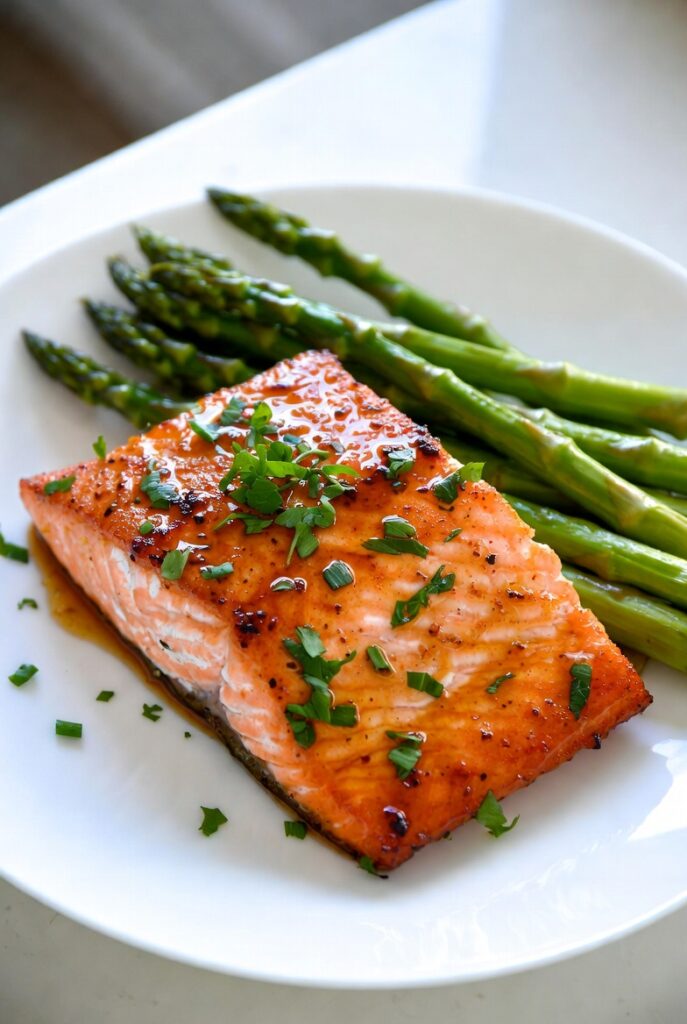
The Honey-Glazed Salmon with Asparagus is more than a recipe; it is a “Vessel for Biological Recovery.” It proves that “Gourmet Results” can be achieved through “Synchronous Thermal Planning.” By mastering the “Glucose-Protein Lacquer” and the “Broil-Finish,” you are delivering a dish that is visually “Glistening,” nutritionally dense, and sensorially perfect.
It is the ultimate “Anchor Meal”—a “Mahogany-Glazed” testament to the power of precision timing and high-quality ingredient pairing.