1. Introduction: The Architecture of the “Botanical-Saline” Synergy
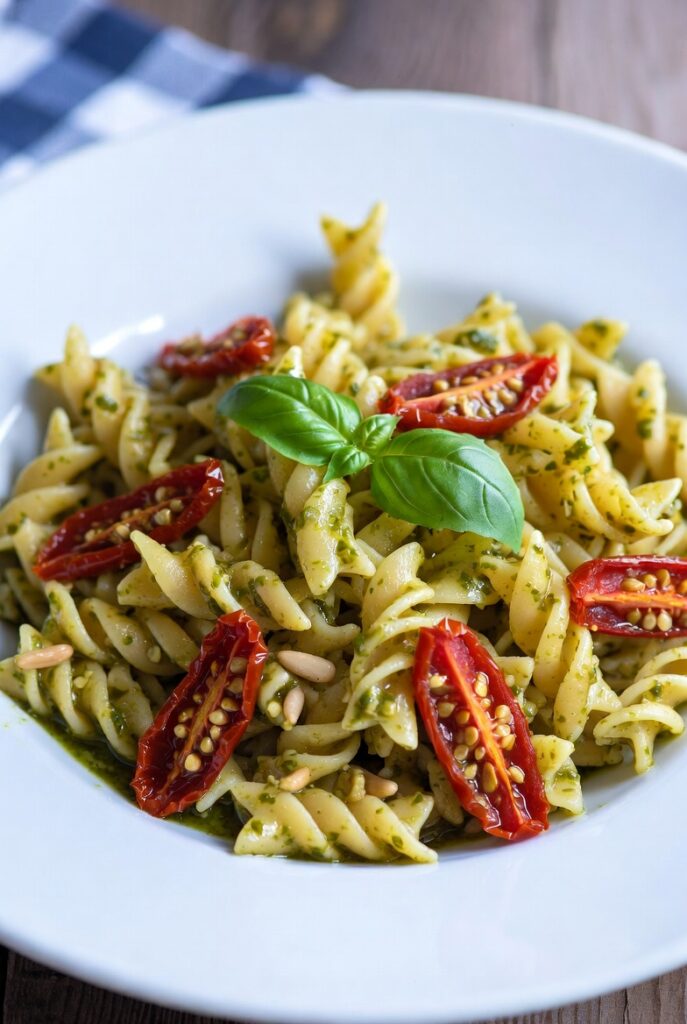
In the global lexicon of Mediterranean comfort, Pesto Pasta with Sun-Dried Tomatoes stands as a masterful study in “Aromatic Contrast.“ This dish is not merely a combination of starch and sauce; it is a sophisticated “Flavor Draft” that pits the cool, herbaceous vitality of fresh basil against the intense, concentrated acidity of sun-dried fruit. While traditional Pesto alla Genovese relies on the delicate balance of pine nuts and Pecorino, the addition of sun-dried tomatoes introduces a “Secondary Umami Layer” that transforms the dish from a light summer staple into a robust, year-round powerhouse.
The brilliance of this dish lies in its “Emulsion Stability.” By leveraging the residual starch water of the pasta and the natural lipids in the pesto, we create a “High-Gloss Coating” that encapsulates every strand of pasta. For the modern professional or the culinary strategist, this is the “Maximum Efficiency Luxury”: it requires zero “active cooking” for the sauce itself, utilizing the latent heat of the pasta to bloom the aromatics. It is the “Platinum Standard” for high-impact dining with low-intervention logistics.
2. The Science of “Volatile Lipid” Infusion
To master this dish, one must look beyond the jar and understand the behavior of Linalool and Esters. Basil is rich in linalool, a terpene alcohol that provides its characteristic floral and spicy aroma. However, linalool is highly volatile and sensitive to heat.
The secret to a “Master Draft” result is “Thermal Modulation.” If you toss pesto into a pan over high heat, the basil molecules oxidize, turning the sauce from a vibrant “Jade Green” to a dull, bitter brown. Instead, we utilize “Latent-Heat Integration”—adding the pesto only after the pasta has been removed from the primary heat source. This allows the residual thermal energy of the starch ($80^\circ C$ to $90^\circ C$) to soften the cheeses and release the basil’s oils without destroying the delicate “Chlorophyll Structure.” This is “Molecular Preservation” disguised as a simple toss.
3. Recipe Overview: The Master Blueprint
- Cuisine Type: Modern Mediterranean / High-Velocity Gourmet
- Difficulty Level: Easy (Focus on “Emulsion Management”)
- Total Preparation Time: 15 Minutes (Includes Pesto construction)
- Total Cooking Time: 10 Minutes (Pasta duration)
- Total Time: 25 Minutes
- Dietary Classifications: Vegetarian. (Can be made Vegan with nutritional yeast).
- Yield: Serves 4
4. Equipment and Tools: The Essentials of “Mechanical Friction”
- Large Stockpot: For achieving the “Starch-to-Water Ratio” required for the emulsion.
- Mortar and Pestle or Food Processor: A mortar and pestle provides “Superior Fragmentation” of basil cells, but a food processor is the “Efficiency Choice.”
- Microplane: For achieving a “Snow-Like” consistency of Parmesan, which melts instantly into the sauce.
5. Ingredients Section: Sourcing for “High-Resolution” Flavor
In a raw-sauce dish, the quality of the “Base Lipids” determines the final “Aromatic Ceiling.”
The Starch Anchor
- Fusilli or Trofie Pasta: 1 lb. The “Corkscrew Geometry” is scientifically superior for “Sauce Retention,” as it creates pockets for the sun-dried tomatoes and pine nuts to nestle.
The “Jade Matrix” (The Pesto)
- Fresh Basil Leaves: 2 cups, packed. (The “Aromatic Foundation”).
- Extra Virgin Olive Oil: 1/2 cup. (The “Lipid Carrier”). Use a “Robust” oil for pepperiness or “Buttery” for smoothness.
- Pine Nuts: 1/4 cup. (The “Creamy Lipid”). Toasted for “Pyrolytic Depth.”
- Parmigiano-Reggiano: 1/2 cup, freshly grated. (The “Crystalline Salt”).
- Garlic: 2 cloves. (The “Allicin Kick”).
The “Acidic Counterpoint”
- Sun-Dried Tomatoes (Oil-Packed): 1/2 cup, julienned.
- Red Pepper Flakes: 1/2 tsp. (The “Capsaicin Spark”).
- Lemon Zest: 1 tsp. (The “High-Note Brightener”).
6. The “Starch-Water” Mandate: The Secret to the Gloss
The number one failure in home pesto pasta is “Clumping.” This happens when the cheese in the pesto hits the hot pasta and seizes into rubbery knots. To achieve a “Master Draft” finish, you must utilize the “Starch-Water Mandate.”
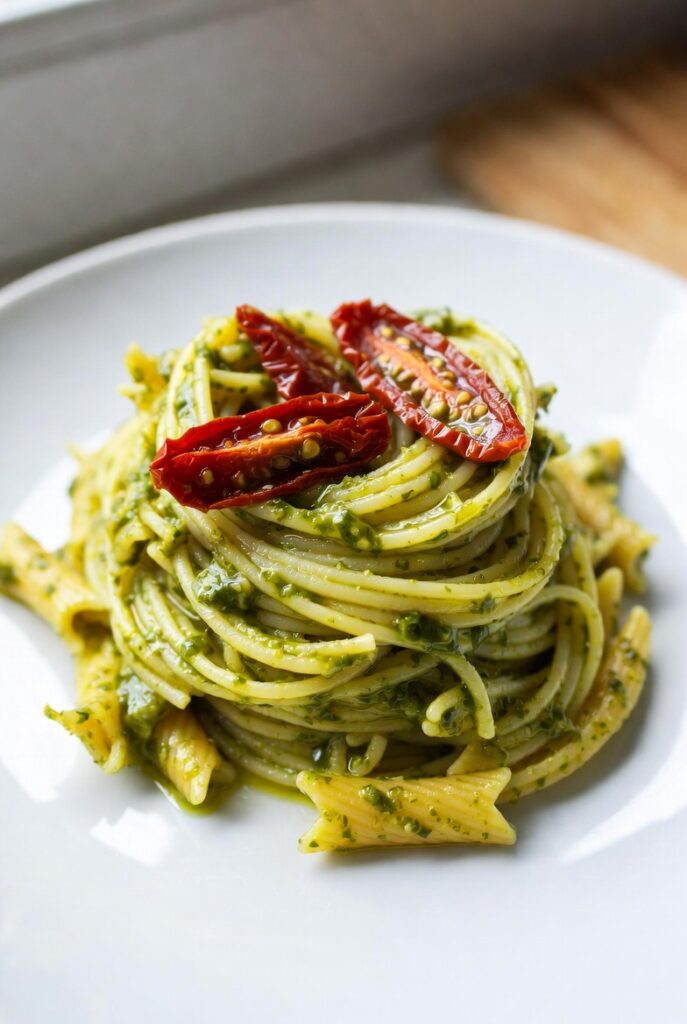
Before draining your pasta, reserve 1 full cup of the cloudy pasta water. This liquid is a “Natural Emulsifier” filled with dissolved amylose. When whisked with the pesto, the starch acts as a “Buffer,” surrounding the fat molecules and preventing them from separating. This results in a “Silk-Satin Veneer” that coats the pasta uniformly, creating a restaurant-tier mouthfeel that is impossible to achieve with oil alone.
7. Deep Dive: Lycopene and the “Bioavailability Bridge”
Why is the addition of Sun-Dried Tomatoes a strategic nutritional move? It centers on Lycopene Concentration. Sun-drying tomatoes involves the removal of water, which concentrates the antioxidant lycopene. Lycopene is a powerful carotenoid that supports cardiovascular health and skin protection.
However, lycopene is fat-soluble. By pairing the concentrated tomatoes with the high-quality lipids of the olive oil and pine nuts in the pesto, you are creating a “Bioavailability Bridge.” The fats facilitate the absorption of the lycopene into the bloodstream. This is “Nutritional Synergy”—where the culinary pairing actually increases the “Biological Utility” of the meal.
8. Step-by-Step Instructions: The Master Blueprint
Step 1: The “Pyrolytic Toast”
Place the pine nuts in a dry pan over medium heat for 2–3 minutes. Toss constantly until they are golden and “Fragrant.” This “Maillard Browning” of the nuts is essential for the nutty baseline of the pesto.
Step 2: The “Jade Matrix” Construction
In a food processor, pulse the garlic and toasted pine nuts until a coarse paste forms. Add the basil, Parmesan, and a pinch of salt. While pulsing, slowly “stream in” the olive oil.Pro-Tip: Pulse, do not blend. Over-processing generates heat, which oxidizes the basil and turns it brown.
Step 3: The Starch Integration
Boil the pasta in “Sea-Level Salty” water until it reaches Al Dente (usually 1 minute less than the package instructions). The pasta should have a “Structural Snap.”
Step 4: The “Mandate” Collection
Crucial: Before draining, dip a measuring cup into the pot and save 1 cup of the pasta water. Drain the pasta but do not rinse it—the surface starch is your “Glue.”
Step 5: The “Latent-Heat” Fold
Return the pasta to the pot (off the heat). Add the sun-dried tomatoes and the pesto. Pour in 1/4 cup of the reserved pasta water. Use tongs to “Vigorously Emulsify” the mixture. Add more water as needed until the sauce is creamy and “Glistening.”
Step 6: The Final Polish
Fold in the lemon zest and red pepper flakes. Top with extra Parmesan and a drizzle of raw olive oil. Serve immediately.
9. Satiety and the “Phytochemical Energy” Curve
Pesto Pasta with Sun-Dried Tomatoes provides a “Stable Satiety Curve.” While pasta is a carbohydrate, the “High-Resolution” fats from the olive oil and nuts, combined with the fiber from the sun-dried tomatoes, effectively lower the Glycemic Load of the meal.
The fats trigger the release of Cholecystokinin (CCK), the hormone that signals the brain to stop eating. Unlike a simple tomato sauce pasta, which can lead to a “Glucose Spike” and subsequent hunger, the Pesto Draft provides a sustained release of energy. It is an “Elite Fuel” for mental clarity and long-form endurance.
10. Modular Customization: The “Regional” Pivots
- The “Sicilian” Draft: Add 2 tbsp of toasted breadcrumbs (mollica) on top for a “Textural Crunch.”
- The “Protein” Fortification: Add grilled chicken strips or sautéed shrimp to increase the “Amino Acid Profile.”
- The “Vegan” Standard: Replace Parmesan with nutritional yeast and a dash of white miso for a “Fermented Umami” kick.
11. Storage and the “Oxidation Guard”
- Refrigeration: Store in an airtight container for up to 2 days.
- The “Surface-Seal” Hack: Before closing the container, pour a thin layer of olive oil over the top of the pasta. This creates a “Physical Barrier” against oxygen, preventing the basil from turning brown.
- The Reheat: Pesto does not like microwaves. To reheat, place in a skillet over very low heat and add a splash of water to “re-emulsify” the fats.
12. Frequently Asked Questions (FAQ)
Q: Why did my pesto turn brown? A: Oxidation or heat. Either the food processor blades got too hot, or the pesto sat exposed to air for too long. Adding a teaspoon of lemon juice to the pesto can help act as an “Antioxidant Shield.”
Q: Can I use sun-dried tomatoes not packed in oil? A: Yes, but you must “Re-Hydrate” them in boiling water for 5 minutes first. Otherwise, they will be “Leathery” and difficult to masticate.
Q: Is store-bought pesto acceptable? A: It is a “Utility Substitute,” but most commercial pestos use sunflower oil and potato starch as fillers. For a “Master Draft” result, fresh-made pesto is the only path.
13. Nutritional Information
(Per serving – approx. 1.5 cups)
| Nutrient | Amount |
| Calories | 580 kcal |
| Protein | 14g |
| Total Fat | 32g |
| Net Carbs | 56g |
| Fiber | 6g |
| Vitamin A | 25% DV |
14. Summary: The Master Draft of Social Utility
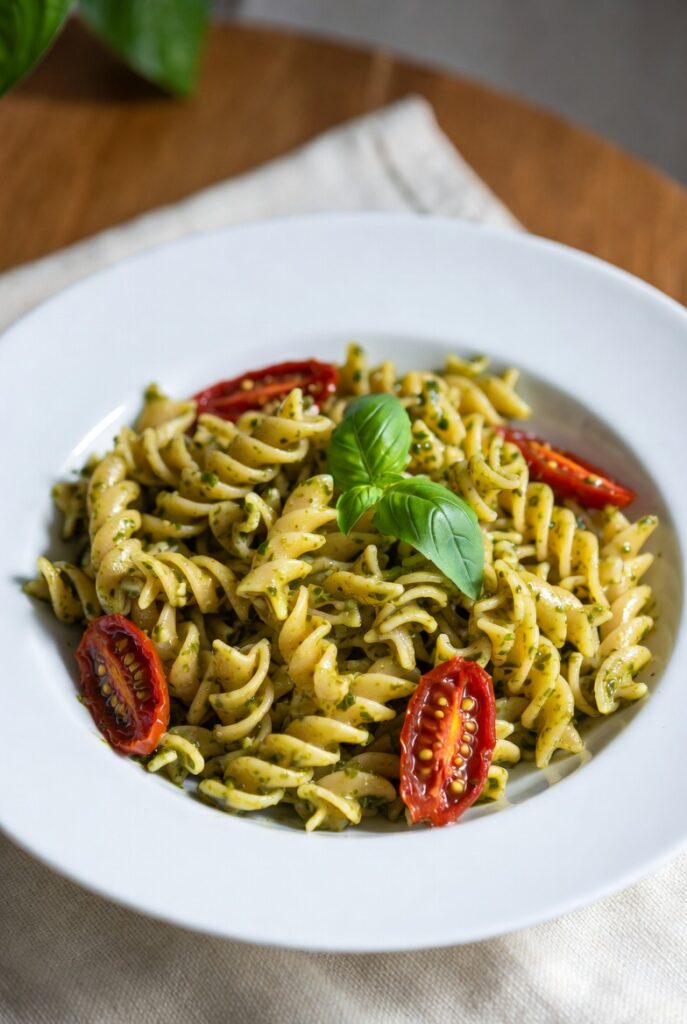
The Pesto Pasta with Sun-Dried Tomatoes is more than a recipe; it is a “Vessel for Sensory Clarity.” It proves that the most “Vibrant” flavors in the Mediterranean repertoire can be distilled into a 25-minute window through the mastery of “Latent Heat” and “Starch Emulsification.” By respecting the volatile nature of the basil and the concentrated acidity of the tomatoes, you are delivering a dish that is biologically satisfying, visually “Jade-Glistening,” and sensorially perfect.