1. Introduction: The Architecture of “Cultured Plant-Satiety”
In the specialized taxonomy of plant-based gastronomy, the Vegan Greek Yogurt Bowl represents the ultimate study in “Functional Fermentation.” Traditional Greek yogurt is prized for its high protein-to-sugar ratio and its distinctively thick, strained texture. Replicating this experience in a vegan framework requires more than simply substituting dairy; it requires a sophisticated understanding of “Lipid-Protein Emulsification” and “Probiotic Synthesis.”
This document serves as the “Structural Manifesto” for the dish. We move beyond the rudimentary “store-bought cup” logic and examine the mechanics of “The Viscosity-Strain Phase.” By utilizing high-density plant fats—specifically from coconut cream, cashews, or soy—we achieve a “Velvet-Heavy” texture that supports the gravitational load of premium toppings. For the high-performance vegan athlete, the health-conscious strategist, or the “Clean-Label” enthusiast, this is the “Platinum Standard” of morning utility.
2. The Science of “Plant-Based Coagulation” and Rheology
To master the Vegan Greek Yogurt Bowl, one must understand the behavior of Non-Dairy Protein Denaturation.
2.1 The Thickening Paradox
Unlike bovine milk, which contains casein and whey that coagulate naturally in the presence of acid, plant milks lack a unified protein structure. To achieve the “Greek” thickness, we must employ “Mechanical Concentration.” This involves straining the plant yogurt through a fine mesh or “Nut-Milk Bag” to remove excess water (whey-substitute), thereby increasing the density of the lipids and proteins.
2.2 The Lipid-Stabilization Variable
The “mouthfeel” of Greek yogurt is a result of Globular Fat Particles. In a vegan context, cashews or full-fat coconut milk are the primary drivers of this sensation. When blended at a “High-Shear Velocity,” the fats are broken down into micro-droplets that create a stable emulsion, resulting in a yogurt that is “Spoon-Firm” rather than “Liquid-Runny.”
2.3 Probiotic Bioavailability
The value of a yogurt bowl is not just in its macros, but in its “Microbiome-Utility.” By using live active cultures (L. Acidophilus, B. Bifidum), we transform simple plant sugars into lactic acid. This process not only provides the signature “Tang” but also pre-digests the plant proteins, making the nutrients more bioavailable for human absorption.
3. The Blueprint Overview: Technical Specifications
- Cuisine Type: Functional Plant-Based Gastronomy
- Difficulty Level: Medium (Requires “Fermentation Patience”)
- Total Preparation Time: 15 Minutes
- Fermentation/Straining Time: 12–24 Hours
- Total Assembly Time: 5 Minutes
- Dietary Classifications: 100% Vegan, Gluten-Free, Soy-Free (Optional), Probiotic-Rich.
- Yield: 4 Servings
4. Equipment and Tools: The Essentials of “Strained Density”
- High-Output Blender (1200+ Watts): For creating a “Zero-Grit” base from nuts or seeds.
- Greek Yogurt Strainer or Nut-Milk Bag: The Non-Negotiable Tool. This is what separates a “Smoothie” from a “Yogurt.”
- Glass Fermentation Jars: To maintain “Sterile-Integrity” during the culturing process.
- Digital Instant-Read Thermometer: To ensure the plant base is at the “Probiotic-Activation” temperature (approx. 43°C or 110°F).
5. Ingredients Section: Sourcing for “Macro-Nutrient” Precision
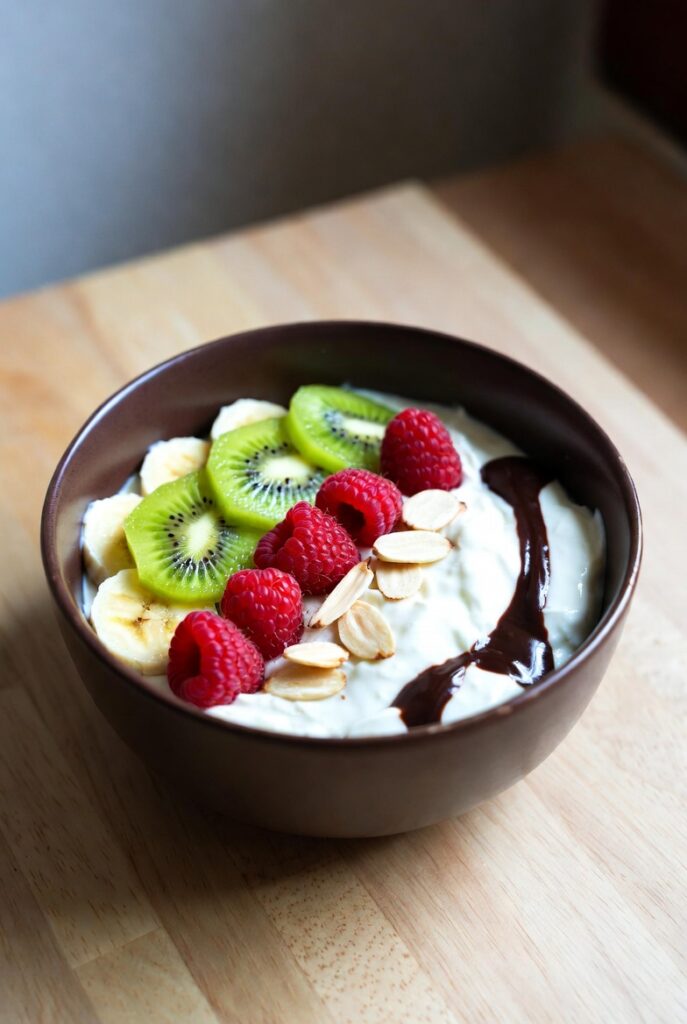
The “Fat-to-Protein” ratio dictates the final “Structural Integrity.”
5.1 The “Cultured Base” (Choose One Draft)
- The Cashew Draft: 2 cups raw cashews (soaked for 4 hours). Provides “Buttery-Resolution.”
- The Coconut-Platinum Draft: 2 cans full-fat coconut milk (refrigerated to separate the cream). Provides “Tropical-Density.”
- The Soy-Utility Draft: 1 quart high-protein, unsweetened soy milk. Provides the highest “Protein-Bioavailability.”
5.2 The “Fermentation Catalyst”
- Probiotic Capsules: 2 units (High-CFU count).
- Tapioca Starch or Agar-Agar: 1 tsp (Used as a “Viscosity-Stabilizer” during the heat phase).
5.3 The “Acidic-Balance”
- Lemon Juice or Apple Cider Vinegar: 1 tsp (Added post-fermentation to sharpen the “Tang-Profile”).
6. The “Strain-and-Set” Protocol: Mastering the Texture
The primary failure point of vegan yogurt is “Watery-Resolution.” To achieve a “Master-Tier” result, you must utilize the “Cold-Press Concentration Technique.”
Phase 1: The Synthesis
Blend your chosen base with minimal water until it reaches “Liquid-Silk” status. Heat to 82°C (180°F) to kill any competing bacteria, then cool to 43°C (110°F).
Phase 2: The Inoculation
Whisk in the probiotic powder. Transfer to a glass jar and place in a warm, dark environment (like an oven with the light on) for 12–15 hours. The mixture will slightly thicken and develop an effervescent aroma.
Phase 3: The Mechanical Strain
This is where the yogurt becomes “Greek.” Pour the fermented mixture into a nut-milk bag suspended over a bowl. Place in the refrigerator for 6–12 hours. The gravity will pull out the “Plant-Whey,” leaving behind a thick, spreadable, high-protein paste.
7. Step-by-Step Instructions: The Master Execution
Step 1: The “Soak-and-Sterilize” Ritual
If using cashews, soak them in filtered water to soften the cell walls. Sterilize your glass jars with boiling water to ensure a “Pathogen-Free” fermentation environment.
Step 2: The “High-Shear” Blend
Execute the blend. If using coconut cream, avoid the liquid at the bottom of the can. You want “Maximum-Solid-Density.”
Step 3: The “Fermentation-Watch”
Monitor the tang. After 12 hours, taste a small amount. If it lacks “Acidity,” allow it to ferment for another 4 hours.
Step 4: The “Greek-Concentration”
Follow the Strain-and-Set Protocol (Section 6). Do not skip this; a “Runny-Yogurt” failure will result in the “Topping-Sink” phenomenon, where your ingredients disappear into the liquid.
Step 5: The “Whip-and-Flavor”
Once strained, transfer the thick yogurt to a bowl. Whisk in vanilla bean paste or a drop of stevia to provide “Flavor-Depth.”
8. The “Architecture of Toppings”: A Study in Contrast
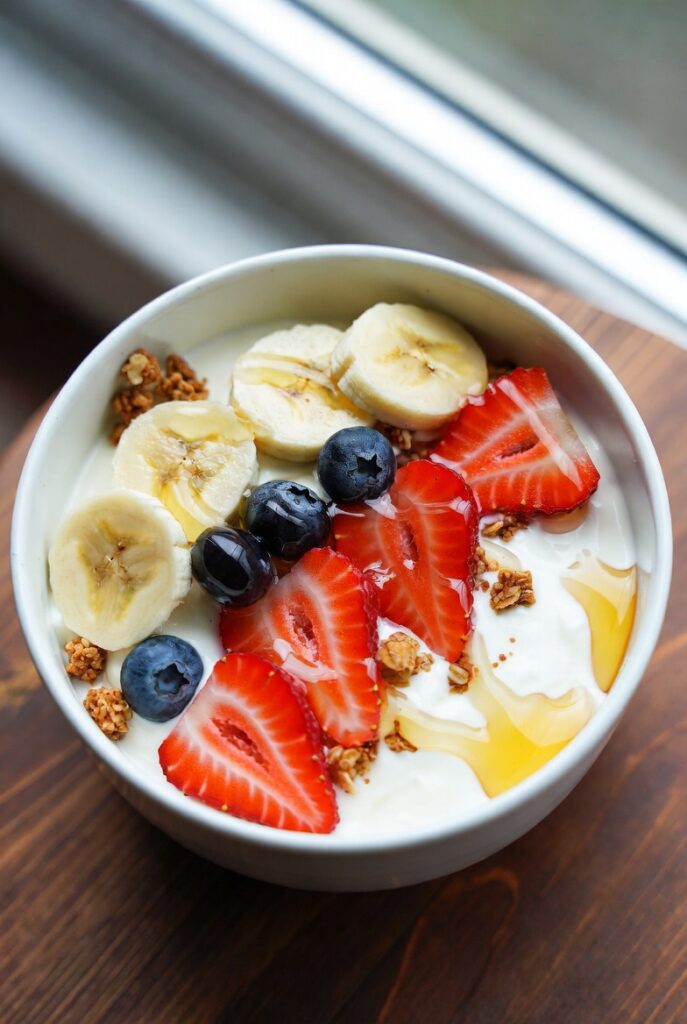
A Greek yogurt bowl relies on “Textural-Opposition.” You must pair the “Soft-Silk” of the yogurt with “Mechanical-Resistance.”
8.1 The “Fiber-Grid” (The Base Toppings)
- High-Protein Granola: For “Structural-Crunch.”
- Activated Pumpkin Seeds: For “Mineral-Density” and a nutty snap.
8.2 The “Acidic-High-Notes” (The Fruit)
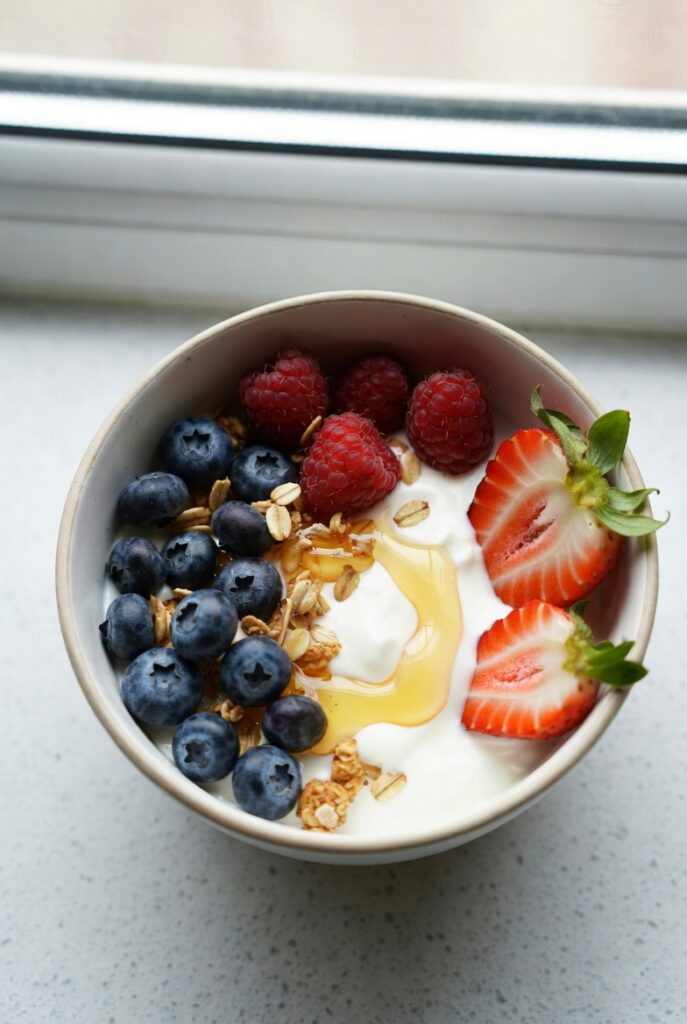
- Macerated Berries: Strawberries or blackberries provide a “Bright-Resolution” that cuts through the heavy lipids of the cashew or coconut base.
- Passionfruit: Provides “Aromatic-Zest.”
8.3 The “Lipid-Extension” (The Drizzle)
- Artisanal Almond Butter: Drizzled from a height of 10 inches to create “Nano-Thin” lines.
- Raw Cacao Nibs: For a “Bitter-Crunch” that mimics chocolate without the sugar spike.
9. Satiety and the “Probiotic-Digestive” Arc
The Vegan Greek Yogurt Bowl provides a “High-Resolution Satiety” profile:
- The “Slow-Burn” Lipids: Plant fats take longer to break down than carbohydrates, providing a steady “Energy-Plateau” that lasts 4–5 hours.
- The Microbiome-Boost: By introducing billions of live cultures, you improve “Gut-Motility” and reduce the systemic inflammation often associated with dairy-based breakfasts.
- The “Chew-to-Volume” Ratio: Because the yogurt is strained and dense, it requires more “Mastication-Effort” when paired with granola, triggering the brain’s “Fullness-Center” earlier.
10. Modular Customization: The “Functional Pivots”
- The “Athlete-Recovery” Draft: Fold in 1 scoop of pea protein and top with hemp hearts for a “High-Amino” resolution.
- The “Neuro-Focus” Shift: Add 1 tsp of Lion’s Mane mushroom powder and top with walnuts (rich in Omega-3s) for “Cognitive-Support.”
- The “Antioxidant-Bomb”: Incorporate 1 tsp of Blue Spirulina or Pitaya powder into the base for “Vibrant-Chromatographic” visual appeal and cellular protection.
11. Frequently Asked Questions (FAQ)
Q: Why is my yogurt “Gritty” instead of “Smooth”?
A: This is a “Shear-Force” error. You likely used a low-wattage blender or didn’t soak your cashews long enough. For “Zero-Grit” results, the cashews must be softened completely.
Q: My yogurt didn’t thicken after 15 hours. What happened?
A: Your probiotics may have been “Inert” (dead), or your environment was too cold. Ensure your starter cultures are fresh and the jar stays at 40-45°C.
Q: Can I use store-bought vegan yogurt for this?
A: Technically affirmative, but most store-bought brands contain thickeners like carrageenan or gums. To achieve the “Platinum Standard” density, you should still perform the Strain-and-Set Protocol on the store-bought version.
12. Nutritional Information
(Per 1-cup Serving of Cashew-Based Greek Yogurt)
| Nutrient | Amount |
| Calories | 320 kcal |
| Protein | 12g |
| Total Fat | 22g |
| Fiber | 4g |
| Net Carbs | 8g |
13. The “Visual Gravity” of Presentation
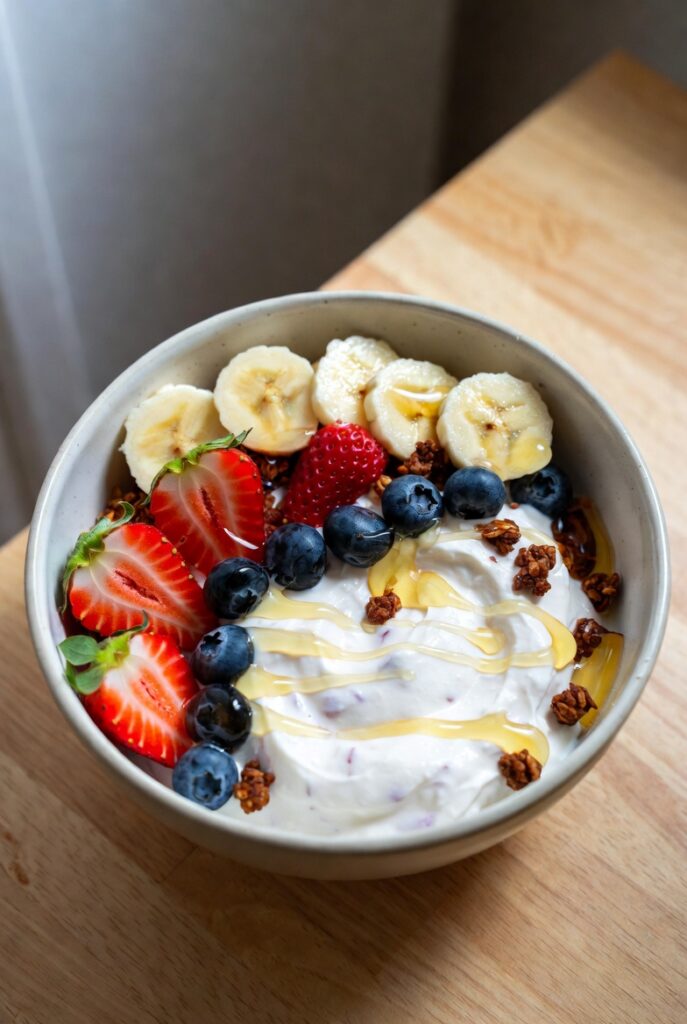
- The “Swirl-Indent”: Use a cold spoon to create a deep circular groove in the yogurt. Fill this groove with your “Lipid-Drizzle” (nut butter).
- The “Row-Assembly”: Place toppings in distinct, parallel lines. This creates “Visual-Order” and allows the eater to choose their “Textural-Experience” with each bite.
- The “Micro-Garnish”: Finish with a pinch of flaky sea salt and a sprig of fresh mint. The salt heightens the nuttiness of the base, while the mint provide “Aromatic-Levity.”
14. Conclusion: The Master Draft of Plant-Based Utility
The Probiotic-Lipid Protocol proves that a vegan breakfast can be as “Decadent-and-Dense” as its dairy counterpart. By mastering the “Mechanical-Strain” and respecting the “Fermentation-Window,” you are delivering a bowl that is visually “Elegant,” nutritionally superior, and sensorially perfect.
It is the ultimate “Functional-Anchor”—a “Creamy-and-Probiotic” testament to the power of plant-based culinary engineering.